
基于特征分解与核判别分析(KDA)组合的分类算法在自动磁共振脑图像分类与 AD 诊断中的应用。
A Classification Algorithm by Combination of Feature Decomposition and Kernel Discriminant Analysis (KDA) for Automatic MR Brain Image Classification and AD Diagnosis.
机构信息
Department of Instrument Science and Engineering, School of SEIEE, Shanghai Jiao Tong University, Shanghai 200240, China.
出版信息
Comput Math Methods Med. 2019 Dec 30;2019:1437123. doi: 10.1155/2019/1437123. eCollection 2019.
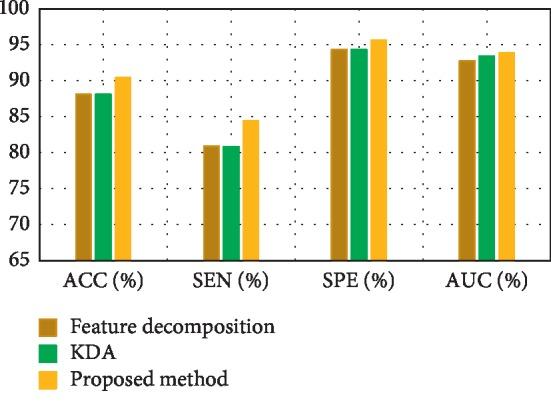
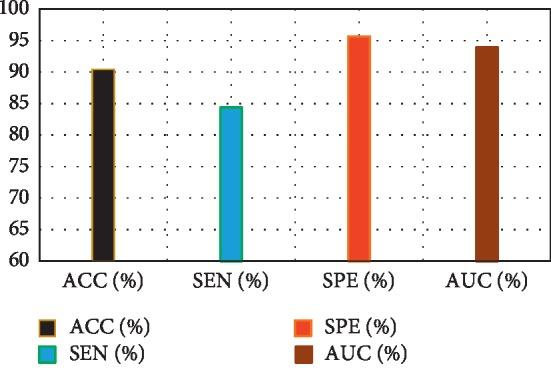
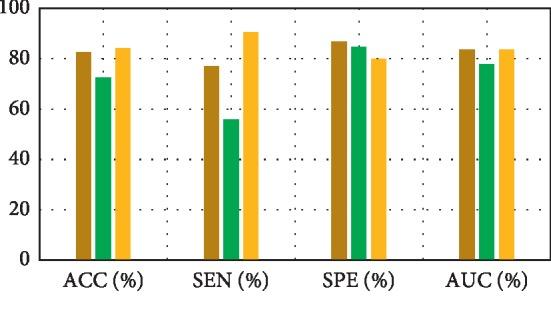
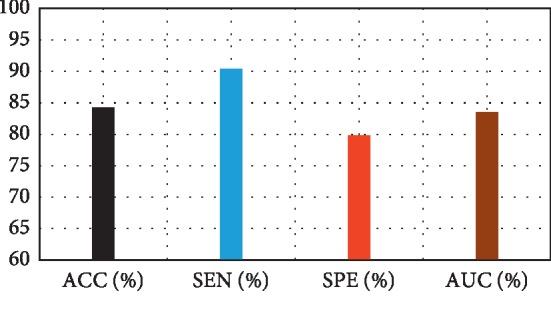
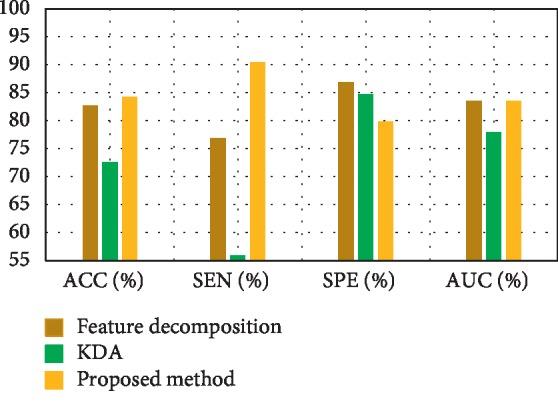
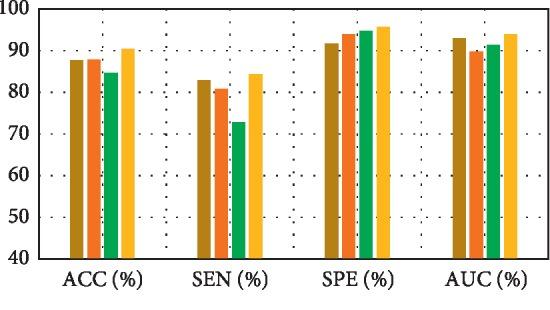
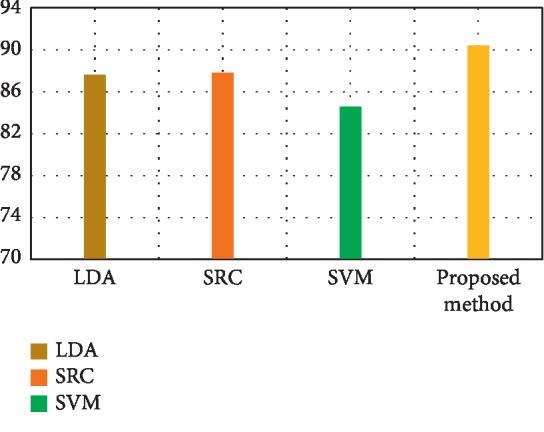
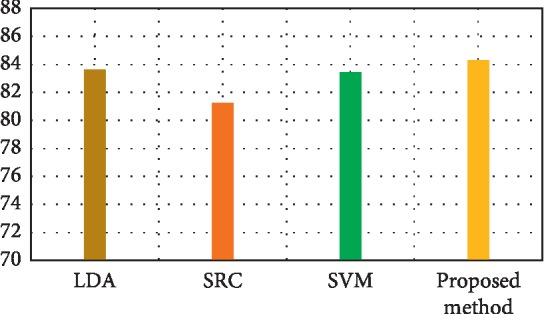
Magnetic resonance (MR) imaging is a widely used imaging modality for detection of brain anatomical variations caused by brain diseases such as Alzheimer's disease (AD) and mild cognitive impairment (MCI). AD considered as an irreversible neurodegenerative disorder with progressive memory impairment moreover cognitive functions, while MCI would be considered as a transitional phase amongst age-related cognitive weakening. Numerous machine learning approaches have been examined, aiming at AD computer-aided diagnosis through employing MR image analysis. Conversely, MR brain image changes could be caused by different effects such as aging and dementia. It is still a challenging difficulty to extract the relevant imaging features and classify the subjects of different groups. This paper would propose an automatic classification technique based on feature decomposition and kernel discriminant analysis (KDA) for classifications of progressive MCI (pMCI) vs. normal control (NC), AD vs. NC, and pMCI vs. stable MCI (sMCI). Feature decomposition would be based on dictionary learning, which is used for separation of class-specific components from the non-class-specific components in the features, while KDA would be applied for mapping original nonlinearly separable feature space to the separable features that are linear. The proposed technique would be evaluated by employing T1-weighted MR brain images from 830 subjects comprising 198 AD patients, 167 pMCI, 236 sMCI, and 229 NC from the Alzheimer's disease neuroimaging initiative (ADNI) dataset. Experimental results demonstrate that classification accuracy (ACC) of 90.41%, 84.29%, and 65.94% can be achieved for classification of AD vs. NC, pMCI vs. NC, and pMCI vs. sMCI, respectively, indicating the promising performance of the proposed method.
磁共振(MR)成像是一种广泛使用的成像方式,可用于检测由阿尔茨海默病(AD)和轻度认知障碍(MCI)等脑部疾病引起的脑解剖变异。AD 被认为是一种不可逆转的神经退行性疾病,伴有进行性记忆障碍和认知功能障碍,而 MCI 则被认为是与年龄相关的认知减弱之间的过渡阶段。已经研究了许多机器学习方法,旨在通过分析 MR 图像辅助 AD 的计算机诊断。相反,MR 脑图像的变化可能是由衰老和痴呆等不同影响引起的。提取相关的成像特征并对不同组的受试者进行分类仍然是一个具有挑战性的难题。本文提出了一种基于特征分解和核判别分析(KDA)的自动分类技术,用于对进展性 MCI(pMCI)与正常对照组(NC)、AD 与 NC 以及 pMCI 与稳定 MCI(sMCI)进行分类。特征分解将基于字典学习,用于从特征中的类特定分量和非类特定分量中分离出类特定分量,而 KDA 将用于将原始非线性可分特征空间映射到可分的线性特征。该技术将通过使用来自阿尔茨海默病神经影像学倡议(ADNI)数据集的 830 名受试者的 T1 加权 MR 脑图像进行评估,其中包括 198 名 AD 患者、167 名 pMCI、236 名 sMCI 和 229 名 NC。实验结果表明,对于 AD 与 NC、pMCI 与 NC 以及 pMCI 与 sMCI 的分类,分类准确率(ACC)分别可以达到 90.41%、84.29%和 65.94%,表明该方法具有良好的性能。



 Zotero 插件