
斑点诱导吞噬体内的细胞内毒力程序。
SpoT Induces Intracellular Virulence Programs in the Phagosome.
机构信息
University of Colorado School of Medicine, Department of Immunology and Microbiology, Aurora, Colorado, USA.
University of California Irvine, School of Medicine, Department of Microbiology and Molecular Genetics, Irvine, California, USA.
出版信息
mBio. 2020 Feb 25;11(1):e03397-19. doi: 10.1128/mBio.03397-19.
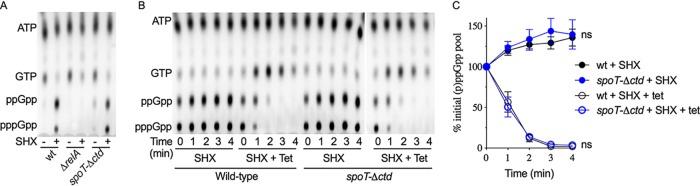
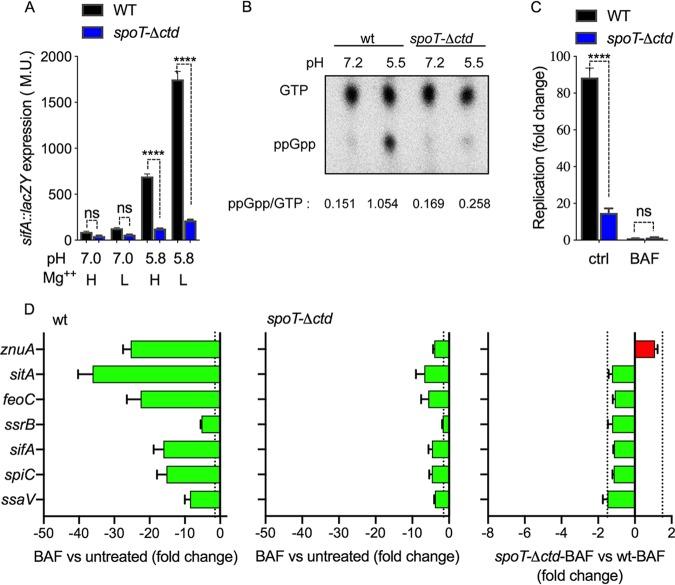
Guanosine tetraphosphate (ppGpp) and guanosine pentaphosphate (pppGpp), together named (p)ppGpp, regulate diverse aspects of pathogenesis, including synthesis of nutrients, resistance to inflammatory mediators, and expression of secretion systems. In , these nucleotide alarmones are generated by the synthetase activities of RelA and SpoT proteins. In addition, the (p)ppGpp hydrolase activity of the bifunctional SpoT protein is essential to preserve cell viability. The contribution of SpoT to physiology and pathogenesis has proven elusive in organisms such as , because the hydrolytic activity of this elA and poT omologue (RSH) is vital to prevent inhibitory effects of (p)ppGpp produced by a functional RelA. Here, we describe the biochemical and functional characterization of a -Δ mutant strain encoding a SpoT protein that lacks the C-terminal regulatory elements collectively referred to as "ctd." expressing the -Δ variant hydrolyzes (p)ppGpp with similar kinetics to those of wild-type bacteria, but it is defective at synthesizing (p)ppGpp in response to acidic pH. -Δ mutants have virtually normal adaptations to nutritional, nitrosative, and oxidative stresses, but poorly induce metal cation uptake systems and pathogenicity island 2 (SPI-2) genes in response to the acidic pH of the phagosome. Importantly, -Δ mutant replicates poorly intracellularly and is attenuated in a murine model of acute salmonellosis. Collectively, these investigations indicate that (p)ppGpp synthesized by SpoT serves a unique function in the adaptation of to the intracellular environment of host phagocytes that cannot be compensated by the presence of a functional RelA. Pathogenic bacteria experience nutritional challenges during colonization and infection of mammalian hosts. Binding of the alarmone nucleotide guanosine tetraphosphate (ppGpp) to RNA polymerase coordinates metabolic adaptations and virulence gene transcription, increasing the fitness of diverse Gram-positive and Gram-negative bacteria as well as that of actinomycetes. Gammaproteobacteria such as synthesize ppGpp by the combined activities of the closely related RelA and SpoT synthetases. Due to its profound inhibitory effects on growth, ppGpp must be removed; in , this process is catalyzed by the vital hydrolytic activity of the bifunctional SpoT protein. Because SpoT hydrolase activity is essential in cells expressing a functional RelA, we have a very limited understanding of unique roles these two synthetases may assume during interactions of bacterial pathogens with their hosts. We describe here a SpoT truncation mutant that lacks ppGpp synthetase activity and all C-terminal regulatory domains but retains excellent hydrolase activity. Our studies of this mutant reveal that SpoT uniquely senses the acidification of phagosomes, inducing virulence programs that increase fitness in an acute model of infection. Our investigations indicate that the coexistence of RelA/SpoT homologues in a bacterial cell is driven by the need to mount a stringent response to a myriad of physiological and host-specific signatures.
鸟苷四磷酸(ppGpp)和鸟苷五磷酸(pppGpp),统称为(p)ppGpp,调节发病机制的多个方面,包括营养物质的合成、对炎症介质的抵抗力和分泌系统的表达。在 ,这些核苷酸警报素是由 RelA 和 SpoT 蛋白的合成酶活性产生的。此外,双功能 SpoT 蛋白的(p)ppGpp 水解酶活性对于维持细胞活力至关重要。在 等生物体中,SpoT 对生理学和发病机制的贡献一直难以捉摸,因为这种 ElA 和 poT 同源物(RSH)的水解活性对于防止功能性 RelA 产生的(p)ppGpp 的抑制作用至关重要。在这里,我们描述了编码缺乏统称为“ctd”的 C 端调节元件的 SpoT 蛋白的 -Δ 突变体 株的生化和功能特征。表达 -Δ 变体的细菌以与野生型细菌相似的动力学水解(p)ppGpp,但在响应酸性 pH 时合成(p)ppGpp 存在缺陷。-Δ 突变体对营养、硝化和氧化应激的适应几乎正常,但在响应吞噬体的酸性 pH 时,金属阳离子摄取系统和致病岛 2(SPI-2)基因的诱导能力较差。重要的是,-Δ 突变体在体内复制不良,并且在急性沙门氏菌病的小鼠模型中减弱。总的来说,这些研究表明,SpoT 合成的(p)ppGpp 在 适应宿主吞噬细胞的细胞内环境方面发挥着独特的作用,而这种作用不能被功能性 RelA 的存在所补偿。在定殖和感染哺乳动物宿主期间,致病性细菌会经历营养挑战。警报核苷酸鸟苷四磷酸(ppGpp)与 RNA 聚合酶结合可协调代谢适应和毒力基因转录,增加各种革兰氏阳性和革兰氏阴性细菌以及放线菌的适应性。γ-变形菌如 通过密切相关的 RelA 和 SpoT 合成酶的联合活性合成 ppGpp。由于其对生长的深远抑制作用,ppGpp 必须被去除;在 ,这个过程是由双功能 SpoT 蛋白的关键水解活性催化的。由于 SpoT 水解酶活性在表达功能性 RelA 的细胞中是必不可少的,因此我们对这两种合成酶在细菌病原体与宿主相互作用过程中可能承担的独特作用知之甚少。我们在这里描述了一种 SpoT 截断突变体,它缺乏 ppGpp 合成酶活性和所有 C 端调节结构域,但保留了极好的水解酶活性。我们对该突变体的研究表明,SpoT 独特地感知吞噬体的酸化,诱导增加感染急性模型中 适应性的毒力程序。我们的研究表明,RelA/SpoT 同源物在细菌细胞中共存是由对各种生理和宿主特异性特征的严格反应的需要驱动的。





 Zotero 插件