
β-内酰胺酶抑制剂硼酸衍生物SM23作为一种新型抗生物膜剂。
The β-Lactamase Inhibitor Boronic Acid Derivative SM23 as a New Anti- Biofilm.
作者信息
Peppoloni Samuele, Pericolini Eva, Colombari Bruna, Pinetti Diego, Cermelli Claudio, Fini Francesco, Prati Fabio, Caselli Emilia, Blasi Elisabetta
机构信息
Department of Surgical, Medical, Dental and Morphological Sciences With Interest in Transplant, Oncological and Regenerative Medicine, University of Modena and Reggio Emilia, Modena, Italy.
Centro Interdipartimentale "Grandi Strumenti" (CIGS), University of Modena and Reggio Emilia, Modena, Italy.
出版信息
Front Microbiol. 2020 Feb 7;11:35. doi: 10.3389/fmicb.2020.00035. eCollection 2020.
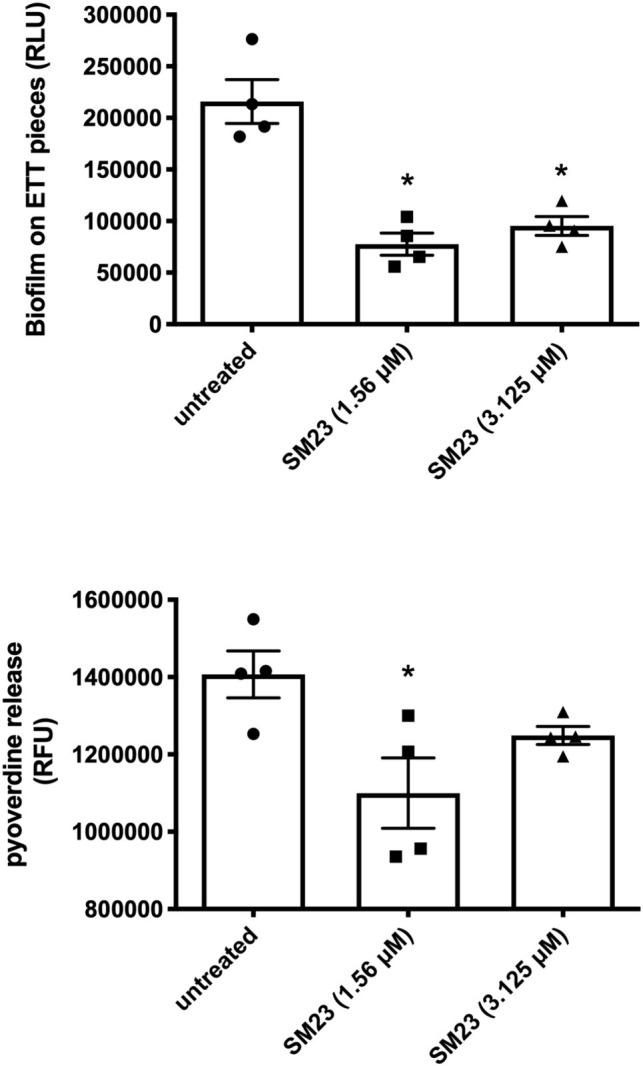
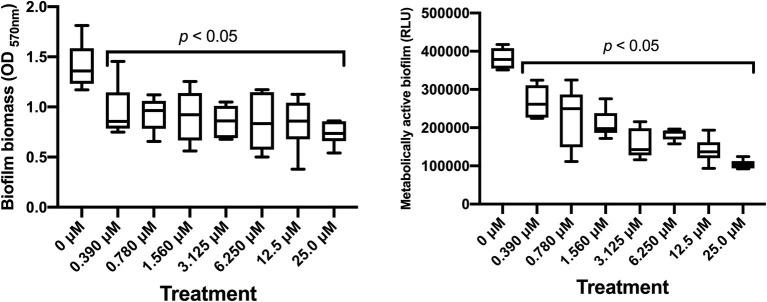
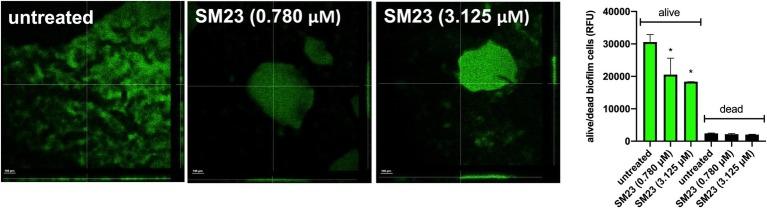
is a Gram-negative nosocomial pathogen, often causative agent of severe device-related infections, given its great capacity to form biofilm. finely regulates the expression of numerous virulence factors, including biofilm production, by Quorum Sensing (QS), a cell-to-cell communication mechanism used by many bacteria. Selective inhibition of QS-controlled pathogenicity without affecting bacterial growth may represent a novel promising strategy to overcome the well-known and widespread drug resistance of . In this study, we investigated the effects of SM23, a boronic acid derivate specifically designed as β-lactamase inhibitor, on biofilm formation and virulence factors production by . Our results indicated that SM23: (1) inhibited biofilm development and production of several virulence factors, such as pyoverdine, elastase, and pyocyanin, without affecting bacterial growth; (2) decreased the levels of 3-oxo-C-HSL and C-HSL, two QS-related autoinducer molecules, in line with a dampened / system; (3) failed to bind to bacterial cells that had been preincubated with conditioned medium; and (4) reduced both biofilm formation and pyoverdine production by onto endotracheal tubes, as assessed by a new model closely mimicking clinical settings. Taken together, our results indicate that, besides inhibiting β-lactamase, SM23 can also act as powerful inhibitor of biofilm, suggesting that it may have a potential application in the prevention and treatment of biofilm-associated infections.
是一种革兰氏阴性医院病原体,由于其形成生物膜的能力很强,常成为严重的与器械相关感染的病原体。通过群体感应(QS)精细调节众多毒力因子的表达,群体感应是许多细菌使用的一种细胞间通讯机制,包括生物膜的产生。在不影响细菌生长的情况下选择性抑制群体感应控制的致病性可能代表一种克服已知且广泛存在的耐药性的新的有前景的策略。在本研究中,我们研究了专门设计作为β-内酰胺酶抑制剂的硼酸衍生物SM23对生物膜形成和毒力因子产生的影响。我们的结果表明,SM23:(1)抑制生物膜形成和几种毒力因子的产生,如绿脓菌素、弹性蛋白酶和绿脓青素,而不影响细菌生长;(2)降低了3-氧代-C-HSL和C-HSL这两种与群体感应相关的自诱导分子的水平,这与/系统的减弱一致;(3)未能与预先用条件培养基预孵育的细菌细胞结合;(4)通过一个紧密模拟临床环境的新模型评估,减少了在气管内导管上的生物膜形成和绿脓菌素产生。综上所述,我们的结果表明,除了抑制β-内酰胺酶外,SM23还可作为强大的生物膜抑制剂,表明它可能在预防和治疗与生物膜相关的感染方面有潜在应用。

 Zotero 插件