
波兰与其他中东欧国家 1990-2017 年疾病负担变化的比较:2017 年全球疾病负担研究的系统分析。
Changes in disease burden in Poland between 1990-2017 in comparison with other Central European countries: A systematic analysis for the Global Burden of Disease Study 2017.
机构信息
Department of Infectious Diseases, Institute of Medical Sciences, Zielona Góra University, Zielona Góra, Poland.
Department of Propedeutics of Internal Diseases, Pomeranian Medical University, Szczecin, Poland.
出版信息
PLoS One. 2020 Mar 2;15(3):e0226766. doi: 10.1371/journal.pone.0226766. eCollection 2020.
BACKGROUND
Systematic collection of mortality/morbidity data over time is crucial for monitoring trends in population health, developing health policies, assessing the impact of health programs. In Poland, a comprehensive analysis describing trends in disease burden for major conditions has never been published. The Global Burden of Diseases, Injuries, and Risk Factors Study (GBD) provides data on the burden of over 300 diseases in 195 countries since 1990. We used the GBD database to undertake an assessment of disease burden in Poland, evaluate changes in population health between 1990-2017, and compare Poland with other Central European (CE) countries.
METHODS
The results of GBD 2017 for 1990 and 2017 for Poland and CE were used to assess rates and trends in years of life lost (YLLs), years lived with disability (YLDs), disability-adjusted life years (DALYs). Data came from cause-of-death registration systems, population health surveys, disease registries, hospitalization databases, and the scientific literature. Analytical approaches have been used to adjust for missing data, errors in cause-of-death certification, and differences in data collection methodology. Main estimation strategies were ensemble modelling for mortality and Bayesian meta-regression for disability.
RESULTS
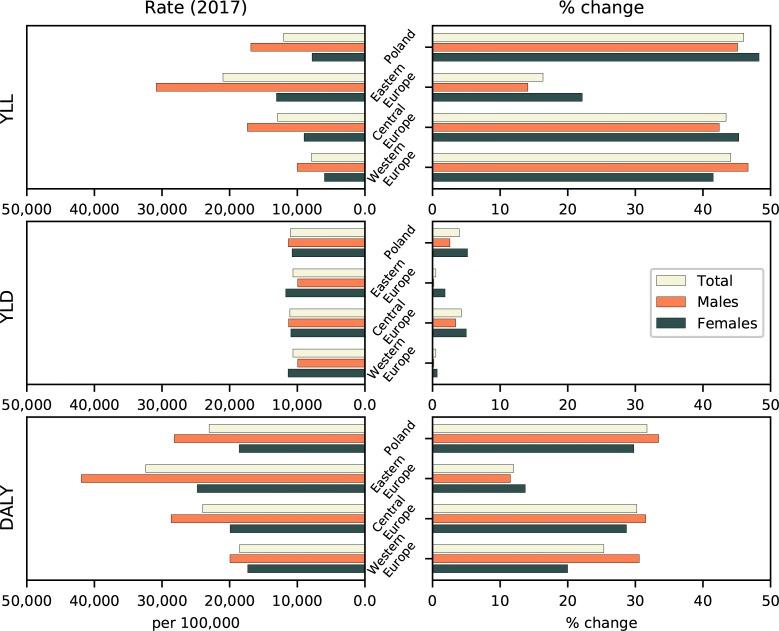
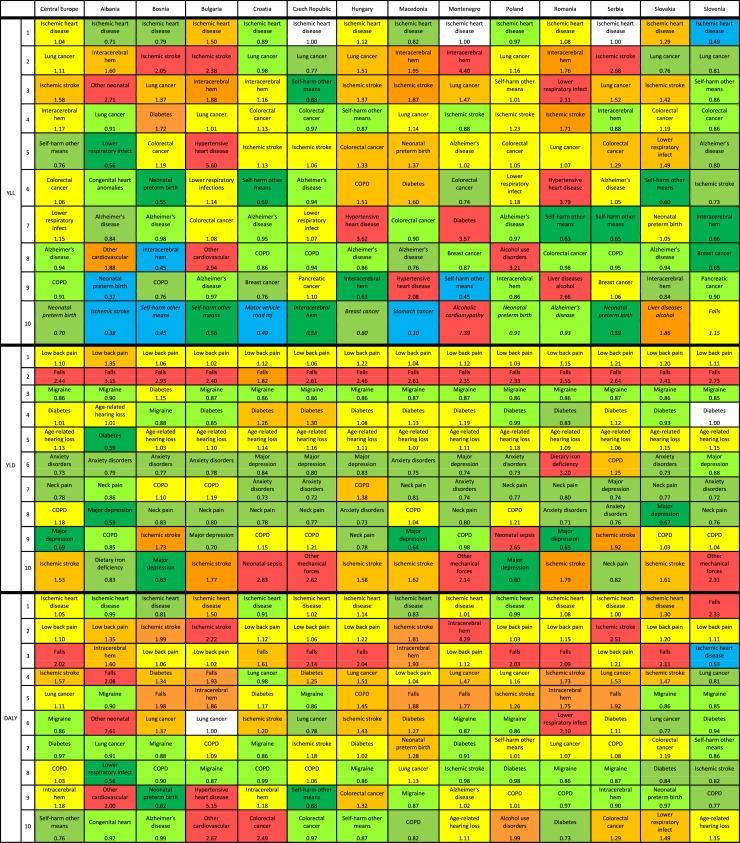
Between 1990-2017, age-standardized YLL rates for all causes declined in Poland by 46.0% (95% UI: 43.7-48.2), YLD rates declined by 4.0% (4.2-4.9), DALY rates by 31.7% (29.2-34.4). For both YLLs and YLDs, greater relative declines were observed for females. There was a large decrease in communicable, maternal, neonatal, and nutritional disease DALYs (48.2%; 46.3-50.4). DALYs due to non-communicable diseases (NCDs) decreased slightly (2.0%; 0.1-4.6). In 2017, Poland performed better than CE as a whole (ranked fourth for YLLs, sixth for YLDs, and fifth for DALYs) and achieved greater reductions in YLLs and DALYs than most CE countries. In 2017 and 1990, the leading cause of YLLs and DALYs in Poland and CE was ischaemic heart disease (IHD), and the leading cause of YLDs was low back pain. In 2017, the top 20 causes of YLLs and YLDs in Poland and CE were the same, although in different order. In Poland, age-standardized DALYs from neonatal causes, other cardiovascular and circulatory diseases, and road injuries declined substantially between 1990-2017, while alcohol use disorders and chronic liver diseases increased. The highest observed-to-expected ratios were seen for alcohol use disorders for YLLs, neonatal sepsis for YLDs, and falls for DALYs (3.21, 2.65, and 2.03, respectively).
CONCLUSIONS
There was relatively little geographical variation in premature death and disability in CE in 2017, although some between-country differences existed. Health in Poland has been improving since 1990; in 2017 Poland outperformed CE as a whole for YLLs, YLDs, and DALYs. While the health gap between Poland and Western Europe has diminished, it remains substantial. The shift to NCDs and chronic disability, together with marked between-gender health inequalities, poses a challenge for the Polish health-care system. IHD is still the leading cause of disease burden in Poland, but DALYs from IHD are declining. To further reduce disease burden, an integrated response focused on NCDs and population groups with disproportionally high burden is needed.
背景
系统地收集随时间推移的死亡率/发病率数据对于监测人口健康趋势、制定卫生政策、评估卫生计划的影响至关重要。在波兰,从未发表过全面分析主要疾病负担趋势的报告。全球疾病、伤害和风险因素研究(GBD)提供了自 1990 年以来 195 个国家 300 多种疾病的负担数据。我们使用 GBD 数据库对波兰的疾病负担进行评估,评估 1990-2017 年期间的人口健康变化,并将波兰与其他中东欧(CE)国家进行比较。
方法
使用 GBD 2017 年波兰和 CE 的 1990 年和 2017 年的结果评估了生命损失年(YLLs)、残疾生活年(YLDs)和残疾调整生命年(DALYs)的发病率和趋势。数据来自死因登记系统、人口健康调查、疾病登记、住院数据库和科学文献。采用分析方法调整缺失数据、死因认证错误和数据收集方法差异。主要估计策略是死亡率的综合建模和残疾的贝叶斯荟萃回归。
结果
1990-2017 年,波兰所有原因的年龄标准化 YLL 率下降了 46.0%(95%UI:43.7-48.2),YLD 率下降了 4.0%(4.2-4.9),DALY 率下降了 31.7%(29.2-34.4)。对于 YLL 和 YLD,女性的相对下降幅度更大。传染病、孕产妇、新生儿和营养疾病的 DALY 大幅减少(48.2%;46.3-50.4)。非传染性疾病(NCDs)的 DALYs 略有下降(2.0%;0.1-4.6)。2017 年,波兰的表现优于整个 CE(YLL 排名第四,YLD 排名第六,DALY 排名第五),并实现了 YLL 和 DALY 比大多数 CE 国家更大的降幅。2017 年和 1990 年,波兰和 CE 的 YLL 和 DALY 的主要原因是缺血性心脏病(IHD),YLD 的主要原因是腰痛。2017 年,波兰和 CE 的 YLL 和 YLD 的前 20 个原因相同,尽管顺序不同。在波兰,1990-2017 年间,新生儿病因、其他心血管和循环系统疾病以及道路交通伤害导致的 DALY 大幅下降,而酒精使用障碍和慢性肝病有所增加。观察到的与预期比值最高的是酒精使用障碍的 YLL、新生儿败血症的 YLD 和跌倒的 DALY(分别为 3.21、2.65 和 2.03)。
结论
2017 年,CE 地区的过早死亡和残疾在地理上的差异相对较小,尽管存在一些国家间的差异。自 1990 年以来,波兰的健康状况一直在改善;2017 年,波兰在 YLL、YLD 和 DALY 方面的表现优于整个 CE。虽然波兰与西欧之间的健康差距有所缩小,但仍然很大。向 NCD 和慢性残疾的转变,加上明显的性别健康不平等,对波兰的医疗保健系统构成了挑战。IHD 仍然是波兰疾病负担的主要原因,但 IHD 的 DALY 正在下降。为了进一步降低疾病负担,需要采取综合措施,重点关注 NCD 和负担过重的人群。


 Zotero 插件