
胃旁路术与袖状胃切除术治疗糖尿病的 5 年结局比较:全国以患者为中心的临床研究网络(PCORNet)减重研究。
Comparing the 5-Year Diabetes Outcomes of Sleeve Gastrectomy and Gastric Bypass: The National Patient-Centered Clinical Research Network (PCORNet) Bariatric Study.
机构信息
Department of Medicine, University of Pittsburgh, Pittsburgh, Pennsylvania.
Department of Epidemiology, University of Pittsburgh, Pittsburgh, Pennsylvania.
出版信息
JAMA Surg. 2020 May 1;155(5):e200087. doi: 10.1001/jamasurg.2020.0087. Epub 2020 May 20.
IMPORTANCE
Bariatric surgery can lead to substantial improvements in type 2 diabetes (T2DM), but outcomes vary across procedures and populations. It is unclear which bariatric procedure has the most benefits for patients with T2DM.
OBJECTIVE
To evaluate associations of bariatric surgery with T2DM outcomes.
DESIGN, SETTING, AND PARTICIPANTS: This cohort study was conducted in 34 US health system sites in the National Patient-Centered Clinical Research Network Bariatric Study. Adult patients with T2DM who had bariatric surgery between January 1, 2005, and September 30, 2015, were included. Data analysis was conducted from April 2017 to August 2019.
INTERVENTIONS
Roux-en-Y gastric bypass (RYGB) or sleeve gastrectomy (SG).
MAIN OUTCOME AND MEASURES
Type 2 diabetes remission, T2DM relapse, percentage of total weight lost, and change in glycosylated hemoglobin (hemoglobin A1c).
RESULTS
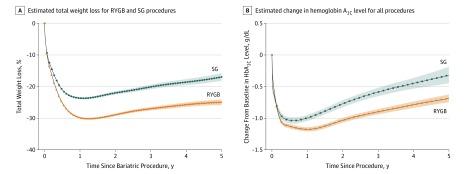
A total of 9710 patients were included (median [interquartile range] follow-up time, 2.7 [2.9] years; 7051 female patients [72.6%]; mean [SD] age, 49.8 [10.5] years; mean [SD] BMI, 49.0 [8.4]; 6040 white patients [72.2%]). Weight loss was significantly greater with RYGB than SG at 1 year (mean difference, 6.3 [95% CI, 5.8-6.7] percentage points) and 5 years (mean difference, 8.1 [95% CI, 6.6-9.6] percentage points). The T2DM remission rate was approximately 10% higher in patients who had RYGB (hazard ratio, 1.10 [95% CI, 1.04-1.16]) than those who had SG. Estimated adjusted cumulative T2DM remission rates for patients who had RYGB and SG were 59.2% (95% CI, 57.7%-60.7%) and 55.9% (95% CI, 53.9%-57.9%), respectively, at 1 year and 86.1% (95% CI, 84.7%-87.3%) and 83.5% (95% CI, 81.6%-85.1%) at 5 years postsurgery. Among 6141 patients who experienced T2DM remission, the subsequent T2DM relapse rate was lower for those who had RYGB than those who had SG (hazard ratio, 0.75 [95% CI, 0.67-0.84]). Estimated relapse rates for those who had RYGB and SG were 8.4% (95% CI, 7.4%-9.3%) and 11.0% (95% CI, 9.6%-12.4%) at 1 year and 33.1% (95% CI, 29.6%-36.5%) and 41.6% (95% CI, 36.8%-46.1%) at 5 years after surgery. At 5 years, compared with baseline, hemoglobin A1c was reduced 0.45 (95% CI, 0.27-0.63) percentage points more for patients who had RYGB vs patients who had SG.
CONCLUSIONS AND RELEVANCE
In this large multicenter study, patients who had RYGB had greater weight loss, a slightly higher T2DM remission rate, less T2DM relapse, and better long-term glycemic control compared with those who had SG. These findings can help inform patient-centered surgical decision-making.
重要性
减重手术可显著改善 2 型糖尿病(T2DM),但不同手术和人群的结果存在差异。尚不清楚哪种减重手术对 T2DM 患者最有益。
目的
评估减重手术与 T2DM 结局的关联。
设计、地点和参与者:这是一项在美国国家以患者为中心的临床研究网络减重研究的 34 个美国医疗系统站点进行的队列研究。纳入了 2005 年 1 月 1 日至 2015 年 9 月 30 日期间接受减重手术的 T2DM 成年患者。数据分析于 2017 年 4 月至 2019 年 8 月进行。
干预措施
Roux-en-Y 胃旁路术(RYGB)或袖状胃切除术(SG)。
主要结局和测量指标
2 型糖尿病缓解、T2DM 复发、总体重减轻百分比和糖化血红蛋白(HbA1c)变化。
结果
共纳入 9710 例患者(中位[四分位距]随访时间,2.7[2.9]年;7051 例女性患者[72.6%];平均[标准差]年龄,49.8[10.5]岁;平均[标准差]BMI,49.0[8.4];6040 例白人患者[72.2%])。与 SG 相比,RYGB 在 1 年(平均差异,6.3[95%CI,5.8-6.7]个百分点)和 5 年(平均差异,8.1[95%CI,6.6-9.6]个百分点)时的体重减轻更明显。与 SG 相比,RYGB 组患者的 T2DM 缓解率约高 10%(风险比,1.10[95%CI,1.04-1.16])。RYGB 和 SG 组患者分别在 1 年和 5 年时的估计调整累积 T2DM 缓解率分别为 59.2%(95%CI,57.7%-60.7%)和 55.9%(95%CI,53.9%-57.9%),86.1%(95%CI,84.7%-87.3%)和 83.5%(95%CI,81.6%-85.1%)。在 6141 例经历 T2DM 缓解的患者中,RYGB 组患者的 T2DM 后续复发率低于 SG 组(风险比,0.75[95%CI,0.67-0.84])。RYGB 和 SG 组患者的估计复发率分别为 8.4%(95%CI,7.4%-9.3%)和 11.0%(95%CI,9.6%-12.4%)在 1 年时和 33.1%(95%CI,29.6%-36.5%)和 41.6%(95%CI,36.8%-46.1%)在 5 年时。与基线相比,5 年后,与 SG 相比,RYGB 组患者的糖化血红蛋白降低 0.45(95%CI,0.27-0.63)个百分点。
结论和相关性
在这项大型多中心研究中,与 SG 相比,RYGB 组患者体重减轻更多,T2DM 缓解率略高,T2DM 复发率更低,长期血糖控制更好。这些发现可以帮助患者做出以患者为中心的手术决策。

 Zotero 插件