
基于手机的血糖监测和反馈系统对多基层医疗机构 2 型糖尿病管理的效果:集群随机对照试验。
Effect of a Mobile Phone-Based Glucose-Monitoring and Feedback System for Type 2 Diabetes Management in Multiple Primary Care Clinic Settings: Cluster Randomized Controlled Trial.
机构信息
Division of Endocrinology and Metabolism, Department of Internal Medicine, Seoul St Mary's Hospital, College of Medicine, The Catholic University of Korea, Seoul, Republic of Korea.
Catholic Smart Health Care Center, The Catholic University of Korea, Seoul, Republic of Korea.
出版信息
JMIR Mhealth Uhealth. 2020 Feb 26;8(2):e16266. doi: 10.2196/16266.
BACKGROUND
Recent evidence of the effectiveness of mobile phone-based diabetes management systems is generally based on studies conducted in tertiary hospitals or professional diabetes clinics.
OBJECTIVE
This study aimed to evaluate the clinical efficacy and applicability of a mobile phone-based glucose-monitoring and feedback system for the management of type 2 diabetes mellitus (T2DM) in multiple primary care clinic settings.
METHODS
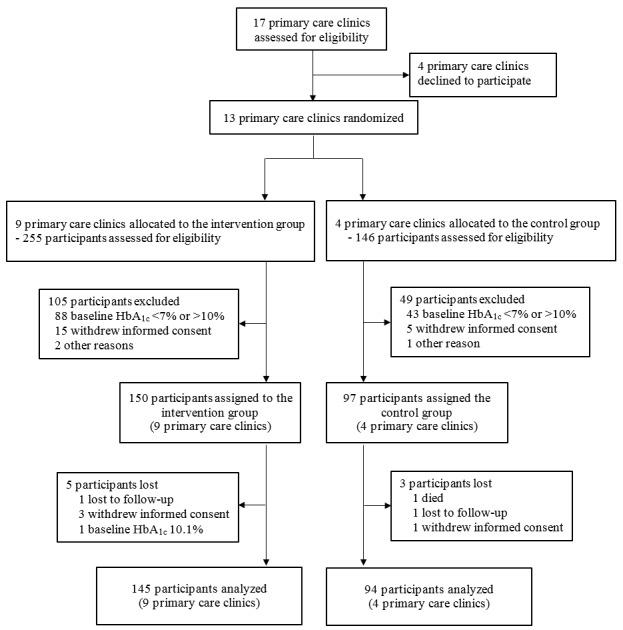
In this multicenter, cluster-randomized controlled, open trial, 13 primary care clinics in Seoul and other large cities in South Korea were voluntarily recruited. Overall, 150 (9 clinics) and 97 (4 clinics) participants with T2DM were assigned to the intervention and control groups, respectively (2:1 allocation). Every month, participants in both groups attended face-to-face physicians' consultation for the management of diabetes in the clinic. For the intervention group, participants were required to upload their daily self-monitoring of blood glucose (SMBG) results using the mobile phone app in addition to outpatient care for 3 months. The results were automatically transmitted to the main server. Physicians had to check their patients' SMBG results through an administrator's website and send a short feedback message at least once a week. At baseline and 3 months, both groups had anthropometry and blood tests, including hemoglobin A (HbA), and responded to questionnaires about treatment satisfaction and compliance.
RESULTS
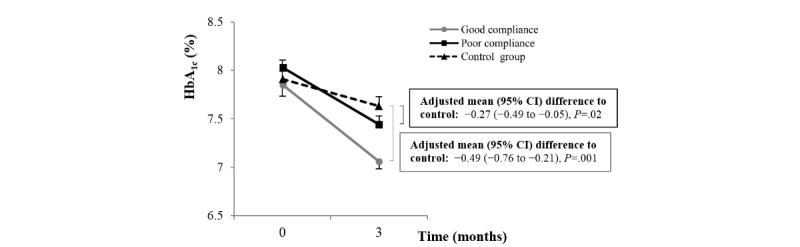
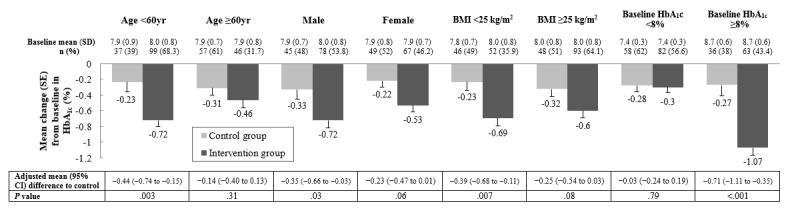
At 3 months, participants in the intervention group showed significantly more improvement in HbA (adjusted mean difference to control -0.30%, 95% CI -0.50 to -0.11; P=.003) and fasting plasma glucose (-17.29 mg/dL, 95% CI -29.33 to -5.26; P=.005) than those in the control group. In addition, there was significantly more reduction in blood pressure, and the score regarding treatment satisfaction and motivation for medication adherence increased more in the intervention group than in the control group. In the subgroup analyses, the effect on glycemic control was more significant among younger patients and higher baseline HbA levels.
CONCLUSIONS
The mobile phone-based glucose-monitoring and feedback system was effective in glycemic control when applied in primary care clinic settings. This system could be utilized effectively with diverse institutions and patients.
TRIAL REGISTRATION
Clinical Research Information Service (CRIS) https://tinyurl.com/tgqawbz.
背景
最近有关移动电话糖尿病管理系统有效性的证据,通常基于在三级医院或专业糖尿病诊所进行的研究。
目的
本研究旨在评估基于手机的血糖监测和反馈系统在多个基层医疗机构中管理 2 型糖尿病(T2DM)的临床疗效和适用性。
方法
本项多中心、集群随机对照、开放性试验在首尔和韩国其他大城市的 13 个基层医疗机构中自愿招募参与者。共有 150 名(9 个诊所)和 97 名(4 个诊所)T2DM 患者被随机分配至干预组和对照组(2:1 分配)。两组患者每月都在诊所进行面对面的糖尿病管理医生咨询。对于干预组,除了门诊护理外,患者还需要使用手机应用程序上传他们的每日自我血糖监测(SMBG)结果,为期 3 个月。结果会自动传输到主服务器。医生必须通过管理员的网站查看患者的 SMBG 结果,并至少每周发送一次简短的反馈信息。在基线和 3 个月时,两组患者都进行了人体测量和血液检查,包括血红蛋白 A(HbA),并回答了关于治疗满意度和依从性的问卷。
结果
在 3 个月时,干预组患者的 HbA(与对照组相比的调整平均差值为-0.30%,95%CI-0.50 至-0.11;P=.003)和空腹血糖(-17.29mg/dL,95%CI-29.33 至-5.26;P=.005)的改善明显优于对照组。此外,干预组的血压下降更明显,治疗满意度和药物依从性的评分也更高。在亚组分析中,该系统在年轻患者和较高基线 HbA 水平的患者中的血糖控制效果更为显著。
结论
基于手机的血糖监测和反馈系统在基层医疗机构中应用时对血糖控制有效。该系统可以在不同的机构和患者中有效利用。
试验注册
临床研究信息服务(CRIS)https://tinyurl.com/tgqawbz。
 Zotero 插件