
新型高灵敏度和特异性 COVID-19-RdRp/Hel 实时荧光 RT-PCR 检测方法在临床标本中的验证及对 COVID-19 的分子诊断改良
Improved Molecular Diagnosis of COVID-19 by the Novel, Highly Sensitive and Specific COVID-19-RdRp/Hel Real-Time Reverse Transcription-PCR Assay Validated and with Clinical Specimens.
机构信息
State Key Laboratory of Emerging Infectious Diseases, The University of Hong Kong, Pokfulam, Hong Kong Special Administrative Region, China.
Department of Clinical Microbiology and Infection, The University of Hong Kong-Shenzhen Hospital, Shenzhen, Guangdong Province, China.
出版信息
J Clin Microbiol. 2020 Apr 23;58(5). doi: 10.1128/JCM.00310-20.
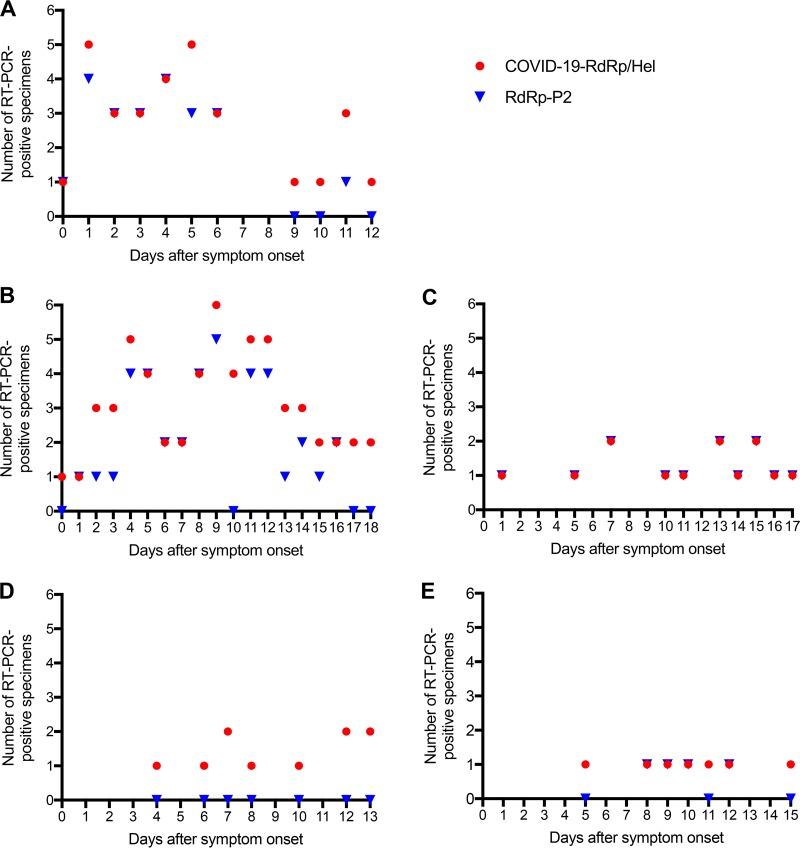
On 31 December 2019, the World Health Organization was informed of a cluster of cases of pneumonia of unknown etiology in Wuhan, China. Subsequent investigations identified a novel coronavirus, now named severe acute respiratory syndrome coronavirus 2 (SARS-CoV-2), from the affected patients. Highly sensitive and specific laboratory diagnostics are important for controlling the rapidly evolving SARS-CoV-2-associated coronavirus disease 2019 (COVID-19) epidemic. In this study, we developed and compared the performance of three novel real-time reverse transcription-PCR (RT-PCR) assays targeting the RNA-dependent RNA polymerase (RdRp)/helicase (Hel), spike (S), and nucleocapsid (N) genes of SARS-CoV-2 with that of the reported RdRp-P2 assay, which is used in >30 European laboratories. Among the three novel assays, the COVID-19-RdRp/Hel assay had the lowest limit of detection (1.8 50% tissue culture infective doses [TCID]/ml with genomic RNA and 11.2 RNA copies/reaction with RNA transcripts). Among 273 specimens from 15 patients with laboratory-confirmed COVID-19 in Hong Kong, 77 (28.2%) were positive by both the COVID-19-RdRp/Hel and RdRp-P2 assays. The COVID-19-RdRp/Hel assay was positive for an additional 42 RdRp-P2-negative specimens (119/273 [43.6%] versus 77/273 [28.2%]; < 0.001), including 29/120 (24.2%) respiratory tract specimens and 13/153 (8.5%) non-respiratory tract specimens. The mean viral load of these specimens was 3.21 × 10 RNA copies/ml (range, 2.21 × 10 to 4.71 × 10 RNA copies/ml). The COVID-19-RdRp/Hel assay did not cross-react with other human-pathogenic coronaviruses and respiratory pathogens in cell culture and clinical specimens, whereas the RdRp-P2 assay cross-reacted with SARS-CoV in cell culture. The highly sensitive and specific COVID-19-RdRp/Hel assay may help to improve the laboratory diagnosis of COVID-19.
2019 年 12 月 31 日,世界卫生组织收到中国武汉不明病因肺炎病例群集的报告。随后的调查从受影响的患者中鉴定出一种新型冠状病毒,现命名为严重急性呼吸综合征冠状病毒 2(SARS-CoV-2)。高度敏感和特异的实验室诊断对于控制 SARS-CoV-2 相关的 2019 年冠状病毒病(COVID-19)疫情的迅速演变非常重要。在这项研究中,我们开发并比较了三种针对 SARS-CoV-2 的 RNA 依赖性 RNA 聚合酶(RdRp)/解旋酶(Hel)、刺突(S)和核衣壳(N)基因的新型实时逆转录-PCR(RT-PCR)检测方法与报告的 RdRp-P2 检测方法的性能,该方法已在 >30 个欧洲实验室中使用。在三种新型检测方法中,COVID-19-RdRp/Hel 检测方法的最低检测限最低(用基因组 RNA 为 1.850%组织培养感染剂量(TCID)/ml,用 RNA 转录本为 11.2 RNA 拷贝/反应)。在香港的 15 例经实验室确诊的 COVID-19 患者的 273 份标本中,COVID-19-RdRp/Hel 和 RdRp-P2 检测方法均阳性的有 77 份(28.2%)。COVID-19-RdRp/Hel 检测方法还对 42 份 RdRp-P2 阴性标本(119/273 [43.6%]比 77/273 [28.2%];<0.001)呈阳性,包括 29/120(24.2%)呼吸道标本和 13/153(8.5%)非呼吸道标本。这些标本的平均病毒载量为 3.21×10 RNA 拷贝/ml(范围为 2.21×10 至 4.71×10 RNA 拷贝/ml)。COVID-19-RdRp/Hel 检测方法在细胞培养和临床标本中不会与其他人类致病冠状病毒和呼吸道病原体发生交叉反应,而 RdRp-P2 检测方法在细胞培养中会与 SARS-CoV 发生交叉反应。高度敏感和特异的 COVID-19-RdRp/Hel 检测方法可能有助于提高 COVID-19 的实验室诊断水平。
 Zotero 插件