
抗逆转录病毒治疗中断 30 个月后 CCR5Δ32/Δ32 异基因造血干细胞移植治疗 HIV-1 治愈的证据:一例报告。
Evidence for HIV-1 cure after CCR5Δ32/Δ32 allogeneic haemopoietic stem-cell transplantation 30 months post analytical treatment interruption: a case report.
机构信息
Department of Medicine, University of Cambridge, Cambridge, UK; Africa Health Research Institute, Durban, South Africa.
Nuffield Department of Medicine, University of Oxford, Oxford, UK; Population, Policy and Practice, UCL Great Ormond Street Institute of Child Health, London, UK.
出版信息
Lancet HIV. 2020 May;7(5):e340-e347. doi: 10.1016/S2352-3018(20)30069-2. Epub 2020 Mar 10.
BACKGROUND
The London patient (participant 36 in the IciStem cohort) underwent allogeneic stem-cell transplantation with cells that did not express CCR5 (CCR5Δ32/Δ32); remission was reported at 18 months after analytical treatment interruption (ATI). Here, we present longer term data for this patient (up to 30 months after ATI), including sampling from diverse HIV-1 reservoir sites.
METHODS
We used ultrasensitive viral load assays of plasma, semen, and cerebrospinal fluid (CSF) samples to detect HIV-1 RNA. In gut biopsy samples and lymph-node tissue, cell-copy number and total HIV-1 DNA levels were quantified in multiple replicates, using droplet digital PCR (ddPCR) and quantitative real-time PCR. We also analysed the presence of intact proviral DNA using multiplex ddPCR targeting the packaging signal (ψ) and envelope (env). We did intracellular cytokine staining to measure HIV-1-specific T-cell responses. We used low-sensitive and low-avidity antibody assays to measure the humoral response to HIV-1. We predicted the probability of rebound using a mathematical model and inference approach.
FINDINGS
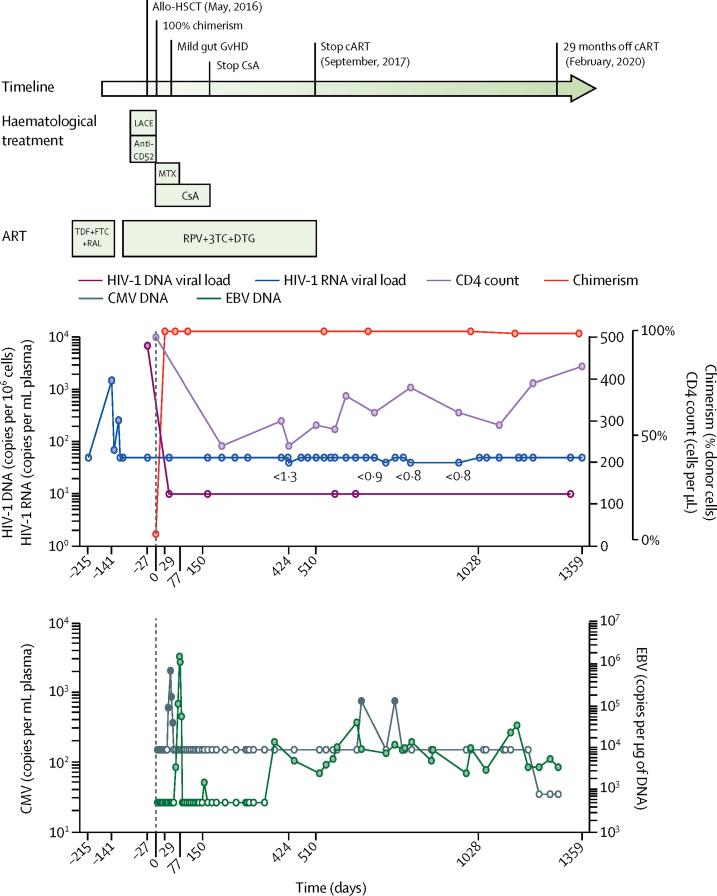
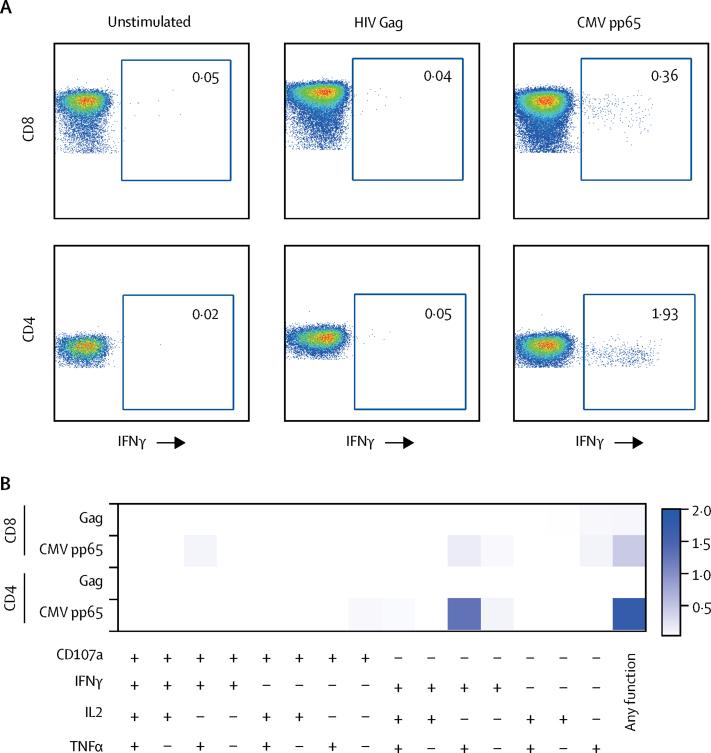
HIV-1 viral load in plasma remained undetectable in the London patient up to 30 months (last tested on March 4, 2020), using an assay with a detection limit of 1 copy per mL. The patient's CD4 count was 430 cells per μL (23·5% of total T cells) at 28 months. A very low-level positive signal for HIV-1 DNA was recorded in peripheral CD4 memory cells at 28 months. The viral load in semen was undetectable in both plasma (lower limit of detection [LLD] <12 copies per mL) and cells (LLD 10 copies per 10 cells) at 21 months. CSF was within normal parameters at 25 months, with HIV-1 RNA below the detection limit (LLD 1 copy per mL). HIV-1 DNA by ddPCR was negative in rectum, caecum, and sigmoid colon and terminal ileum tissue samples at 22 months. Lymph-node tissue from axilla was positive for the long-terminal repeat (33 copies per 10 cells) and env (26·1 copies per 10 cells), negative for ψ and integrase, and negative by the intact proviral DNA assay, at 27 months. HIV-1-specific CD4 and CD8 T-cell responses have remained absent at 27 months. Low-avidity Env antibodies have continued to decline. Mathematical modelling suggests that the probability of remission for life (cure) is 98% in the context of 80% donor chimerism in total HIV target cells and greater than 99% probability of remission for life with 90% donor chimerism.
INTERPRETATION
The London patient has been in HIV-1 remission for 30 months with no detectable replication-competent virus in blood, CSF, intestinal tissue, or lymphoid tissue. Donor chimerism has been maintained at 99% in peripheral T cells. We propose that these findings represent HIV-1 cure.
FUNDING
Wellcome Trust and amfAR (American Foundation for AIDS Research).
背景
伦敦患者(iciStem 队列中的第 36 位参与者)接受了不表达 CCR5(CCR5Δ32/Δ32)的异体干细胞移植;在分析性治疗中断(ATI)后 18 个月报告缓解。在此,我们报告了该患者的更长期数据(ATI 后最长 30 个月),包括来自不同 HIV-1 储存库部位的采样。
方法
我们使用超灵敏的血浆、精液和脑脊液(CSF)样本病毒载量检测方法检测 HIV-1 RNA。在肠道活检样本和淋巴结组织中,使用液滴数字 PCR(ddPCR)和定量实时 PCR 多次重复定量细胞拷贝数和总 HIV-1 DNA 水平。我们还使用靶向包装信号(ψ)和包膜(env)的多重 ddPCR 分析完整前病毒 DNA 的存在。我们进行了细胞内细胞因子染色以测量 HIV-1 特异性 T 细胞反应。我们使用低灵敏度和低亲和力抗体测定法测量 HIV-1 的体液反应。我们使用数学模型和推理方法预测了反弹的概率。
结果
截至 2020 年 3 月 4 日最后一次检测,使用检测限为每毫升 1 拷贝的检测方法,伦敦患者的血浆 HIV-1 病毒载量在 30 个月内仍无法检测到。患者的 CD4 计数在 28 个月时为 430 个细胞/μL(总 T 细胞的 23.5%)。在 28 个月时,外周 CD4 记忆细胞中记录到 HIV-1 DNA 的极低水平阳性信号。在 21 个月时,精液中的病毒载量在血浆(检测限 [LLD] <12 拷贝/毫升)和细胞(LLD 10 拷贝/10 个细胞)中均无法检测到。在 25 个月时,CSF 处于正常范围内,HIV-1 RNA 低于检测限(LLD 1 拷贝/毫升)。在 22 个月时,ddPCR 检测直肠、盲肠和乙状结肠和回肠末端组织样本中 HIV-1 DNA 为阴性。在 27 个月时,腋窝淋巴结组织中长末端重复序列(每 10 个细胞 33 个拷贝)和 env(每 10 个细胞 26.1 个拷贝)呈阳性,ψ和整合酶呈阴性,完整前病毒 DNA 检测呈阴性。在 27 个月时,HIV-1 特异性 CD4 和 CD8 T 细胞反应仍未出现。低亲和力 Env 抗体继续下降。数学模型表明,在总 HIV 靶细胞中 80%供体嵌合率的情况下,缓解持续一生(治愈)的概率为 98%,而 90%供体嵌合率时缓解持续一生的概率大于 99%。
解释
伦敦患者在没有检测到可复制的病毒的情况下,已经处于 HIV-1 缓解期 30 个月,血液、CSF、肠道组织或淋巴组织中均未检测到。外周 T 细胞中的供体嵌合率保持在 99%。我们提出这些发现代表 HIV-1 治愈。
资金
惠康信托基金会和 amfAR(美国艾滋病研究基金会)。



 Zotero 插件