
Lgr5 阴性癌细胞的可塑性驱动结直肠癌转移。
Plasticity of Lgr5-Negative Cancer Cells Drives Metastasis in Colorectal Cancer.
机构信息
Department of Molecular Pathology, Oncode Institute, Netherlands Cancer Institute, 1066 CX Amsterdam, the Netherlands.
Department of Molecular Pathology, Oncode Institute, Netherlands Cancer Institute, 1066 CX Amsterdam, the Netherlands; Molecular Cancer Research, Center for Molecular Medicine, Oncode Insitute, University Medical Center Utrecht, 3584 CX Utrecht, the Netherlands.
出版信息
Cell Stem Cell. 2020 Apr 2;26(4):569-578.e7. doi: 10.1016/j.stem.2020.02.008. Epub 2020 Mar 12.
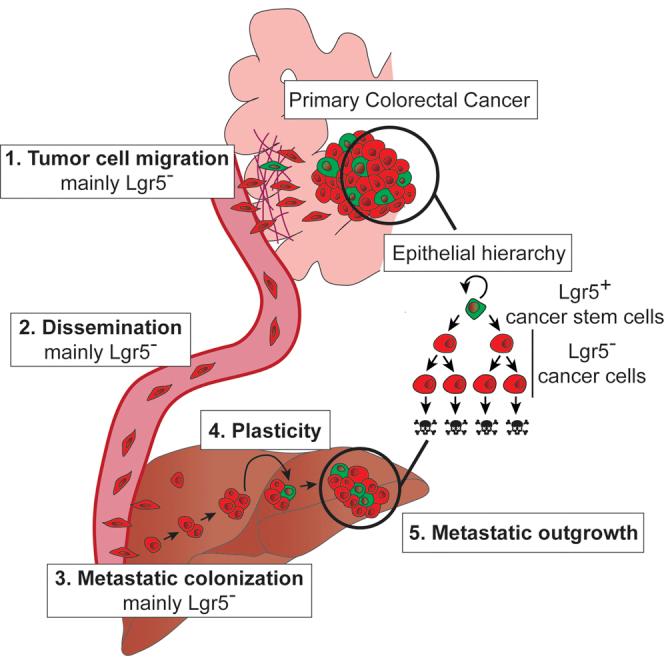
Colorectal cancer stem cells (CSCs) express Lgr5 and display extensive stem cell-like multipotency and self-renewal and are thought to seed metastatic disease. Here, we used a mouse model of colorectal cancer (CRC) and human tumor xenografts to investigate the cell of origin of metastases. We found that most disseminated CRC cells in circulation were Lgr5 and formed distant metastases in which Lgr5 CSCs appeared. This plasticity occurred independently of stemness-inducing microenvironmental factors and was indispensable for outgrowth, but not establishment, of metastases. Together, these findings show that most colorectal cancer metastases are seeded by Lgr5 cells, which display intrinsic capacity to become CSCs in a niche-independent manner and can restore epithelial hierarchies in metastatic tumors.
结直肠癌干细胞(CSCs)表达 Lgr5,并表现出广泛的干细胞样多能性和自我更新能力,被认为是引发转移性疾病的根源。在这里,我们使用结直肠癌(CRC)的小鼠模型和人肿瘤异种移植物来研究转移的起始细胞。我们发现,循环中大多数播散的 CRC 细胞是 Lgr5 阳性的,并在远处形成转移,其中 Lgr5 CSCs 出现。这种可塑性独立于诱导干细胞特性的微环境因素发生,对于转移的生长而不是建立是必不可少的。总之,这些发现表明,大多数结直肠癌转移是由 Lgr5 细胞播种的,这些细胞具有内在的能力,以非依赖于生态位的方式成为 CSCs,并能在转移瘤中恢复上皮层次结构。



 Zotero 插件