
珍珠粟(Pennisetum glaucum)脱水和盐胁迫下全基因组 WRKY 转录因子的鉴定和表达分析。
Genome-wide identification and expression analysis of WRKY transcription factors in pearl millet (Pennisetum glaucum) under dehydration and salinity stress.
机构信息
Institute of Life Sciences, NALCO Nagar Road, NALCO Square, Chandrasekharpur, Bhubaneswar, Odisha, 751023, India.
School of Biotechnology, Campus 11, KIIT (Deemed to be) University, Patia, Bhubaneswar, Odisha, 751024, India.
出版信息
BMC Genomics. 2020 Mar 14;21(1):231. doi: 10.1186/s12864-020-6622-0.
BACKGROUND
Plants have developed various sophisticated mechanisms to cope up with climate extremes and different stress conditions, especially by involving specific transcription factors (TFs). The members of the WRKY TF family are well known for their role in plant development, phytohormone signaling and developing resistance against biotic or abiotic stresses. In this study, we performed a genome-wide screening to identify and analyze the WRKY TFs in pearl millet (Pennisetum glaucum; PgWRKY), which is one of the most widely grown cereal crops in the semi-arid regions.
RESULTS
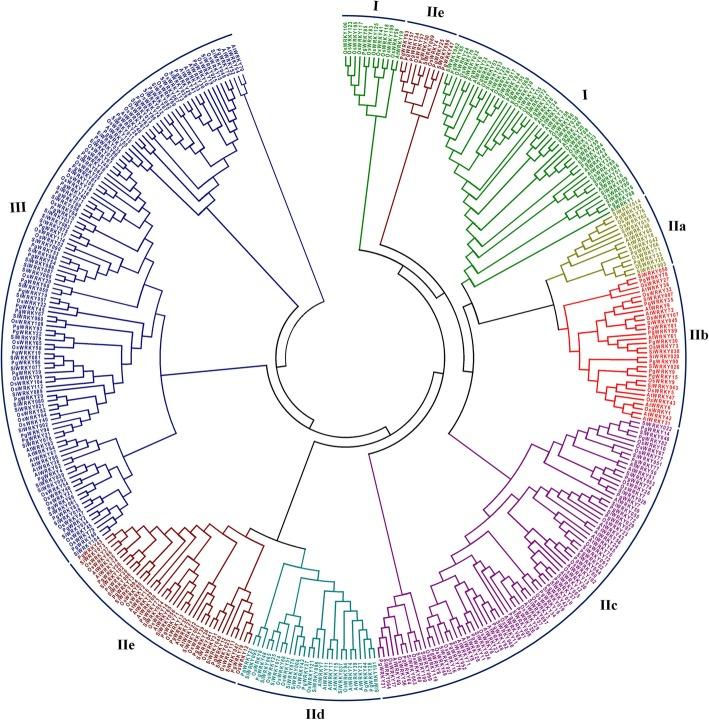
A total number of 97 putative PgWRKY proteins were identified and classified into three major Groups (I-III) based on the presence of WRKY DNA binding domain and zinc-finger motif structures. Members of Group II have been further subdivided into five subgroups (IIa-IIe) based on the phylogenetic analysis. In-silico analysis of PgWRKYs revealed the presence of various cis-regulatory elements in their promoter region like ABRE, DRE, ERE, EIRE, Dof, AUXRR, G-box, etc., suggesting their probable involvement in growth, development and stress responses of pearl millet. Chromosomal mapping evidenced uneven distribution of identified 97 PgWRKY genes across all the seven chromosomes of pearl millet. Synteny analysis of PgWRKYs established their orthologous and paralogous relationship among the WRKY gene family of Arabidopsis thaliana, Oryza sativa and Setaria italica. Gene ontology (GO) annotation functionally categorized these PgWRKYs under cellular components, molecular functions and biological processes. Further, the differential expression pattern of PgWRKYs was noticed in different tissues (leaf, stem, root) and under both drought and salt stress conditions. The expression pattern of PgWRKY33, PgWRKY62 and PgWRKY65 indicates their probable involvement in both dehydration and salinity stress responses in pearl millet.
CONCLUSION
Functional characterization of identified PgWRKYs can be useful in delineating their role behind the natural stress tolerance of pearl millet against harsh environmental conditions. Further, these PgWRKYs can be employed in genome editing for millet crop improvement.
背景
植物已经发展出各种复杂的机制来应对气候极端和不同的压力条件,特别是通过涉及特定的转录因子(TFs)。WRKY TF 家族的成员以其在植物发育、植物激素信号转导以及对生物或非生物胁迫产生抗性方面的作用而闻名。在这项研究中,我们进行了全基因组筛选,以鉴定和分析珍珠粟(Pennisetum glaucum;PgWRKY)中的 WRKY TFs,珍珠粟是半干旱地区广泛种植的主要谷物之一。
结果
共鉴定出 97 个假定的 PgWRKY 蛋白,并根据 WRKY DNA 结合域和锌指结构的存在将它们分为三大类(I-III)。基于系统发育分析,II 组的成员进一步细分为五个亚组(IIa-IIe)。PgWRKYs 的计算机分析显示,它们启动子区域存在各种顺式调控元件,如 ABRE、DRE、ERE、EIRE、Dof、AUXRR、G-box 等,表明它们可能参与珍珠粟的生长、发育和应激反应。染色体定位表明,在所鉴定的 97 个 PgWRKY 基因在珍珠粟的所有 7 条染色体上的分布不均匀。珍珠粟 WRKY 基因家族与拟南芥、水稻和柳枝稷的 WRKY 基因的同线性分析建立了它们的直系同源和旁系同源关系。基因本体(GO)注释根据细胞成分、分子功能和生物过程对这些 PgWRKY 进行了功能分类。此外,在不同组织(叶、茎、根)和干旱及盐胁迫条件下观察到 PgWRKYs 的差异表达模式。PgWRKY33、PgWRKY62 和 PgWRKY65 的表达模式表明它们可能参与珍珠粟的脱水和盐胁迫反应。
结论
鉴定的 PgWRKYs 的功能特征可以有助于阐明它们在珍珠粟对恶劣环境条件的自然胁迫耐受性背后的作用。此外,这些 PgWRKYs 可以用于小米作物改良的基因组编辑。




 Zotero 插件