
猪小肠上皮细胞的转录组学研究揭示了与F4ac腹泻易感性相关的重要基因和途径。
Transcriptomic Study of Porcine Small Intestine Epithelial Cells Reveals Important Genes and Pathways Associated With Susceptibility to F4ac Diarrhea.
作者信息
Augustino Serafino M A, Xu Qinglei, Liu Xueqin, Liu Lei, Zhang Qin, Yu Ying
机构信息
Key Laboratory of Animal Genetics, Breeding and Reproduction, Ministry of Agriculture & National Engineering Laboratory for Animal Breeding, College of Animal Science and Technology, China Agricultural University, Beijing, China.
Research Centre for Animal Genomic, Agricultural Genomic Institute at Shenzhen, Chinese Academy of Agricultural Sciences, Shenzhen, China.
出版信息
Front Genet. 2020 Feb 27;11:68. doi: 10.3389/fgene.2020.00068. eCollection 2020.
BACKGROUND
Diarrhea represents one of the most frequent major problems during piglets' neonatal and post-weaning periods leading to tremendous economic losses in the swine industry. Enterotoxigenic (ETEC) F4 is regarded as the most important cause of diarrhea in piglets. However, some pigs are naturally resistant to those diarrheas caused by ETEC-F4, because they have no F4 receptors (F4R) on their small intestine epithelial cells that allow F4 fimbriae attachment. Thus, our study characterized a complete transcriptome of small intestine epithelial cells of Large White piglets using RNA-Seq. The aim of the study was to identify DEGs with regard to differences in the F4R phenotypes and SNP (C/T) genotypes at and important pathways associated with ETEC-F4ac susceptibility in small intestine epithelial cells of Large White piglets and derive molecular markers as a result of loss of F4acR in swine.
METHODS
A total of eight samples of small intestine epithelial cells obtained from Large White piglets (35 days old) used in this study were selected on the basis of two criteria. One was the adhesion phenotype to ETEC-F4ac fimbriae, and the other was the comparison of SNP (C > T) genotype sequences across all the samples. The samples were then divided into two groups, non-adhesive with CC genotype (n = 4), and adhesive with TT genotype (n = 4).
RESULTS
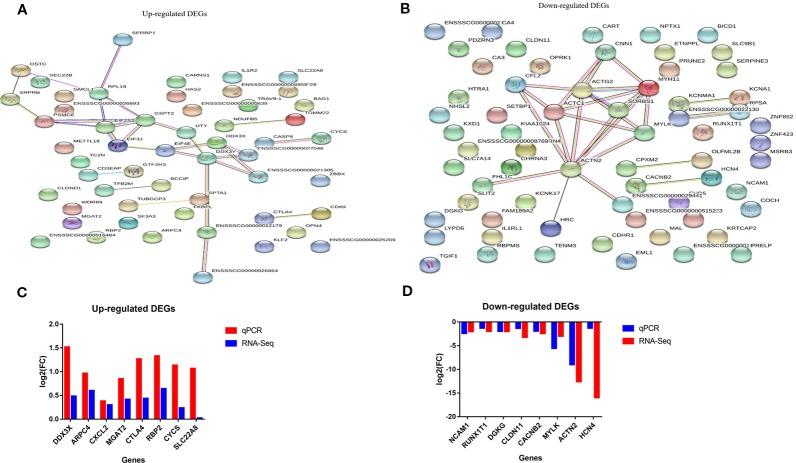
More down-regulated DEGs (p < 0.05, |logFC| > 2) were detected in the comparison of non-adhesive vs. adhesive small intestine epithelial cells in the present study. Six genes, of which two () exclusively expressed and four (, and DEGs with up-regulation pattern in adhesive (F4R positive) pigs were involved in two pathways associated with diarrhea. The DEGs with up-regulation pattern in non-adhesive (F4R negative) pigs were mostly engaged in multiple immune response-related pathways.
CONCLUSION
The results provide insights on the biology of the phenotypes of F4R positive and negative pigs. One gene () located on SSC13 locus for F4acR strongly support that it might have played a role in the adhesion phenotype which was obviously detected by adhesion assay in adhesive (F4R positive) group.
背景
腹泻是仔猪新生期和断奶后最常见的主要问题之一,给养猪业带来巨大经济损失。产肠毒素大肠杆菌(ETEC)F4被认为是仔猪腹泻的最重要原因。然而,一些猪对ETEC-F4引起的腹泻具有天然抵抗力,因为它们的小肠上皮细胞上没有允许F4菌毛附着的F4受体(F4R)。因此,我们的研究使用RNA测序对大白仔猪小肠上皮细胞的完整转录组进行了表征。本研究的目的是确定大白仔猪小肠上皮细胞中F4R表型和SNP(C/T)基因型差异相关的差异表达基因(DEG),以及与ETEC-F4ac易感性相关的重要途径,并得出猪中F4acR缺失导致的分子标记。
方法
本研究中从大白仔猪(35日龄)获得的总共八个小肠上皮细胞样本根据两个标准进行选择。一个是对ETEC-F4ac菌毛的粘附表型,另一个是所有样本中SNP(C>T)基因型序列的比较。然后将样本分为两组,CC基因型的非粘附组(n = 4)和TT基因型的粘附组(n = 4)。
结果
在本研究中,非粘附性与粘附性小肠上皮细胞的比较中检测到更多下调的差异表达基因(p < 0.05,|logFC| > 2)。六个基因,其中两个()仅在粘附性(F4R阳性)猪中特异性表达且四个(,和)差异表达基因呈上调模式,参与了与腹泻相关的两条途径。非粘附性(F4R阴性)猪中呈上调模式的差异表达基因大多参与多种免疫反应相关途径。
结论
研究结果为FBR阳性和阴性猪的表型生物学提供了见解。位于SSC13位点的一个基因()对于F4acR有力地支持了它可能在粘附表型中发挥了作用,这在粘附性(F4R阳性)组的粘附试验中明显检测到。


 Zotero 插件