
展示在纳米颗粒上的新型二价甘露糖基化靶向配体可选择性靶向抗炎性M2巨噬细胞。
A Novel Bivalent Mannosylated Targeting Ligand Displayed on Nanoparticles Selectively Targets Anti-Inflammatory M2 Macrophages.
作者信息
Chen Peiming, Zhang Xiaoping, Venosa Alessandro, Lee In Heon, Myers Daniel, Holloway Jennifer A, Prud'homme Robert K, Gao Dayuan, Szekely Zoltan, Laskin Jeffery D, Laskin Debra L, Sinko Patrick J
机构信息
Elucida Oncology, Inc., Monmouth Junction, NJ 08852, USA.
Department of Pharmaceutics, Ernest Mario School of Pharmacy, Rutgers, The State University of New Jersey, Piscataway, NJ 08854, USA.
出版信息
Pharmaceutics. 2020 Mar 8;12(3):243. doi: 10.3390/pharmaceutics12030243.
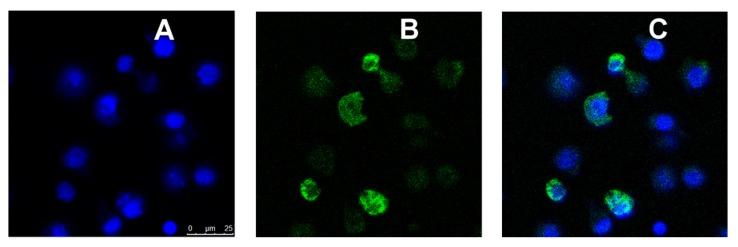
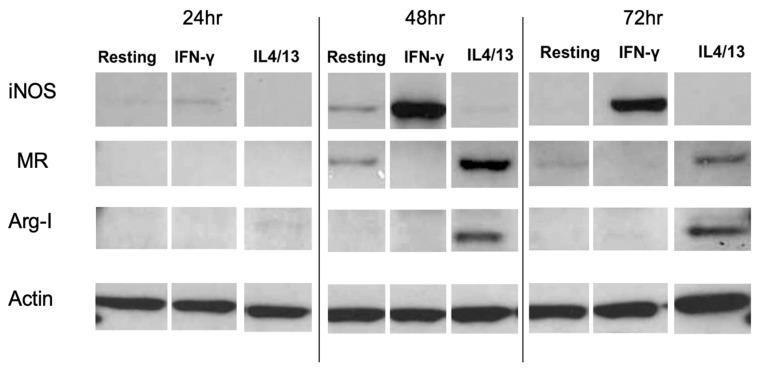
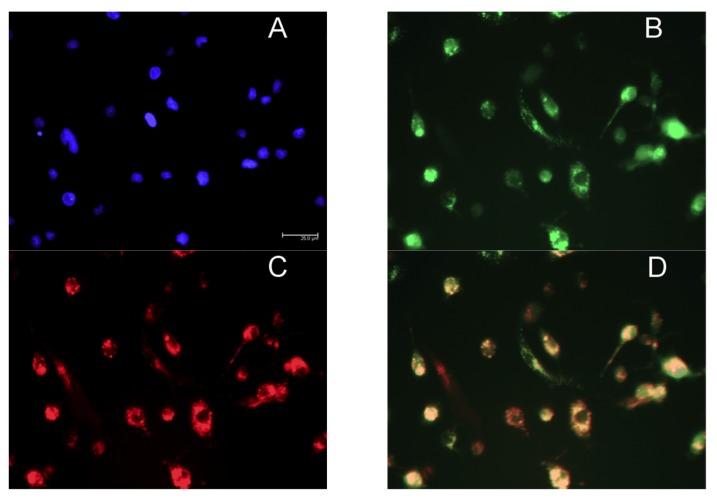
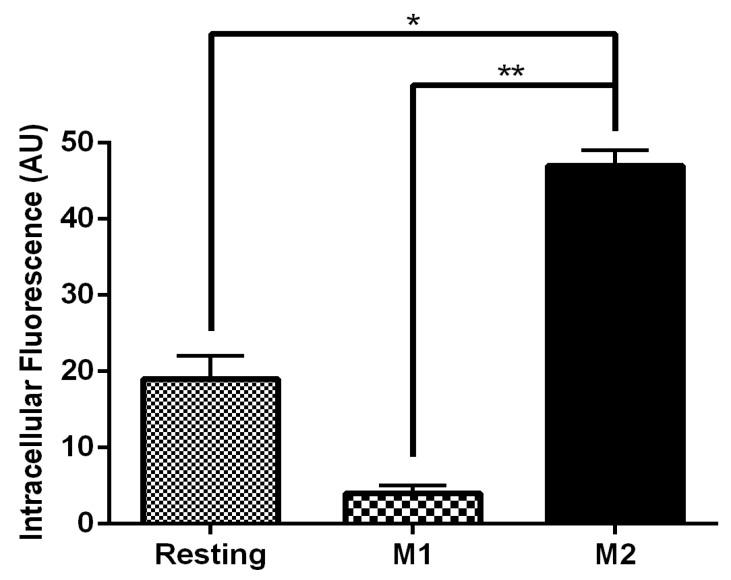
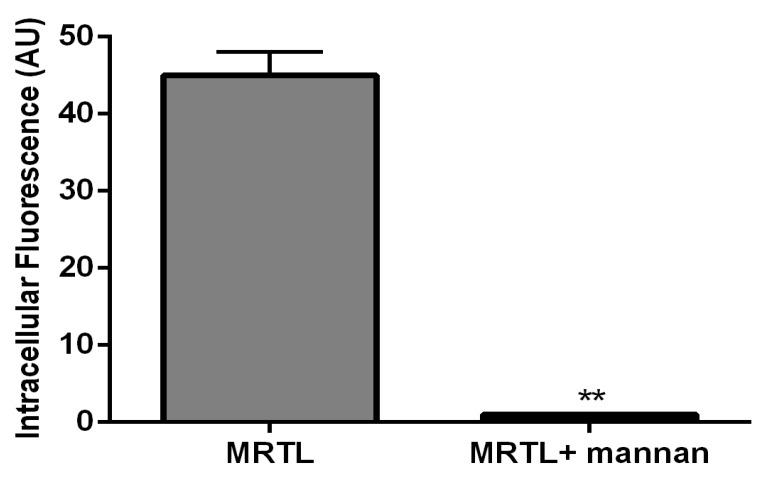
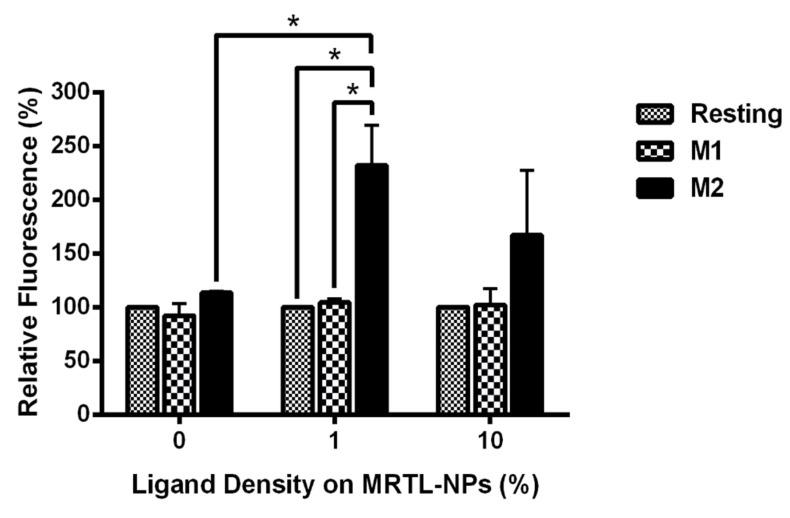
Persistent activation of macrophages (MP)s into a proinflammatory M1 or anti-inflammatory M2 phenotype plays a role in several pathological conditions, including autoimmune diseases, fibrosis, infections, atherosclerosis and tumor development. The mannose receptor (MR, CD206), expressed at low levels on resting MPs and absent on M1 MPs, is highly expressed on M2 MPs, making it a potential target and drug delivery portal. Recently, we developed a novel, highly selective MR targeting ligand (MRTL), consisting of two mannose molecules separated by a monodisperse 12 unit poly(ethylene glycol) linker, to enhance the cellular uptake of polymeric nanocarriers. The feasibility of using the MRTL ligand for selectively targeting M2 MPs for intracellular delivery of nanoparticles (NPs) was investigated. Rat peritoneal MPs were differentiated into an M1 or M2 phenotype using IFN-γ and IL-4/IL-13, respectively. Expression of the M1 marker, inducible nitric oxide synthase (iNOS), and the M2 markers arginase (Arg)-1 and MR (at both the mRNA and protein levels) confirmed MP phenotypic activation. Resting, M1 and M2 MPs were treated with fluorescein isothiocyanate (FITC)-labeled MRTL or NPs displaying FITC-labeled MRTL at two surface densities (1 and 10%) and examined by confocal microscopy. Intracellular fluorescence was also quantified. Uptake of the MRTL was 2.4- and 11.8-fold higher in M2 MPs when compared to resting or M1 MPs, respectively, consistent with marker expression levels. Mannan, a competitive inhibitor of the MR, abrogated MRTL uptake. MRTL also co-localized with a fluid-phase endocytosis marker, further suggesting that uptake was mediated by MR-mediated endocytosis. Intracellular NP fluorescence was confirmed by flow cytometry and by confocal microscopy. MRTL-NPs accumulated intracellularly with no significant cell surface binding, suggesting efficient translocation. NPs displaying a low surface density (1%) of the MRTL exhibited significantly higher (2.3-fold) uptake into M2 MPs, relative to resting and M1 MPs. The 10% MRTL-NPs displayed greater uptake by M2 MPs when compared to resting and M1 MPs, but less uptake than 1% MRTL-NPs into M2 MPs. Control FITC-labeled plain NPs did not exhibit selective MP uptake. These studies demonstrate that M2 MPs are selectively targeted by NPs displaying a novel bivalent ligand that utilizes the MR as a target/portal for cell entry. This study also establishes the feasibility of the approach allowing for further investigation in vivo.
巨噬细胞(MP)持续激活为促炎性M1或抗炎性M2表型在多种病理状况中发挥作用,包括自身免疫性疾病、纤维化、感染、动脉粥样硬化和肿瘤发展。甘露糖受体(MR,CD206)在静息MP上低水平表达,在M1 MP上不表达,而在M2 MP上高度表达,使其成为一个潜在的靶点和药物递送门户。最近,我们开发了一种新型的、高度选择性的MR靶向配体(MRTL),它由两个甘露糖分子通过单分散的12单元聚乙二醇连接子隔开,以增强聚合物纳米载体的细胞摄取。研究了使用MRTL配体选择性靶向M2 MP以进行纳米颗粒(NP)细胞内递送的可行性。分别使用IFN-γ和IL-4/IL-13将大鼠腹膜MP分化为M1或M2表型。M1标志物诱导型一氧化氮合酶(iNOS)以及M2标志物精氨酸酶(Arg)-1和MR(在mRNA和蛋白质水平)的表达证实了MP表型激活。用异硫氰酸荧光素(FITC)标记的MRTL或在两种表面密度(1%和10%)下展示FITC标记的MRTL的NP处理静息、M1和M2 MP,并通过共聚焦显微镜检查。还对细胞内荧光进行了定量。与静息或M1 MP相比,M2 MP对MRTL的摄取分别高出2.4倍和11.8倍,这与标志物表达水平一致。MR的竞争性抑制剂甘露聚糖消除了MRTL的摄取。MRTL还与液相内吞标志物共定位,进一步表明摄取是由MR介导的内吞作用介导的。通过流式细胞术和共聚焦显微镜证实了细胞内NP荧光。MRTL-NP在细胞内积累,细胞表面无明显结合,表明有效转运。相对于静息和M1 MP,展示低表面密度(1%)MRTL的NP对M2 MP的摄取显著更高(2.3倍)。与静息和M1 MP相比,10% MRTL-NP对M2 MP的摄取更多,但比1% MRTL-NP对M2 MP的摄取少。对照FITC标记的普通NP未表现出选择性MP摄取。这些研究表明,展示一种利用MR作为细胞进入靶点/门户的新型二价配体的NP可选择性靶向M2 MP。本研究还确立了该方法的可行性,以便在体内进行进一步研究。


 Zotero 插件