
慢性肾脏病中的心血管钙化——治疗机遇。
Cardiovascular Calcification in Chronic Kidney Disease-Therapeutic Opportunities.
机构信息
Department of Internal Medicine I, Cardiology, Medical Faculty, RWTH, Aachen University, 52074 Aachen, Germany.
出版信息
Toxins (Basel). 2020 Mar 14;12(3):181. doi: 10.3390/toxins12030181.
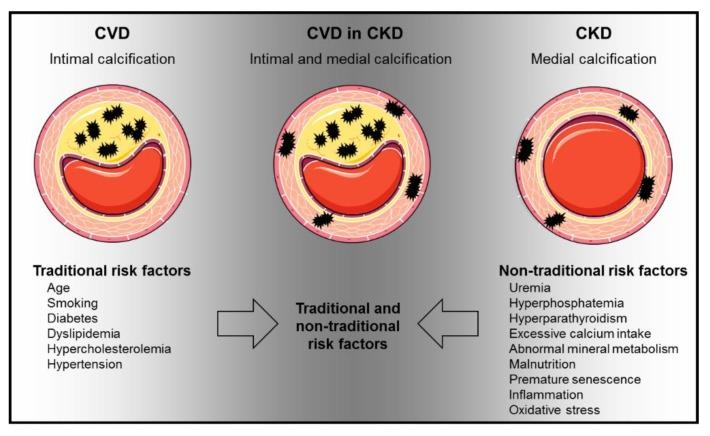
Patients with chronic kidney disease (CKD) are highly susceptible to cardiovascular (CV) complications, thus suffering from clinical manifestations such as heart failure and stroke. CV calcification greatly contributes to the increased CV risk in CKD patients. However, no clinically viable therapies towards treatment and prevention of CV calcification or early biomarkers have been approved to date, which is largely attributed to the asymptomatic progression of calcification and the dearth of high-resolution imaging techniques to detect early calcification prior to the 'point of no return'. Clearly, new intervention and management strategies are essential to reduce CV risk factors in CKD patients. In experimental rodent models, novel promising therapeutic interventions demonstrate decreased CKD-induced calcification and prevent CV complications. Potential diagnostic markers such as the serum T50 assay, which demonstrates an association of serum calcification propensity with all-cause mortality and CV death in CKD patients, have been developed. This review provides an overview of the latest observations and evaluates the potential of these new interventions in relation to CV calcification in CKD patients. To this end, potential therapeutics have been analyzed, and their properties compared via experimental rodent models, human clinical trials, and meta-analyses.
慢性肾脏病(CKD)患者极易发生心血管(CV)并发症,从而出现心力衰竭和中风等临床表现。CV 钙化极大地增加了 CKD 患者的 CV 风险。然而,迄今为止,尚无针对 CV 钙化的治疗和预防或早期生物标志物的临床可行疗法获得批准,这主要归因于钙化的无症状进展和缺乏高分辨率成像技术来在“不可逆转点”之前检测早期钙化。显然,需要新的干预和管理策略来降低 CKD 患者的 CV 风险因素。在实验性啮齿动物模型中,新的有前途的治疗干预措施显示可减少 CKD 引起的钙化并预防 CV 并发症。已经开发了一些潜在的诊断标志物,例如血清 T50 测定,该测定表明血清钙化倾向与 CKD 患者的全因死亡率和 CV 死亡率相关。本文综述了最新的观察结果,并评估了这些新干预措施在 CKD 患者 CV 钙化方面的潜力。为此,通过实验性啮齿动物模型、人类临床试验和荟萃分析分析了潜在的治疗方法,并比较了它们的特性。


 Zotero 插件