
男孩和女孩不同青春期体征的起始年龄以及10岁和18岁时的DNA甲基化差异:一项全表观基因组随访研究。
Age at onset of different pubertal signs in boys and girls and differential DNA methylation at age 10 and 18 years: an epigenome-wide follow-up study.
作者信息
Chen Su, Refaey Hala, Mukherjee Nandini, Solatikia Farnaz, Jiang Yu, Arshad S Hasan, Ewart Susan, Holloway John W, Zhang Hongmei, Karmaus Wilfried
机构信息
Department of Mathematical Science, University of Memphis, Dunn Hall, Memphis, TN, USA.
School of Public Health, University of Memphis, Robison Hall, Memphis, TN, USA.
出版信息
Hum Reprod Open. 2020 Mar 12;2020(2):hoaa006. doi: 10.1093/hropen/hoaa006. eCollection 2020.
STUDY QUESTION
Is the age of onset of pubertal markers related to subsequent changes in DNA methylation (DNAm)?
SUMMARY ANSWER
We identified 273 cytosine-phosphate-guanine (CpG) dinucleotides in girls and 67 CpGs in boys that were related to puberty and that were replicable in two other investigations.
WHAT IS KNOWN ALREADY
Previously, 457 CpGs (not gender-specific) and 347 (in girls) and 50 (in boys), respectively, were found to be associated with puberty, according to investigations of studies from Denmark (20 girls and 31 boys) and North America (30 girls and 25 boys).
STUDY DESIGN SIZE DURATION
The study was based on a birth cohort of 1456 participants born in 1989/90, with follow-up at age 10 and 18 years.
PARTICIPANTS/MATERIALS SETTING METHODS: The follow-up included 470 participants with information on DNAm and age of pubertal onset (244 girls and 226 boys). Age of pubertal onset was ascertained retrospectively at age 18 years. Using the Pubertal Development Scale, both genders were asked about ages of onset of growth spurt, body hair growth and skin changes. Ages at voice deepening and growth of facial hair were inquired from boys; ages at breast development and menarche from girls. Blood samples were collected at 10 and 18 years of age. DNA was extracted using a standard salting out procedure. The methylation level for each CpG site was assessed using one of two different platforms. DNAm was measured by a ratio of intensities denoted as values for each CpG site. After quality control, 349 455 CpG sites were available for analysis. values were calculated (log2(/(1-)) to approximate a normal distribution, and their levels were adjusted for blood cell proportions. Linear mixed models were applied to test the association between age of pubertal markers and repeated measurement of DNAm at 10 and 18 years.
MAIN RESULTS AND THE ROLE OF CHANCE
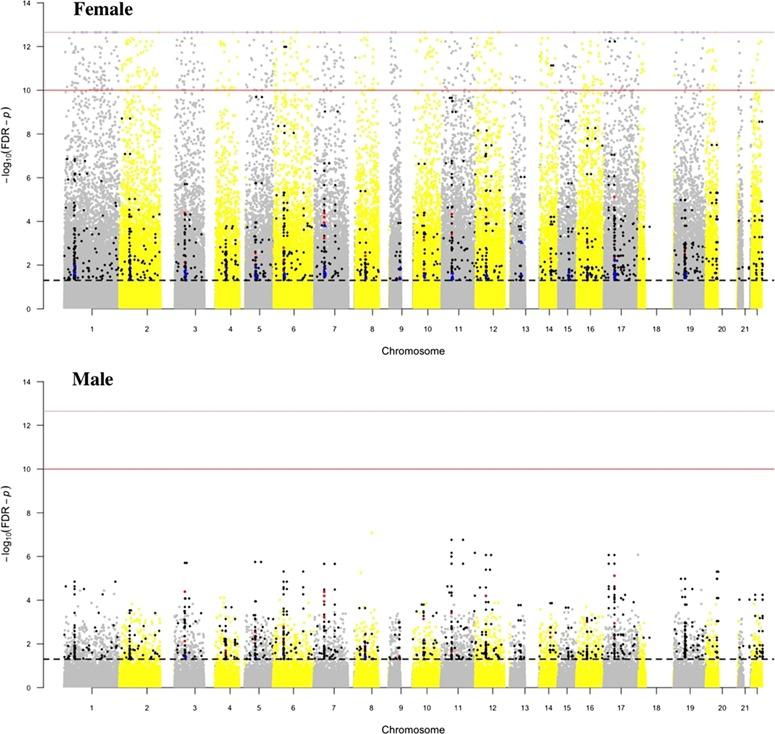
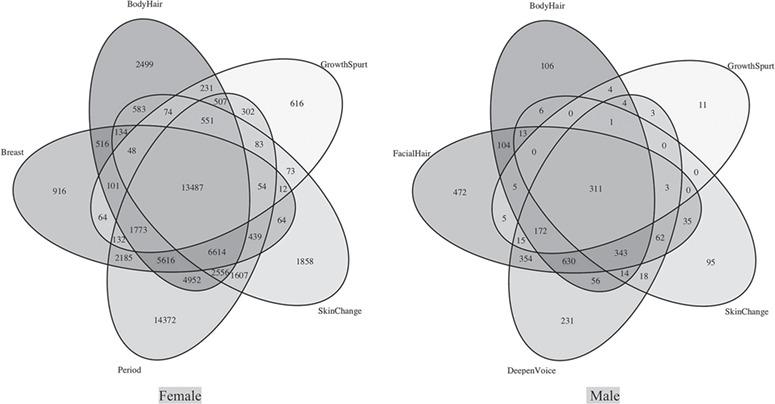
In girls, a total of 63 019 CpGs statistically significantly changed after occurrence of any of the five pubertal events and 13 487 were changed subsequent to all five events: the respective number is boys were 3072 and 301. To further exclude false-positive findings, we investigated which CpGs were replicable in prior studies from Denmark or North America, resulting in 273 replicable CpG in girls and 67 CpGs in boys (236 and 68 genes, respectively). Most identified genes are known to be related to biological processes of puberty; however, genetic polymorphisms of only four of these genes were previously linked to pubertal markers in humans.
LIMITATIONS REASONS FOR CAUTION
The relative age of pubertal onset to the age of DNAm measurements does not allow causal inference, since DNAm at an earlier age may have affected the pubertal age or pubertal age may have altered later DNAm. This investigation concentrates on autosomes. CpGs on X and Y chromosomes are not included in the current study.
WIDER IMPLICATIONS OF THE FINDINGS
Assessment of biological processes involved in pubertal transitions should include epigenetic information. Differential DNAm related to puberty needs to be investigated to determine whether it can act as an early marker for adult diseases known to be associated with puberty.
STUDY FUNDING/COMPETING INTERESTS: This work was supported by NIH grants R03HD092776 (Epigenetic characterization of pubertal transitions) and R01AI121226. The 10-year follow-up of this study was funded by National Asthma Campaign, UK (Grant No 364), and the 18-year follow-up by a grant from the National Heart and Blood Institute (R01 HL082925). The authors have no conflicts to report.
研究问题
青春期标志的起始年龄与随后的DNA甲基化(DNAm)变化有关吗?
总结答案
我们在女孩中鉴定出273个胞嘧啶-磷酸-鸟嘌呤(CpG)二核苷酸,在男孩中鉴定出67个CpG,它们与青春期相关,并且在另外两项研究中可重复。
已知信息
此前,根据丹麦(20名女孩和31名男孩)和北美的研究(30名女孩和25名男孩),分别发现457个CpG(非性别特异性)以及347个(女孩)和50个(男孩)与青春期相关。
研究设计规模持续时间
该研究基于1989/90年出生的1456名参与者的出生队列,在10岁和18岁时进行随访。
参与者/材料设置方法:随访包括470名有DNAm和青春期起始年龄信息的参与者(244名女孩和226名男孩)。青春期起始年龄在18岁时进行回顾性确定。使用青春期发育量表,询问两性生长突增、体毛生长和皮肤变化的起始年龄。询问男孩声音变粗和面部毛发生长的年龄;询问女孩乳房发育和初潮的年龄。在10岁和18岁时采集血样。使用标准盐析法提取DNA。使用两种不同平台之一评估每个CpG位点的甲基化水平。通过表示为每个CpG位点值的强度比来测量DNAm。经过质量控制后,有349455个CpG位点可用于分析。计算值(log2(/(1 - ))以近似正态分布,并针对血细胞比例对其水平进行调整。应用线性混合模型来测试青春期标志年龄与10岁和18岁时DNAm重复测量之间的关联。
主要结果及机遇的作用
在女孩中,在五个青春期事件中的任何一个发生后,共有63019个CpG在统计学上有显著变化,在所有五个事件之后有13487个发生变化;男孩的相应数字分别为3072和301。为了进一步排除假阳性结果,我们调查了哪些CpG在丹麦或北美的先前研究中可重复,结果在女孩中得到273个可重复的CpG,在男孩中得到67个CpG(分别涉及236个和68个基因)。大多数鉴定出的基因已知与青春期的生物学过程相关;然而,这些基因中只有四个的基因多态性先前与人类青春期标志相关。
局限性谨慎原因
青春期起始年龄与DNAm测量年龄的相对关系不允许进行因果推断,因为较早年龄的DNAm可能影响了青春期年龄,或者青春期年龄可能改变了后来的DNAm。本研究集中在常染色体上。X和Y染色体上的CpG不包括在当前研究中。
研究结果的更广泛影响
对青春期过渡所涉及的生物学过程的评估应包括表观遗传信息。需要研究与青春期相关的差异DNAm,以确定它是否可以作为已知与青春期相关的成人疾病的早期标志物。
研究资金/利益冲突:这项工作得到了美国国立卫生研究院(NIH)的R03HD


 Zotero 插件