
评估循环脂蛋白脂质与载脂蛋白与冠心病风险的关系:多变量孟德尔随机分析。
Evaluating the relationship between circulating lipoprotein lipids and apolipoproteins with risk of coronary heart disease: A multivariable Mendelian randomisation analysis.
机构信息
Medical Research Council Integrative Epidemiology Unit, University of Bristol, Bristol, United Kingdom.
Population Health Sciences, Bristol Medical School, University of Bristol, Barley House, Oakfield Grove, Bristol, United Kingdom.
出版信息
PLoS Med. 2020 Mar 23;17(3):e1003062. doi: 10.1371/journal.pmed.1003062. eCollection 2020 Mar.
BACKGROUND
Circulating lipoprotein lipids cause coronary heart disease (CHD). However, the precise way in which one or more lipoprotein lipid-related entities account for this relationship remains unclear. Using genetic instruments for lipoprotein lipid traits implemented through multivariable Mendelian randomisation (MR), we sought to compare their causal roles in the aetiology of CHD.
METHODS AND FINDINGS
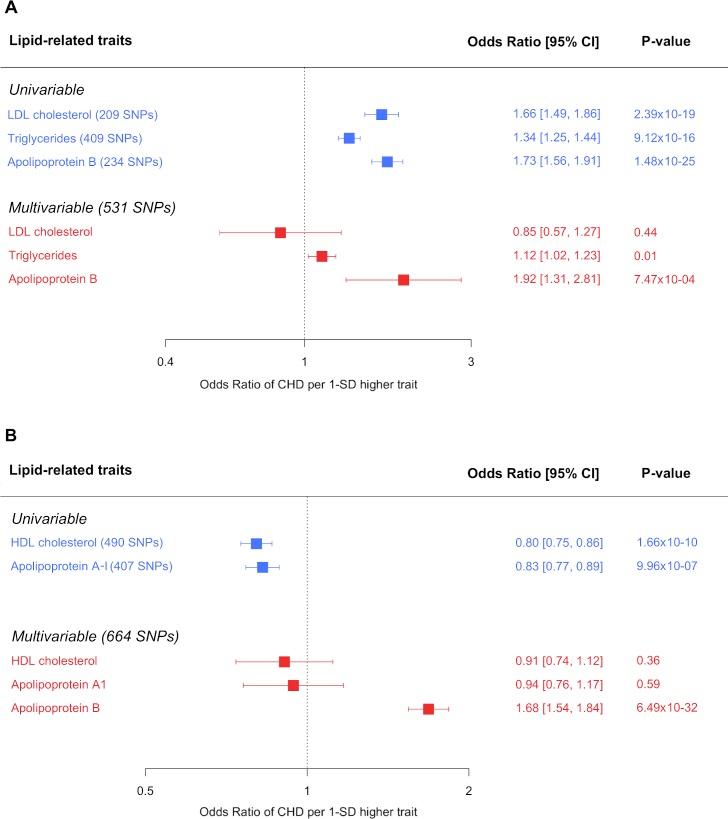
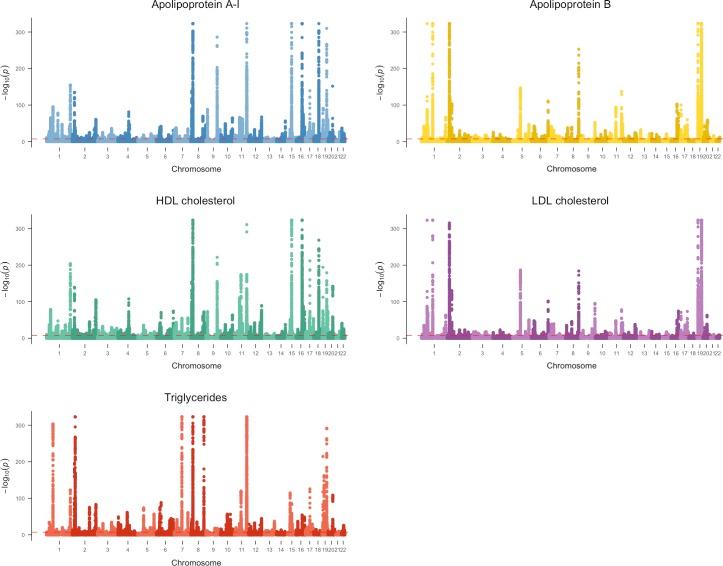
We conducted a genome-wide association study (GWAS) of circulating non-fasted lipoprotein lipid traits in the UK Biobank (UKBB) for low-density lipoprotein (LDL) cholesterol, triglycerides, and apolipoprotein B to identify lipid-associated single nucleotide polymorphisms (SNPs). Using data from CARDIoGRAMplusC4D for CHD (consisting of 60,801 cases and 123,504 controls), we performed univariable and multivariable MR analyses. Similar GWAS and MR analyses were conducted for high-density lipoprotein (HDL) cholesterol and apolipoprotein A-I. The GWAS of lipids and apolipoproteins in the UKBB included between 393,193 and 441,016 individuals in whom the mean age was 56.9 y (range 39-73 y) and of whom 54.2% were women. The mean (standard deviation) lipid concentrations were LDL cholesterol 3.57 (0.87) mmol/L and HDL cholesterol 1.45 (0.38) mmol/L, and the median triglycerides was 1.50 (IQR = 1.11) mmol/L. The mean (standard deviation) values for apolipoproteins B and A-I were 1.03 (0.24) g/L and 1.54 (0.27) g/L, respectively. The GWAS identified multiple independent SNPs associated at P < 5 × 10⁻⁸ for LDL cholesterol (220), apolipoprotein B (n = 255), triglycerides (440), HDL cholesterol (534), and apolipoprotein A-I (440). Between 56%-93% of SNPs identified for each lipid trait had not been previously reported in large-scale GWASs. Almost half (46%) of these SNPs were associated at P < 5 × 10⁻⁸ with more than one lipid-related trait. Assessed individually using MR, LDL cholesterol (odds ratio [OR] 1.66 per 1-standard-deviation-higher trait; 95% CI: 1.49-1.86; P < 0.001), triglycerides (OR 1.34; 95% CI: 1.25-1.44; P < 0.001) and apolipoprotein B (OR 1.73; 95% CI: 1.56-1.91; P < 0.001) had effect estimates consistent with a higher risk of CHD. In multivariable MR, only apolipoprotein B (OR 1.92; 95% CI: 1.31-2.81; P < 0.001) retained a robust effect, with the estimate for LDL cholesterol (OR 0.85; 95% CI: 0.57-1.27; P = 0.44) reversing and that of triglycerides (OR 1.12; 95% CI: 1.02-1.23; P = 0.01) becoming weaker. Individual MR analyses showed a 1-standard-deviation-higher HDL cholesterol (OR 0.80; 95% CI: 0.75-0.86; P < 0.001) and apolipoprotein A-I (OR 0.83; 95% CI: 0.77-0.89; P < 0.001) to lower the risk of CHD, but these effect estimates attenuated substantially to the null on accounting for apolipoprotein B. A limitation is that, owing to the nature of lipoprotein metabolism, measures related to the composition of lipoprotein particles are highly correlated, creating a challenge in making exclusive interpretations on causation of individual components.
CONCLUSIONS
These findings suggest that apolipoprotein B is the predominant trait that accounts for the aetiological relationship of lipoprotein lipids with risk of CHD.
背景
循环脂蛋白脂质会导致冠心病(CHD)。然而,一个或多个脂蛋白脂质相关实体确切的致病机制仍不清楚。本研究使用多变量孟德尔随机化(MR)的脂蛋白脂质特征遗传工具,旨在比较它们在 CHD 发病机制中的因果作用。
方法和发现
我们对英国生物库(UKBB)中的非空腹脂蛋白脂质特征(包括低密度脂蛋白胆固醇、甘油三酯和载脂蛋白 B)进行了全基因组关联研究(GWAS),以鉴定与脂质相关的单核苷酸多态性(SNP)。我们使用包含 60801 例病例和 123504 例对照的 CARDIOGRAMplusC4D 中的 CHD 数据进行了单变量和多变量 MR 分析。我们对高密度脂蛋白胆固醇(HDL)和载脂蛋白 A-I 也进行了类似的 GWAS 和 MR 分析。在 UKBB 中进行的脂质和载脂蛋白 GWAS 包含了 393193 到 441016 名参与者,他们的平均年龄为 56.9 岁(范围 39-73 岁),其中 54.2%为女性。平均(标准差)脂质浓度分别为低密度脂蛋白胆固醇 3.57(0.87)mmol/L 和高密度脂蛋白胆固醇 1.45(0.38)mmol/L,中位数甘油三酯为 1.50(IQR=1.11)mmol/L。载脂蛋白 B 和 A-I 的平均(标准差)值分别为 1.03(0.24)g/L 和 1.54(0.27)g/L。GWAS 确定了与 LDL 胆固醇(220 个)、载脂蛋白 B(n=255)、甘油三酯(440 个)、HDL 胆固醇(534 个)和载脂蛋白 A-I(440 个)相关的多个独立 SNP,这些 SNP 的 P 值均小于 5×10⁻⁸。对于每个脂质特征,有 56%-93%的鉴定 SNP 以前未在大规模 GWAS 中报道过。这些 SNP 中近一半(46%)与超过一种与脂质相关的特征相关,P 值均小于 5×10⁻⁸。使用 MR 进行单独评估时,LDL 胆固醇(每增加 1 个标准差的比值比 [OR] 为 1.66;95%CI:1.49-1.86;P<0.001)、甘油三酯(OR 为 1.34;95%CI:1.25-1.44;P<0.001)和载脂蛋白 B(OR 为 1.73;95%CI:1.56-1.91;P<0.001)的效应估计值与 CHD 风险增加一致。在多变量 MR 中,只有载脂蛋白 B(OR 为 1.92;95%CI:1.31-2.81;P<0.001)保留了稳健的效应,LDL 胆固醇(OR 为 0.85;95%CI:0.57-1.27;P=0.44)的估计值发生逆转,甘油三酯(OR 为 1.12;95%CI:1.02-1.23;P=0.01)的估计值变得较弱。个体 MR 分析显示,每增加 1 个标准差的高密度脂蛋白胆固醇(OR 为 0.80;95%CI:0.75-0.86;P<0.001)和载脂蛋白 A-I(OR 为 0.83;95%CI:0.77-0.89;P<0.001)可降低 CHD 风险,但这些效应估计值在考虑到载脂蛋白 B 后显著减弱至无效。一个限制是,由于脂蛋白代谢的性质,与脂蛋白颗粒组成相关的测量值高度相关,这在对单个成分的因果关系进行排他性解释时带来了挑战。
结论
这些发现表明,载脂蛋白 B 是解释脂蛋白脂质与 CHD 风险之间因果关系的主要特征。

 Zotero 插件