
特定氨基酸以类生长因子的方式促进小鼠植入前胚胎发育。
Selected Amino Acids Promote Mouse Pre-implantation Embryo Development in a Growth Factor-Like Manner.
作者信息
Morris Michael B, Ozsoy Sukran, Zada Matthew, Zada Mark, Zamfirescu Radu C, Todorova Mariana G, Day Margot L
机构信息
Discipline of Physiology, School of Medical Sciences, The University of Sydney, Sydney, NSW, Australia.
Bosch Institute, The University of Sydney, Sydney, NSW, Australia.
出版信息
Front Physiol. 2020 Mar 10;11:140. doi: 10.3389/fphys.2020.00140. eCollection 2020.
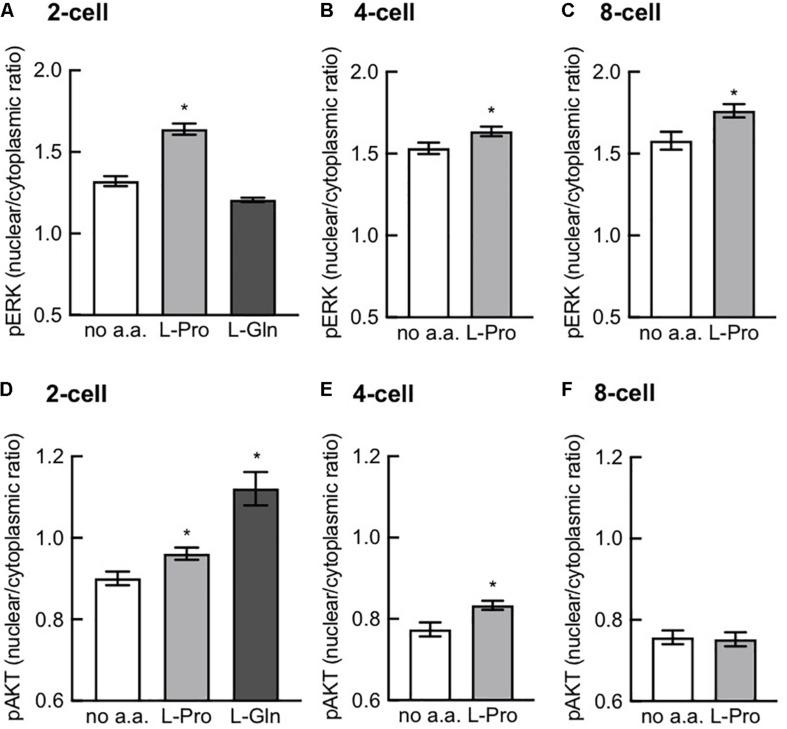
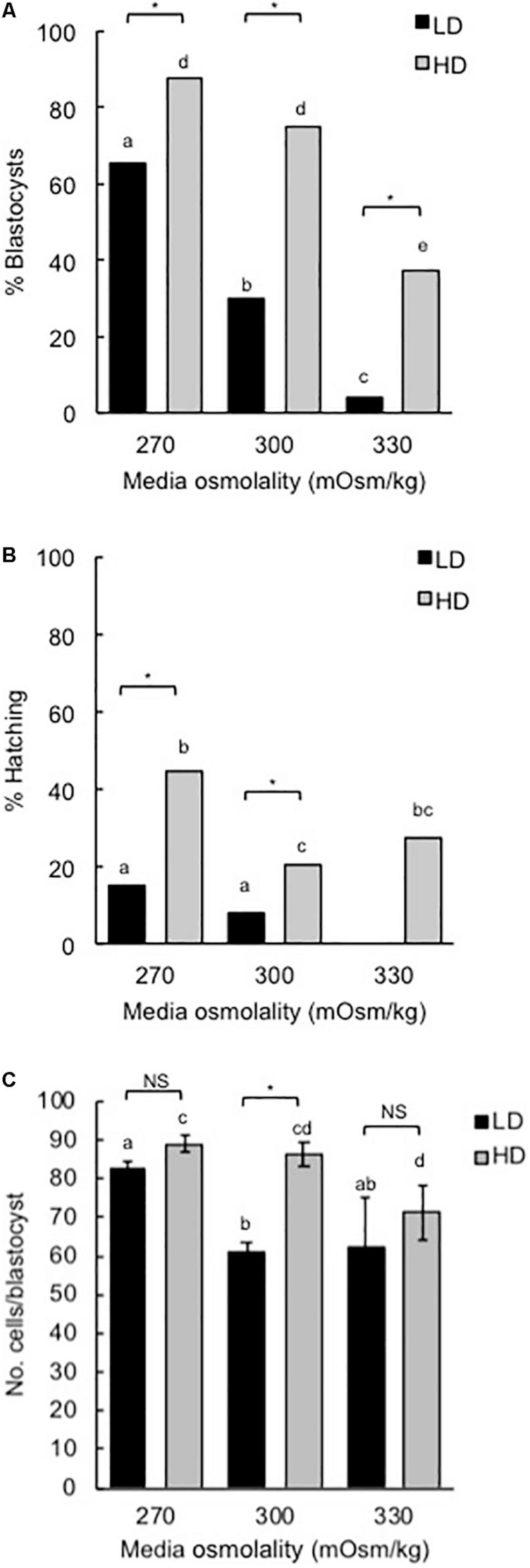
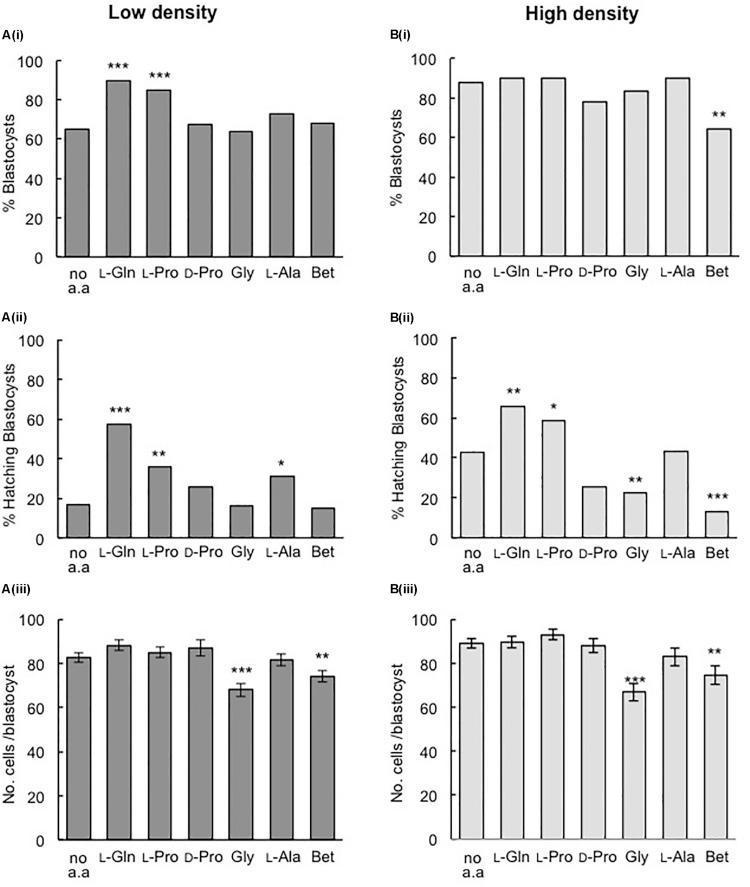
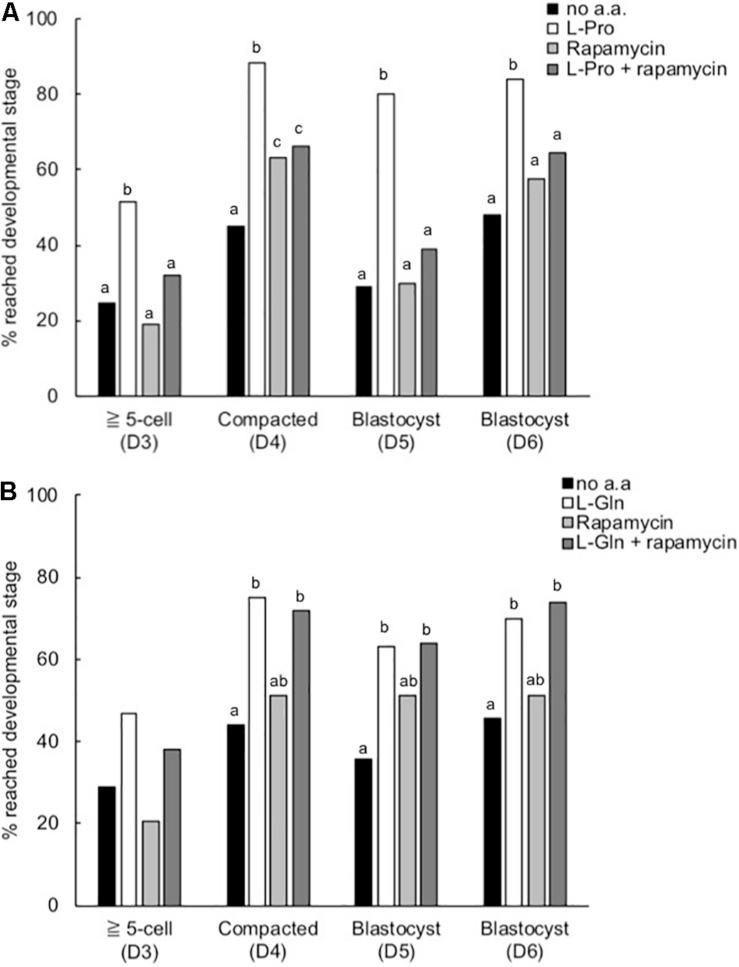
Groups of amino acids, and some selected amino acids, added to media used for culture of pre-implantation embryos have previously been shown to improve development in various ways including survival to the blastocyst stage, increased blastocyst cell number and improved hatching. In this study, we cultured 1-cell mouse embryos for 5 days to the hatching blastocyst stage in isosmotic medium (270 mOsm/kg) at high density (10 embryos/10 μL), where autocrine/paracrine support of development occurs, and low density (1 embryo/100 μL), where autocrine/paracrine support is minimized and development is compromised. When 400 μM L-Pro or 1 mM L-Gln was added to embryos at low density, the percentage of embryos reaching the blastocyst stage and the percentage hatching increased compared to low-density culture without these amino acids, and were now similar to those for embryos cultured at high density without amino acids. When L-Pro or L-Gln was added to embryos at high density, the percentage of embryos reaching the blastocyst stage didn't change but hatching improved. Neither embryo culture density nor the presence of these amino acids had any effect on blastocyst cell number. D-Pro and the osmolytes Gly and Betaine did not improve embryo development in low- or high-density culture indicating the mechanism was stereospecific and not osmotic, respectively. L-Pro- and L-Gln-mediated improvement in development is observed from the 5-cell stage and persists to the blastocyst stage. Molar excess of Gly, Betaine or L-Leu over L-Pro eliminated improvement in development and hatching consistent with them acting as competitive inhibitors of transporter-mediated uptake across the plasma membrane. The L-Pro effect is dependent on mTORC1 signaling (rapamycin sensitive) while that for L-Gln is not. The addition of L-Pro leads to significant nuclear translocation of p-Akt at the 2- and 4-cell stages and of p-ERK1/2 nuclear translocation at the 2-, 4-, and 8-cell stages. L-Pro improvement in embryo development involves mechanisms analogous to those seen with Pro-mediated differentiation of mouse ES cells, which is also stereoselective, dependent on transporter uptake, and activates Akt, ERK, and mTORC1 signaling pathways.
先前的研究表明,添加到用于培养植入前胚胎的培养基中的氨基酸组以及一些选定的氨基酸,能以多种方式改善胚胎发育,包括提高囊胚期的存活率、增加囊胚细胞数量以及改善孵化情况。在本研究中,我们将单细胞小鼠胚胎在等渗培养基(270 mOsm/kg)中高密度(10个胚胎/10 μL)培养5天至孵化囊胚阶段,此时会发生自分泌/旁分泌对发育的支持作用;同时在低密度(1个胚胎/100 μL)条件下培养,此时自分泌/旁分泌支持作用最小化,发育受到损害。当向低密度培养的胚胎中添加400 μM的L-脯氨酸或1 mM的L-谷氨酰胺时,与不添加这些氨基酸的低密度培养相比,达到囊胚阶段的胚胎百分比和孵化百分比增加,且现在与不添加氨基酸的高密度培养胚胎相似。当向高密度培养的胚胎中添加L-脯氨酸或L-谷氨酰胺时,达到囊胚阶段的胚胎百分比没有变化,但孵化情况得到改善。胚胎培养密度以及这些氨基酸的存在对囊胚细胞数量均无任何影响。D-脯氨酸以及渗透剂甘油和甜菜碱在低密度或高密度培养中均未改善胚胎发育,这表明该机制分别具有立体特异性而非渗透压相关。从5细胞阶段开始观察到L-脯氨酸和L-谷氨酰胺介导的发育改善,并持续到囊胚阶段。相对于L-脯氨酸,过量的甘油、甜菜碱或L-亮氨酸消除了发育和孵化方面的改善,这与它们作为跨质膜转运体介导摄取的竞争性抑制剂的作用一致。L-脯氨酸的作用依赖于mTORC1信号传导(对雷帕霉素敏感),而L-谷氨酰胺的作用则不依赖。添加L-脯氨酸会导致在2细胞和4细胞阶段p-Akt显著核转位,以及在2细胞、4细胞和8细胞阶段p-ERK1/2核转位。L-脯氨酸对胚胎发育的改善涉及与Pro介导的小鼠胚胎干细胞分化类似的机制,这也是立体选择性的,依赖于转运体摄取,并激活Akt、ERK和mTORC1信号通路。


 Zotero 插件