
膝关节骨关节炎进展过程中迁移性软骨祖细胞的生物学潜能改变。
Biological potential alterations of migratory chondrogenic progenitor cells during knee osteoarthritic progression.
机构信息
People's Liberation Army General Hospital, Road Fuxing 28, Beijing, 100853, People's Republic of China.
Beijing Institute of Radiation Medicine, Road Taiping 27, Beijing, 100850, People's Republic of China.
出版信息
Arthritis Res Ther. 2020 Mar 27;22(1):62. doi: 10.1186/s13075-020-2144-z.
BACKGROUND
Although increasing studies have demonstrated that chondrogenic progenitor cells (CPCs) remain present in human osteoarthritic cartilage, the biological alterations of the CPCs from the less diseased lateral tibial condyle and the more diseased medial condyle of same patient remain to be investigated.
METHODS
CPCs were isolated from paired grade 1-2 and grade 3-4 osteoarthritic cartilage by virtue of cell migratory capacities. The cell morphology, immunophenotype, self-renewal, multi-differentiation, and cell migration of these CPCs were evaluated. Additionally, the distributions of CD105/CD271 cells in OA osteochondral specimen were determined. Furthermore, a high-throughput mRNA sequencing was performed.
RESULTS
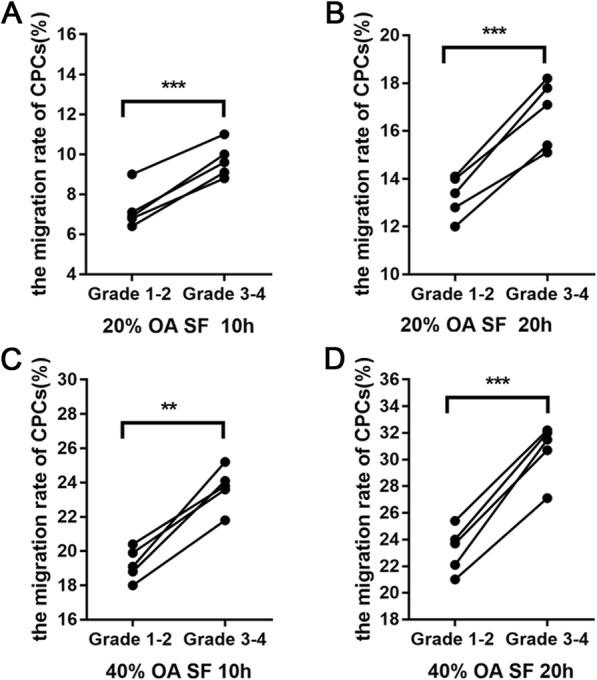
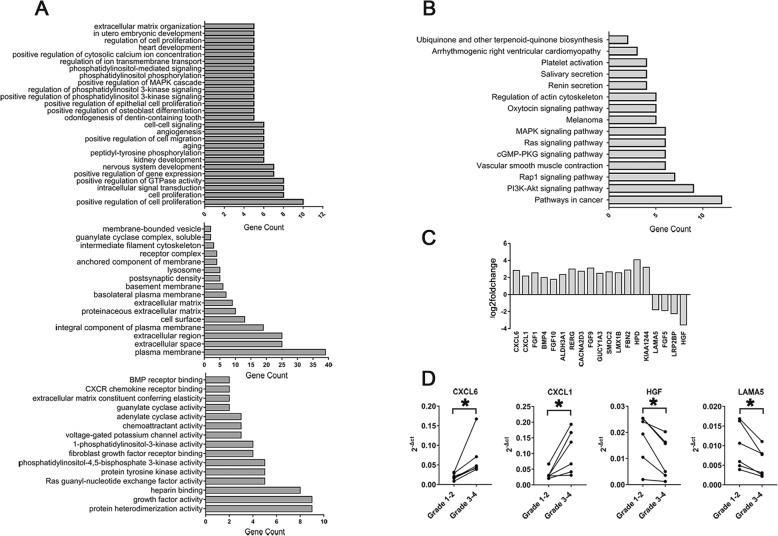
Migratory CPCs (mCPCs) robustly outgrew from mildly collagenases-digested osteoarthritic cartilages. The mCPCs from grade 3-4 cartilages (mCPCs, grades 3-4) harbored morphological characteristics, cell proliferation, and colony formation capacity that were similar to those of the mCPCs from the grade 1-2 OA cartilages (mCPCs, grades 1-2). However, the mCPCs (grades 3-4) highly expressed CD271. In addition, the mCPCs (grades 3-4) showed enhanced osteo-adipogenic activities and decreased chondrogenic capacity. Furthermore, the mCPCs (grades 3-4) exhibited stronger cell migration in response to osteoarthritis synovial fluids. More CD105/CD271 cells resided in grade 3-4 articular cartilages. Moreover, the results of mRNA sequencing showed that mCPCs (grades 3-4) expressed higher migratory molecules.
CONCLUSIONS
Our data suggest that more mCPCs (grades 3-4) migrate to injured articular cartilages but with enhanced osteo-adipogenic and decreased chondrogenic capacity, which might explain the pathological changes of mCPCs during the progression of OA from early to late stages. Thus, these dysfunctional mCPCs might be optional cell targets for OA therapies.
背景
尽管越来越多的研究表明,软骨祖细胞(CPCs)仍然存在于人类骨关节炎软骨中,但来自同一患者病变较轻的外侧胫骨髁和病变较重的内侧髁的 CPCs 的生物学变化仍有待研究。
方法
通过细胞迁移能力从配对的 1-2 级和 3-4 级骨关节炎软骨中分离 CPCs。评估这些 CPC 的细胞形态、免疫表型、自我更新、多向分化和细胞迁移。此外,还确定了 OA 骨软骨标本中 CD105/CD271 细胞的分布。此外,进行了高通量 mRNA 测序。
结果
从轻度胶原酶消化的骨关节炎软骨中,大量增殖的 CPC(mCPCs)。来自 3-4 级软骨的 mCPCs(mCPCs,3-4 级)具有与来自 1-2 级 OA 软骨的 mCPCs(mCPCs,1-2 级)相似的形态特征、细胞增殖和集落形成能力。然而,mCPCs(3-4 级)高度表达 CD271。此外,mCPCs(3-4 级)表现出增强的成骨-脂肪生成活性和降低的软骨形成能力。此外,mCPCs(3-4 级)在响应骨关节炎滑液时表现出更强的细胞迁移能力。更多的 CD105/CD271 细胞存在于 3-4 级关节软骨中。此外,mRNA 测序结果表明,mCPCs(3-4 级)表达更高的迁移分子。
结论
我们的数据表明,更多的 mCPCs(3-4 级)迁移到受损的关节软骨,但具有增强的成骨-脂肪生成和降低的软骨形成能力,这可能解释了 mCPCs 在 OA 从早期到晚期进展过程中的病理变化。因此,这些功能失调的 mCPCs 可能是 OA 治疗的可选细胞靶点。



 Zotero 插件