
口服阿扎胞苷和 Cedazuridine 近似于注射用阿扎胞苷在小鼠模型中的疗效。
Oral Azacitidine and Cedazuridine Approximate Parenteral Azacitidine Efficacy in Murine Model.
机构信息
Department of Medicine, Vanderbilt University School of Medicine, Nashville, TN, USA.
Cancer Biology Program, Vanderbilt University School of Medicine, Nashville, TN, USA.
出版信息
Target Oncol. 2020 Apr;15(2):231-240. doi: 10.1007/s11523-020-00709-x.
BACKGROUND
DNA methyltransferase inhibitors (DNMTis) improve survival for patients with myelodysplastic syndromes (MDS) and those with acute myeloid leukemia (AML) unable to receive standard cytotoxic chemotherapy and are, accordingly, the backbone of standard-of-care treatment for these conditions. Standard regimens with DNMTIs, decitabine (DEC) or azacitidine (AZA) include daily subcutaneous (s.c.) or intravenous (i.v.) administration for 5-7 consecutive days. Attempts to provide the therapy orally have been limited given rapid clearance of the agents by the enzyme cytidine deaminase (CDA), which is ubiquitous in the gut and liver as part of first-pass metabolism. Recently, cedazuridine (CDZ), an oral inhibitor of CDA, was successfully combined with DEC to approximate the pharmacokinetics of i.v. DEC in patients.
OBJECTIVE
To determine if an oral dosing strategy might be feasible in the clinic with AZA, we attempted to increase the bioavailability of oral AZA through the use of CDZ, in a murine model.
METHODS
Following pharmacokinetic and pharmacodynamic assessment of oral AZA dosed with CDZ in murine and monkey models, we tested this regimen in vivo with a human cell line-derived xenograft transplantation experiment (CDX). Following this we combined the regimen with venetoclax (VEN) to test the efficacy of an all-oral regimen in a patient-derived xenograft (PDX) model.
RESULTS
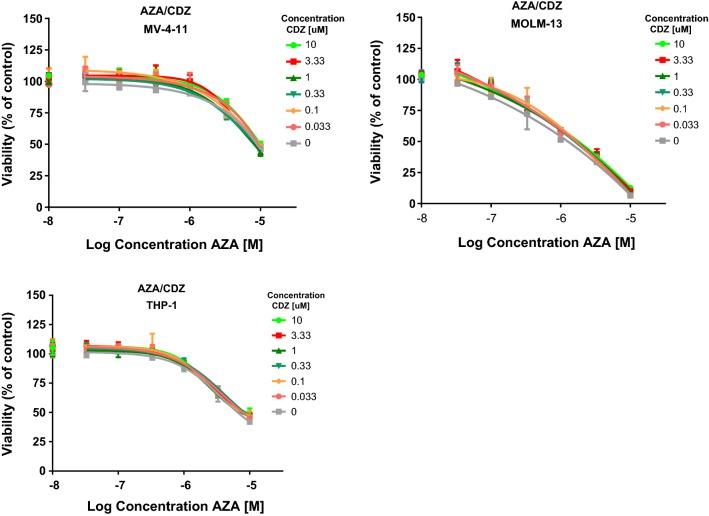
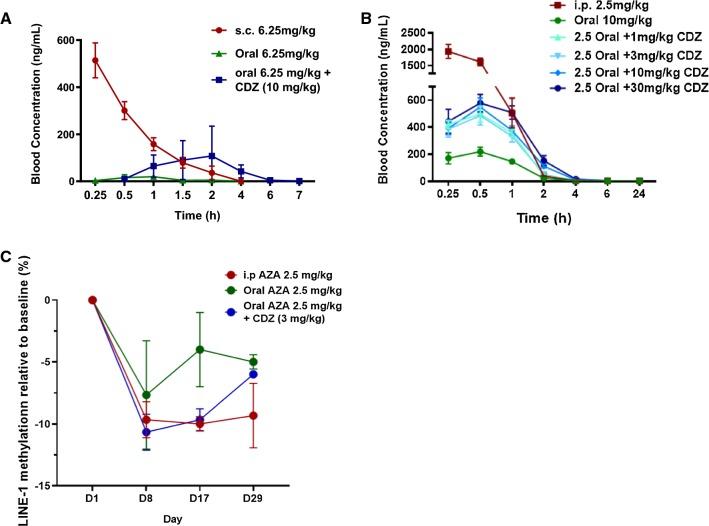
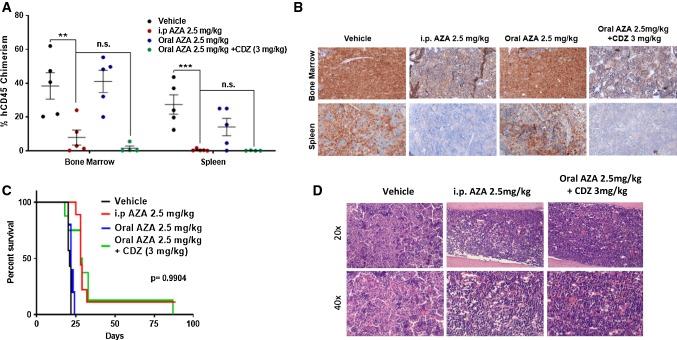
Parenteral AZA and oral AZA + CDZ exhibited similar pharmacokinetic profiles, and efficacy against human AML cells. Tumor regression was seen with AZA + CDZ in MOLM-13 CDX and PDX models.
CONCLUSIONS
We conclude that oral AZA when combined with CDZ achieves successful tumor regression in both CDX and PDX models. Furthermore, the combination of AZA + CDZ with VEN in a PDX model emulated responses seen with VEN + AZA in the clinic, implying a potential all-oral VEN-based therapy opportunity in myeloid diseases.
背景
DNA 甲基转移酶抑制剂(DNMTi)可改善骨髓增生异常综合征(MDS)和不能接受标准细胞毒性化疗的急性髓系白血病(AML)患者的生存率,因此是这些疾病标准治疗的基础。DNMTi(地西他滨[DEC]或阿扎胞苷[AZA])的标准方案包括每天皮下(s.c.)或静脉内(i.v.)给药 5-7 天。由于药物被酶胞苷脱氨酶(CDA)快速清除,尝试口服给药受到限制,CDA 是肠道和肝脏中无处不在的酶,是首过代谢的一部分。最近,CDA 的口服抑制剂西他滨(CDZ)与 DEC 联合成功,使患者的静脉内 DEC 药代动力学近似。
目的
为了确定在 AZA 方面,口服给药策略在临床上是否可行,我们尝试在小鼠模型中使用 CDZ 增加口服 AZA 的生物利用度。
方法
在小鼠和猴模型中对口服 AZA 联合 CDZ 进行药代动力学和药效学评估后,我们在人源细胞系衍生的异种移植移植实验(CDX)中测试了该方案。在此之后,我们将该方案与 venetoclax(VEN)联合使用,以在患者衍生的异种移植(PDX)模型中测试全口服方案的疗效。
结果
静脉内 AZA 和口服 AZA+CDZ 表现出相似的药代动力学特征,并且对人 AML 细胞有效。在 MOLM-13 CDX 和 PDX 模型中,AZA+CDZ 可观察到肿瘤消退。
结论
我们得出结论,口服 AZA 联合 CDZ 在 CDX 和 PDX 模型中均能成功实现肿瘤消退。此外,在 PDX 模型中,AZA+CDZ 联合 VEN 的组合模拟了 VEN+AZA 在临床上的反应,这意味着在髓系疾病中可能存在基于 VEN 的全口服治疗机会。

 Zotero 插件