
下丘脑室旁核中的葡萄糖调节胰高血糖素样肽-1的释放。
Glucose in the hypothalamic paraventricular nucleus regulates GLP-1 release.
作者信息
Ma Yue, Ratnasabapathy Risheka, De Backer Ivan, Izzi-Engbeaya Chioma, Nguyen-Tu Marie-Sophie, Cuenco Joyceline, Jones Ben, John Christopher D, Lam Brian Yh, Rutter Guy A, Yeo Giles Sh, Dhillo Waljit S, Gardiner James
机构信息
Section of Endocrinology and Investigative Medicine and.
Section of Cell Biology and Functional Genomics, Department of Metabolism, Digestion and Reproduction, Imperial College London, London, United Kingdom.
出版信息
JCI Insight. 2020 Mar 31;5(8):132760. doi: 10.1172/jci.insight.132760.
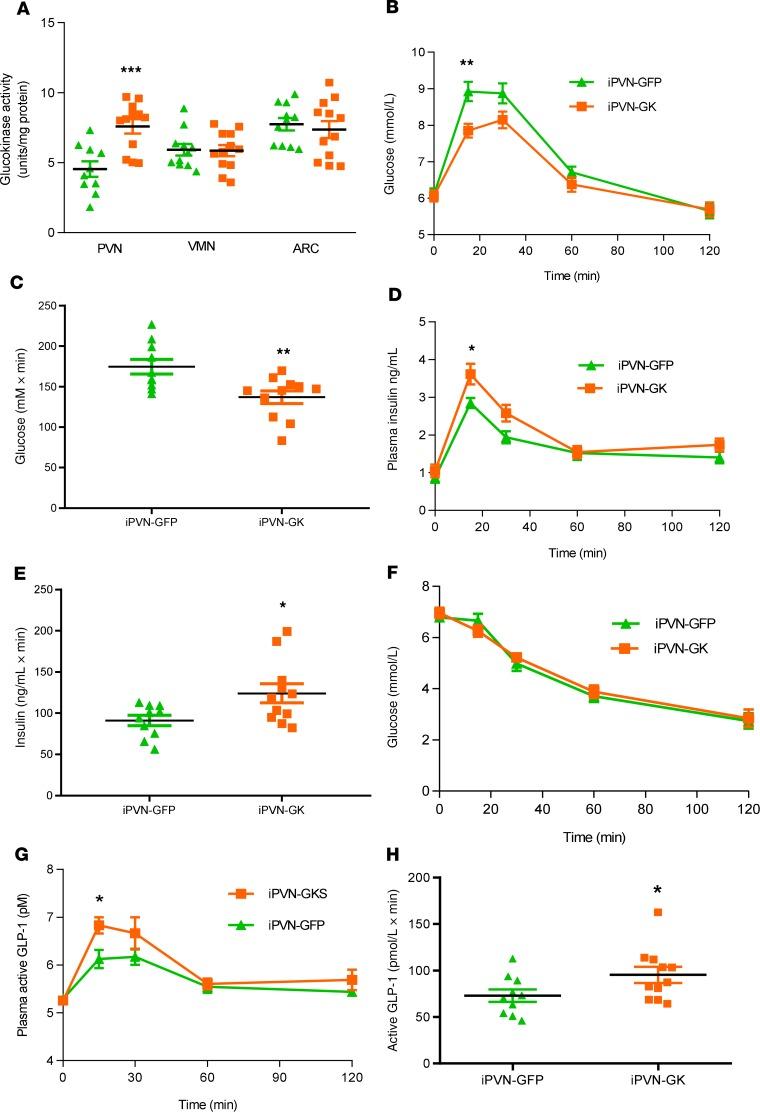
Glucokinase (GK) is highly expressed in the hypothalamic paraventricular nucleus (PVN); however, its role is currently unknown. We found that GK in the PVN acts as part of a glucose-sensing mechanism within the PVN that regulates glucose homeostasis by controlling glucagon-like peptide 1 (GLP-1) release. GLP-1 is released from enteroendocrine L cells in response to oral glucose. Here we identify a brain mechanism critical to the release of GLP-1 in response to oral glucose. We show that increasing expression of GK or injection of glucose into the PVN increases GLP-1 release in response to oral glucose. On the contrary, decreasing expression of GK or injection of nonmetabolizable glucose into the PVN prevents GLP-1 release. Our results demonstrate that gluco-sensitive GK neurons in the PVN are critical to the response to oral glucose and subsequent release of GLP-1.
葡萄糖激酶(GK)在下丘脑室旁核(PVN)中高表达;然而,其作用目前尚不清楚。我们发现,PVN中的GK作为PVN内葡萄糖传感机制的一部分,通过控制胰高血糖素样肽1(GLP-1)的释放来调节葡萄糖稳态。GLP-1是肠内分泌L细胞在口服葡萄糖后释放的。在这里,我们确定了一种对口服葡萄糖后GLP-1释放至关重要的脑机制。我们表明,增加GK的表达或向PVN注射葡萄糖会增加对口服葡萄糖的GLP-1释放。相反,降低GK的表达或向PVN注射不可代谢的葡萄糖会阻止GLP-1释放。我们的结果表明,PVN中对葡萄糖敏感的GK神经元对口服葡萄糖的反应以及随后GLP-1的释放至关重要。



 Zotero 插件