
计算推断新型冠状病毒、严重急性呼吸综合征冠状病毒 2 的进化选择基础。
Computational Inference of Selection Underlying the Evolution of the Novel Coronavirus, Severe Acute Respiratory Syndrome Coronavirus 2.
机构信息
Scientific Institute IRCCS E. MEDEA, Bioinformatics, Bosisio Parini, Italy
Scientific Institute IRCCS E. MEDEA, Bioinformatics, Bosisio Parini, Italy.
出版信息
J Virol. 2020 Jun 1;94(12). doi: 10.1128/JVI.00411-20.
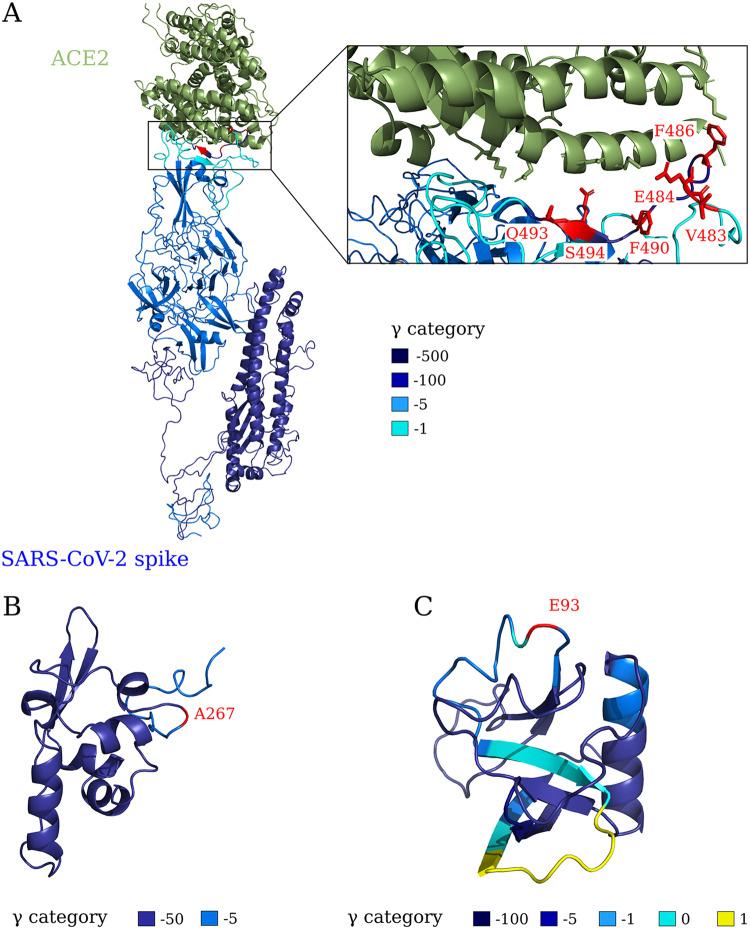
The novel coronavirus severe acute respiratory syndrome coronavirus 2 (SARS-CoV-2) that recently emerged in China is thought to have a bat origin, as its closest known relative (BatCoV RaTG13) was described previously in horseshoe bats. We analyzed the selective events that accompanied the divergence of SARS-CoV-2 from BatCoV RaTG13. To this end, we applied a population genetics-phylogenetics approach, which leverages within-population variation and divergence from an outgroup. Results indicated that most sites in the viral open reading frames (ORFs) evolved under conditions of strong to moderate purifying selection. The most highly constrained sequences corresponded to some nonstructural proteins (nsps) and to the M protein. Conversely, nsp1 and accessory ORFs, particularly ORF8, had a nonnegligible proportion of codons evolving under conditions of very weak purifying selection or close to selective neutrality. Overall, limited evidence of positive selection was detected. The 6 bona fide positively selected sites were located in the N protein, in ORF8, and in nsp1. A signal of positive selection was also detected in the receptor-binding motif (RBM) of the spike protein but most likely resulted from a recombination event that involved the BatCoV RaTG13 sequence. In line with previous data, we suggest that the common ancestor of SARS-CoV-2 and BatCoV RaTG13 encoded/encodes an RBM similar to that observed in SARS-CoV-2 itself and in some pangolin viruses. It is presently unknown whether the common ancestor still exists and, if so, which animals it infects. Our data, however, indicate that divergence of SARS-CoV-2 from BatCoV RaTG13 was accompanied by limited episodes of positive selection, suggesting that the common ancestor of the two viruses was poised for human infection. Coronaviruses are dangerous zoonotic pathogens; in the last 2 decades, three coronaviruses have crossed the species barrier and caused human epidemics. One of these is the recently emerged SARS-CoV-2. We investigated how, since its divergence from a closely related bat virus, natural selection shaped the genome of SARS-CoV-2. We found that distinct coding regions in the SARS-CoV-2 genome evolved under conditions of different degrees of constraint and are consequently more or less prone to tolerate amino acid substitutions. In practical terms, the level of constraint provides indications about which proteins/protein regions are better suited as possible targets for the development of antivirals or vaccines. We also detected limited signals of positive selection in three viral ORFs. However, we warn that, in the absence of knowledge about the chain of events that determined the human spillover, these signals should not be necessarily interpreted as evidence of an adaptation to our species.
新型冠状病毒(SARS-CoV-2)在中国的出现被认为与蝙蝠有关,因为其最近的亲缘关系(BatCoV RaTG13)以前在马蹄蝠中发现。我们分析了 SARS-CoV-2 与 BatCoV RaTG13 分化过程中伴随的选择事件。为此,我们应用了一种群体遗传学-系统发育方法,该方法利用了群体内变异和与外群的分化。结果表明,病毒开放阅读框(ORF)中的大多数位点在强到中度纯化选择条件下进化。最受限制的序列对应于一些非结构蛋白(nsps)和 M 蛋白。相反,nsp1 和辅助 ORF,特别是 ORF8,具有不可忽视的比例的密码子在非常弱的纯化选择或接近选择中性的条件下进化。总体而言,检测到的正选择证据有限。6 个真正的阳性选择位点位于 N 蛋白、ORF8 和 nsp1 中。刺突蛋白的受体结合基序(RBM)也检测到了正选择信号,但很可能是由于涉及 BatCoV RaTG13 序列的重组事件所致。与之前的数据一致,我们认为 SARS-CoV-2 和 BatCoV RaTG13 的共同祖先编码/编码的 RBM 类似于 SARS-CoV-2 本身和一些穿山甲病毒中观察到的 RBM。目前尚不清楚共同祖先是否仍然存在,如果存在,它感染哪些动物。然而,我们的数据表明,SARS-CoV-2 与 BatCoV RaTG13 的分化伴随着有限的正选择事件,这表明这两种病毒的共同祖先已经准备好感染人类。冠状病毒是危险的人畜共患病病原体;在过去的 20 年中,有三种冠状病毒跨越了物种屏障并引起了人类流行病。其中之一是最近出现的 SARS-CoV-2。我们研究了自与一种密切相关的蝙蝠病毒分化以来,自然选择如何塑造 SARS-CoV-2 的基因组。我们发现,SARS-CoV-2 基因组中的不同编码区域在不同程度的约束条件下进化,因此更容易或更难容忍氨基酸替换。实际上,约束程度提供了有关哪些蛋白质/蛋白质区域更适合作为抗病毒药物或疫苗开发的潜在目标的信息。我们还在三个病毒 ORF 中检测到有限的正选择信号。然而,我们警告说,在缺乏关于决定人类溢出事件链的知识的情况下,这些信号不应被解释为对我们物种的适应的证据。


 Zotero 插件