
组织耐受性与离子识别相结合可能会使水稻耐盐性的能量成本降至最低。
Tissue Tolerance Coupled With Ionic Discrimination Can Potentially Minimize the Energy Cost of Salinity Tolerance in Rice.
作者信息
Chakraborty Koushik, Mondal Subhankar, Ray Soham, Samal Pankajini, Pradhan Bhubaneswar, Chattopadhyay Krishnendu, Kar Meera Kumari, Swain Padmini, Sarkar Ramani K
机构信息
ICAR-National Rice Research Institute, Cuttack, India.
出版信息
Front Plant Sci. 2020 Mar 25;11:265. doi: 10.3389/fpls.2020.00265. eCollection 2020.
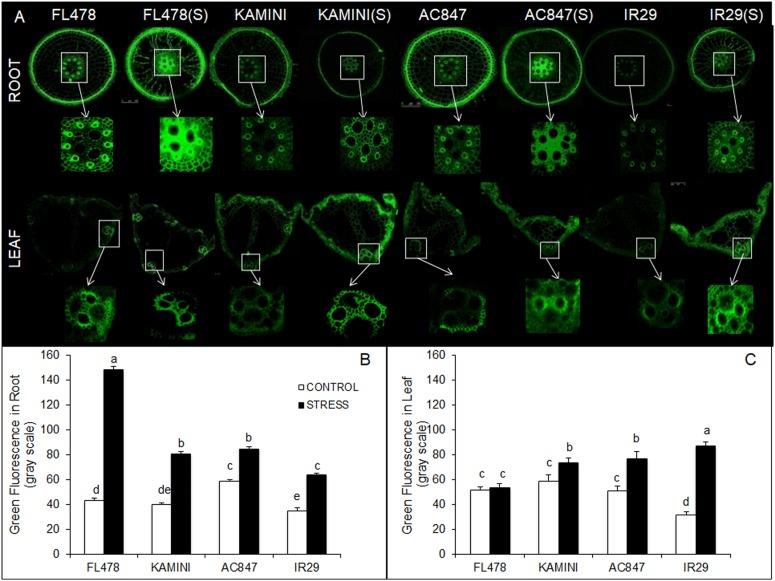
Salinity is one of the major constraints in rice production. To date, development of salt-tolerant rice cultivar is primarily focused on salt-exclusion strategies, which incur greater energy cost. The present study aimed to evaluate a balancing strategy of ionic discrimination tissue tolerance, which could potentially minimize the energy cost of salt tolerance in rice. Four rice genotypes, ., FL478, IR29, Kamini, and AC847, were grown hydroponically and subjected to salt stress equivalent to 12 dS m at early vegetative stage. Different physiological observations (leaf chlorophyll content, chlorophyll fluorescence traits, and tissue Na and K content) and visual scoring suggested a superior Na-partitioning strategy operating in FL478. A very low tissue Na/K ratio in the leaves of FL478 after 7 days of stress hinted the existence of selective ion transport mechanism in this genotype. On the contrary, Kamini, an equally salt-tolerant genotype, was found to possess a higher leaf Na/K ratio than does FL478 under similar stress condition. Salt-induced expression of different Na and K transporters indicated significant upregulation of , , , and groups of transporters in both leaves and roots of FL478, followed by Kamini. The expression of plasma membrane and vacuolar H pumps (, , and ) were also upregulated in these two genotypes. On the other hand, IR29 and AC847 showed greater salt susceptibility owing to excess upward transport of Na and eventually died within a few days of stress imposition. But in the "leaf clip" assay, it was found that both IR29 and Kamini had high tissue-tolerance and chlorophyll-retention abilities. On the contrary, FL478, although having higher ionic-discrimination ability, showed the least degree of tissue tolerance as evident from the LC score (amount of Na required to reduce the initial chlorophyll content to half) of 336 mmol g as against 459 and 424 mmol g for IR29 and Kamini, respectively. Overall, the present study indicated that two components (ionic selectivity and tissue tolerance) of salt tolerance mechanism are distinct in rice. Unique genotypes like Kamini could effectively balance both of these strategies to achieve considerable salt tolerance, perhaps with lesser energy cost.
盐分是水稻生产的主要限制因素之一。迄今为止,耐盐水稻品种的培育主要集中在排盐策略上,而这会产生更高的能量成本。本研究旨在评估离子区分与组织耐受性的平衡策略,这可能会使水稻耐盐的能量成本降至最低。四种水稻基因型,即FL478、IR29、卡米尼(Kamini)和AC847,采用水培法种植,并在营养生长早期施加相当于12 dS m的盐胁迫。不同的生理观测指标(叶片叶绿素含量、叶绿素荧光特性以及组织中钠和钾的含量)和视觉评分表明,FL478存在一种更优的钠分配策略。胁迫7天后,FL478叶片中极低的组织钠/钾比暗示该基因型中存在选择性离子转运机制。相反,同样耐盐的基因型卡米尼在相似胁迫条件下,其叶片钠/钾比高于FL478。不同钠和钾转运蛋白的盐诱导表达表明,FL478的叶片和根系中,、、、几组转运蛋白均显著上调,其次是卡米尼。这两种基因型中质膜和液泡H泵(、、)的表达也上调。另一方面,IR29和AC847因钠向上过量运输而表现出更高的盐敏感性,并在施加胁迫后的几天内死亡。但在“叶夹”试验中发现,IR29和卡米尼均具有较高的组织耐受性和叶绿素保留能力。相反,FL478虽然具有较高的离子区分能力,但从LC评分(将初始叶绿素含量降低一半所需的钠量)来看,其组织耐受性程度最低。FL478的LC评分为336 mmol g,而IR29和卡米尼分别为459 mmol g和424 mmol g。总体而言,本研究表明,水稻耐盐机制的两个组成部分(离子选择性和组织耐受性)是不同的。像卡米尼这样的独特基因型可以有效地平衡这两种策略,以实现相当程度的耐盐性,或许能量成本更低。




 Zotero 插件