
炎症生物标志物对神经母细胞瘤患者生存的预后价值
Prognostic Value of Inflammation Biomarkers for Survival of Patients with Neuroblastoma.
作者信息
Zheng Chen, Liu Shuaibin, Feng Jiexiong, Zhao Xiang
机构信息
Department of Pediatric Surgery, Tongji Hospital, Tongji Medical College, Huazhong University of Science and Technology, Wuhan, Hubei Province, People's Republic of China.
出版信息
Cancer Manag Res. 2020 Apr 1;12:2415-2425. doi: 10.2147/CMAR.S245622. eCollection 2020.
PURPOSE
The prognostic significance of inflammation-based biomarkers for neuroblastoma (NB) has not been investigated before. The aim of this study was to evaluate the prognostic value of pre-treatment inflammation biomarkers in children patients with NB.
PATIENTS AND METHODS
Patients diagnosed with NB from 2008 to 2016 in our institution were enrolled in this study. The clinical data and survival outcomes were retrospectively reviewed. Inflammation biomarkers or scores including C-reactive protein (CRP), albumin (ALB), Glasgow Prognostic Score (GPS), modified Glasgow Prognostic Score (mGPS), high-sensitivity modified Glasgow Prognostic Score (Hs-mGPS), neutrophil to lymphocyte ratio (NLR), platelet to lymphocyte ratio (PLR), lymphocyte to monocyte ratio (LMR) and system inflammation index (SII) were tested in this study. Univariate and multivariate survival analyses were performed to assess the prognostic value of these inflammation indicators for overall survival (OS) of children with NB. Kaplan-Meier survival curves were also conducted.
RESULTS
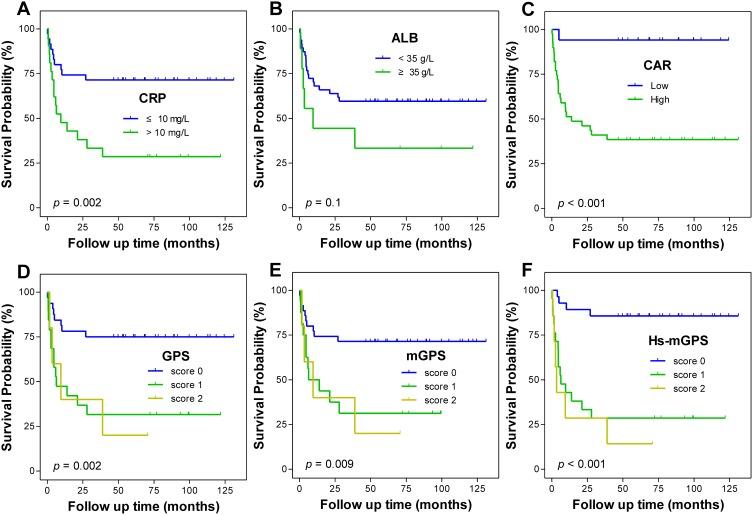
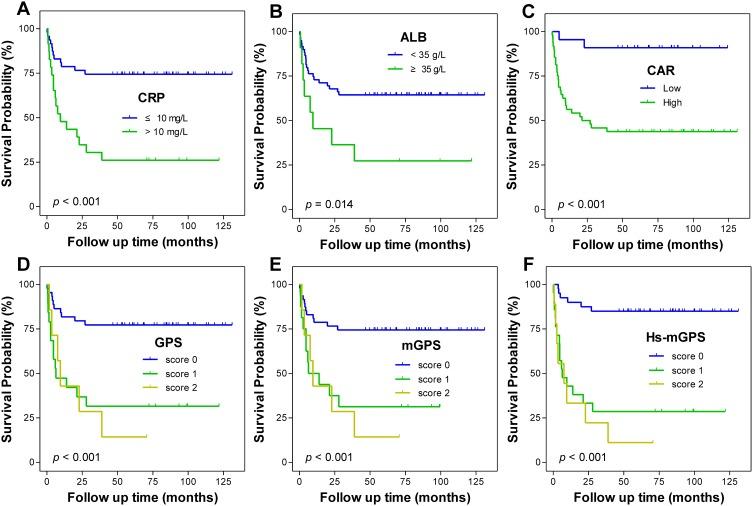
A total of 70 children diagnosed with neuroblastoma were enrolled in this study. NLR, PLR, LMR and SII were found to be not predictive of OS for NB patients. However, CRP, ALB, GPS and CAR were significantly associated with OS of NB patients. Multivariate analysis adjusting for age, sex, histology, tumor size, tumor stage and metastasis revealed that ALB, CAR, GPS and Hs-mGPS were significantly associated with OS of NB patients. Receiver operating characteristic (ROC) curves and Akaike Information Criterion (AIC) analyses revealed that Hs-mGPS is superior to other inflammation biomarkers in predicting OS of NB patients. Subgroup survival analysis for immature NB patients revealed similar results.
CONCLUSION
Hs-mGPS is an effective prognostic factor for OS of patients with NB and is promising to be used as a factor for risk stratification and an indicator for more aggressive therapy.
目的
基于炎症的生物标志物对神经母细胞瘤(NB)的预后意义此前尚未得到研究。本研究的目的是评估预处理炎症生物标志物在NB儿童患者中的预后价值。
患者与方法
纳入2008年至2016年在本机构诊断为NB的患者。对临床数据和生存结局进行回顾性分析。本研究检测了炎症生物标志物或评分,包括C反应蛋白(CRP)、白蛋白(ALB)、格拉斯哥预后评分(GPS)、改良格拉斯哥预后评分(mGPS)、高敏改良格拉斯哥预后评分(Hs-mGPS)、中性粒细胞与淋巴细胞比值(NLR)、血小板与淋巴细胞比值(PLR)、淋巴细胞与单核细胞比值(LMR)以及全身炎症指数(SII)。进行单因素和多因素生存分析以评估这些炎症指标对NB儿童总生存(OS)的预后价值。还绘制了Kaplan-Meier生存曲线。
结果
本研究共纳入70例诊断为神经母细胞瘤的儿童。发现NLR、PLR、LMR和SII对NB患者的OS无预测价值。然而,CRP、ALB、GPS和CAR与NB患者的OS显著相关。在对年龄、性别、组织学、肿瘤大小、肿瘤分期和转移进行校正的多因素分析中,发现ALB、CAR、GPS和Hs-mGPS与NB患者的OS显著相关。受试者工作特征(ROC)曲线和赤池信息准则(AIC)分析显示,Hs-mGPS在预测NB患者的OS方面优于其他炎症生物标志物。对未成熟NB患者的亚组生存分析得出了类似结果。
结论
Hs-mGPS是NB患者OS的有效预后因素,有望用作风险分层因素和更积极治疗的指标。

 Zotero 插件