
木糖醇和赤藓糖醇对致龋菌的单一和协同作用的探索。
Exploration of singular and synergistic effect of xylitol and erythritol on causative agents of dental caries.
机构信息
Department of Microbiology, Institute of Biomedicine and Translational Medicine, University of Tartu, Tartu, Estonia.
Cargill R&D Centre Europe, Vilvoorde, Belgium.
出版信息
Sci Rep. 2020 Apr 14;10(1):6297. doi: 10.1038/s41598-020-63153-x.
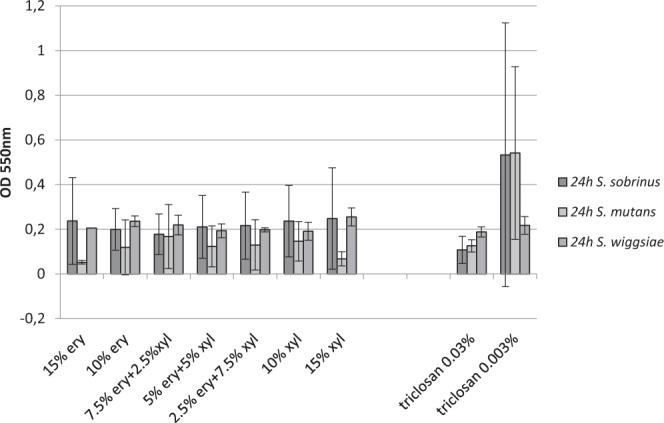
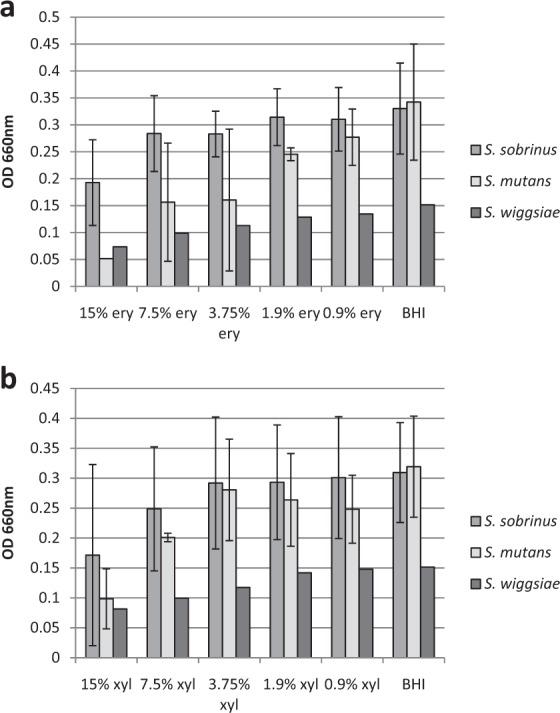
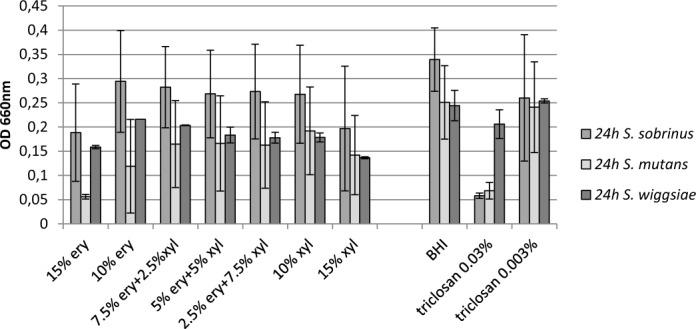
Non-cariogenic sweet substances, like sugar alcohols, are used to decrease the risk of caries by reducing the growth of dental plaque. The aim of our study was to reveal the impact of xylitol and erythritol on the growth and biofilm formation of cariogenic bacteria including as a novelty, set of clinical mutans streptococci and Scardovia wiggsiae and to assess the possible synergistic influence of these polyols. We found both xylitol and erythritol to express high growth inhibition effect on cariogenic bacteria. In synergistic effect experiments, 10% polyol combination with excess of erythritol was found to be more effective against growth of Streptococcus mutans and the combination with excess of xylitol more effective against growth of Streptococcus sobrinus and S. wiggsiae. In biofilm inhibition experiments, solutions of 10% polyols in different combinations and 15% single polyols were equally effective against mutans streptococci. At the same time, higher biofilm formation of S. wiggsiae compared to experiments without polyols was detected in different polyol concentrations for up to 34%. In conclusion, both erythritol and xylitol as well as their combinations inhibit the growth of different cariogenic bacteria. Biofilm formation of mutans streptococci is also strongly inhibited. When applying polyols in caries prophylaxis, it is relevant to consider that the profile of pathogens in a particular patient may influence the effect of polyols used.
非致龋性甜味剂,如糖醇,被用于通过减少牙菌斑的生长来降低龋齿风险。我们的研究目的是揭示木糖醇和赤藓糖醇对致龋细菌(包括一组新型临床变异链球菌和斯卡尔多维亚菌)的生长和生物膜形成的影响,并评估这些多元醇可能的协同影响。我们发现木糖醇和赤藓糖醇对致龋细菌均表现出高生长抑制作用。在协同作用实验中,发现 10%多元醇与过量赤藓糖醇的组合对变形链球菌的生长更有效,而与过量木糖醇的组合对变形链球菌和斯卡尔多维亚菌的生长更有效。在生物膜抑制实验中,不同组合的 10%多元醇溶液和 15%单一多元醇溶液对变形链球菌的抑制效果相同。同时,在高达 34%的不同多元醇浓度下,与无多元醇的实验相比,斯卡尔多维亚菌的生物膜形成更高。总之,赤藓糖醇和木糖醇及其组合均能抑制不同致龋细菌的生长。变形链球菌的生物膜形成也受到强烈抑制。在龋病预防中应用多元醇时,需要考虑特定患者中病原体的特征可能会影响所用多元醇的效果。
 Zotero 插件