
肠道微生物代谢产物三甲胺 N-氧化物通过诱导小鼠 M1 巨噬细胞极化加重移植物抗宿主病。
The gut microbial metabolite trimethylamine N-oxide aggravates GVHD by inducing M1 macrophage polarization in mice.
机构信息
Department of Hematology, Huashan Hospital, Fudan University, Shanghai, China; and.
Department of Gynecology, Obstetrics & Gynecology Hospital, Fudan University, Shanghai, China.
出版信息
Blood. 2020 Jul 23;136(4):501-515. doi: 10.1182/blood.2019003990.
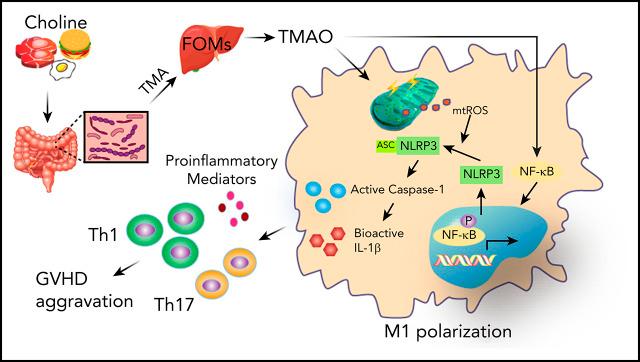
The diversity of the human microbiome heralds the difference of the impact that gut microbial metabolites exert on allogenic graft-versus-host (GVH) disease (GVHD), even though short-chain fatty acids and indole were demonstrated to reduce its severity. In this study, we dissected the role of choline-metabolized trimethylamine N-oxide (TMAO) in the GVHD process. Either TMAO or a high-choline diet enhanced the allogenic GVH reaction, whereas the analog of choline, 3,3-dimethyl-1-butanol reversed TMAO-induced GVHD severity. Interestingly, TMAO-induced alloreactive T-cell proliferation and differentiation into T-helper (Th) subtypes was seen in GVHD mice but not in in vitro cultures. We thus investigated the role of macrophage polarization, which was absent from the in vitro culture system. F4/80+CD11b+CD16/32+ M1 macrophage and signature genes, IL-1β, IL-6, TNF-α, CXCL9, and CXCL10, were increased in TMAO-induced GVHD tissues and in TMAO-cultured bone marrow-derived macrophages (BMDMs). Inhibition of the NLRP3 inflammasome reversed TMAO-stimulated M1 features, indicating that NLRP3 is the key proteolytic activator involved in the macrophage's response to TMAO stimulation. Consistently, mitochondrial reactive oxygen species and enhanced NF-κB nuclear relocalization were investigated in TMAO-stimulated BMDMs. In vivo depletion of NLRP3 in GVHD recipients not only blocked M1 polarization but also reversed GVHD severity in the presence of TMAO treatment. In conclusion, our data revealed that TMAO-induced GVHD progression resulted from Th1 and Th17 differentiation, which is mediated by the polarized M1 macrophage requiring NLRP3 inflammasome activation. It provides the link among the host choline diet, microbial metabolites, and GVH reaction, shedding light on alleviating GVHD by controlling choline intake.
人类微生物组的多样性预示着肠道微生物代谢产物对同种异体移植物抗宿主病(GVHD)的影响存在差异,尽管短链脂肪酸和吲哚已被证明可以减轻其严重程度。在这项研究中,我们剖析了胆碱代谢产物三甲胺 N-氧化物(TMAO)在 GVHD 过程中的作用。TMAO 或高胆碱饮食增强了同种异体 GVH 反应,而胆碱类似物 3,3-二甲基-1-丁醇则逆转了 TMAO 诱导的 GVHD 严重程度。有趣的是,在 GVHD 小鼠中观察到 TMAO 诱导的同种反应性 T 细胞增殖和分化为 T 辅助(Th)亚型,但在体外培养中则没有。因此,我们研究了巨噬细胞极化的作用,而这种作用在体外培养系统中是不存在的。F4/80+CD11b+CD16/32+M1 巨噬细胞和特征基因,如 IL-1β、IL-6、TNF-α、CXCL9 和 CXCL10,在 TMAO 诱导的 GVHD 组织和 TMAO 培养的骨髓来源巨噬细胞(BMDM)中增加。NLRP3 炎性小体的抑制逆转了 TMAO 刺激的 M1 特征,表明 NLRP3 是参与巨噬细胞对 TMAO 刺激反应的关键蛋白水解激活剂。一致地,在 TMAO 刺激的 BMDM 中研究了线粒体活性氧和增强的 NF-κB 核重定位。在 GVHD 受者体内耗尽 NLRP3 不仅阻断了 M1 极化,而且在 TMAO 治疗存在的情况下逆转了 GVHD 的严重程度。总之,我们的数据表明,TMAO 诱导的 GVHD 进展是由 Th1 和 Th17 分化引起的,这是由需要 NLRP3 炎性小体激活的极化 M1 巨噬细胞介导的。它提供了宿主胆碱饮食、微生物代谢产物和 GVH 反应之间的联系,为通过控制胆碱摄入来缓解 GVHD 提供了思路。
 Zotero 插件