
病毒大小和附着参数如何影响病毒与宿主细胞结合的温度敏感性:虫媒病毒和HIV热力学模型的预测
How virus size and attachment parameters affect the temperature sensitivity of virus binding to host cells: Predictions of a thermodynamic model for arboviruses and HIV.
作者信息
Gale Paul
机构信息
Independent Scientist, 15 Weare Close, Portland, Dorset, DT5 1JP, United Kingdom.
出版信息
Microb Risk Anal. 2020 Aug;15:100104. doi: 10.1016/j.mran.2020.100104. Epub 2020 Mar 12.
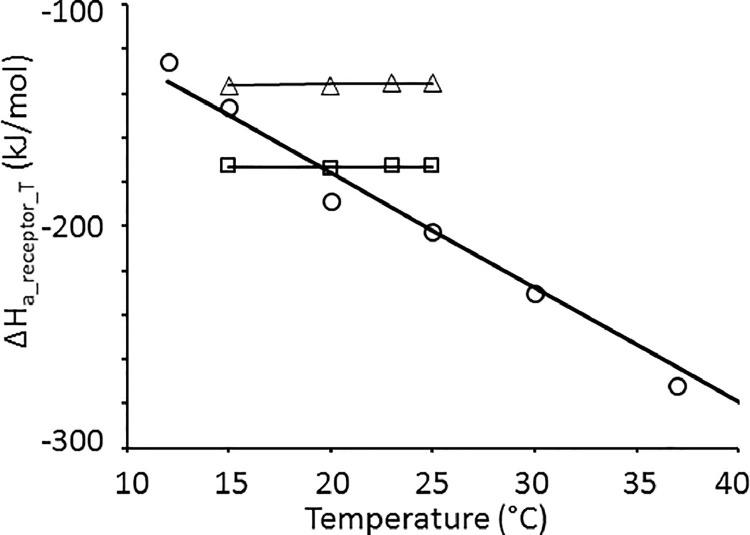
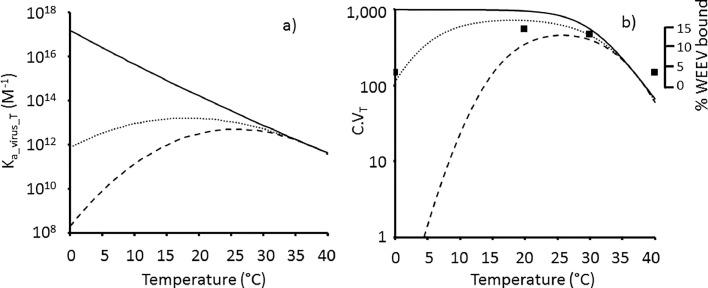
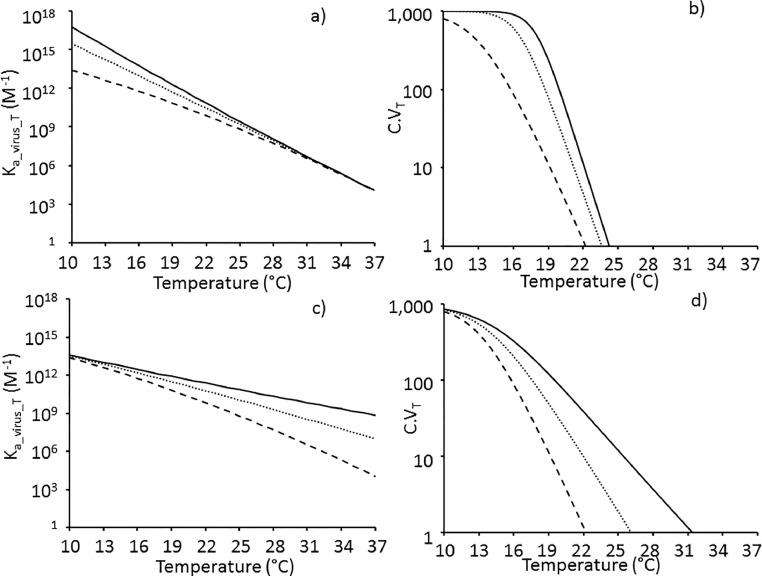
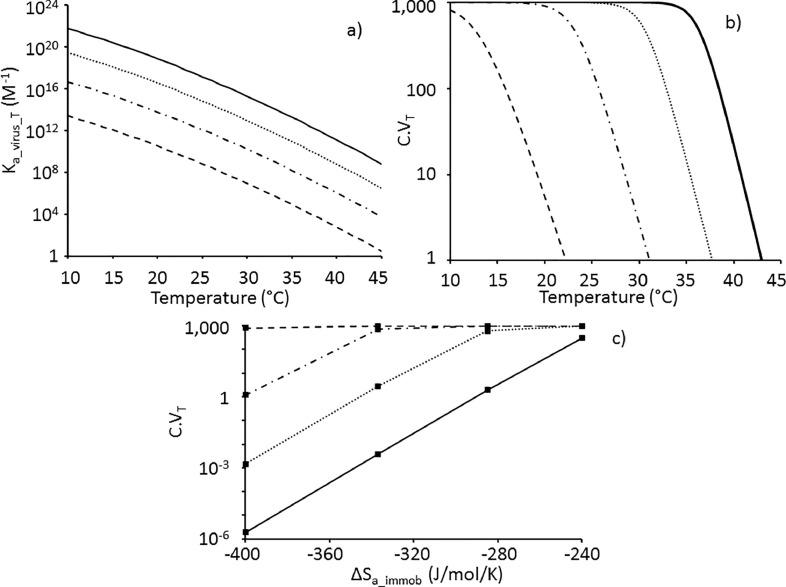
Virus binding to host cells involves specific interactions between viral (glyco)proteins (GP) and host cell surface receptors (Cr) (protein or sialic acid (SA)). The magnitude of the enthalpy of association changes with temperature according to the change in heat capacity (ΔC) on GP/Cr binding, being little affected for avian influenza virus (AIV) haemagglutinin (HA) binding to SA (ΔC = 0 kJ/mol/K) but greatly affected for HIV gp120 binding to CD4 receptor (ΔC = -5.0 kJ/mol/K). A thermodynamic model developed here predicts that values of ΔC from 0 to ~-2.0 kJ/mol/K have relatively little impact on the temperature sensitivity of the number of mosquito midgut cells with bound arbovirus, while intermediate values of ΔC of ~-3.0 kJ/mol/K give a peak binding at a temperature of ~20 °C as observed experimentally for Western equine encephalitis virus. More negative values of ΔC greatly decrease arbovirus binding at temperatures below ~20 °C. Thus to promote transmission at low temperatures, arboviruses may benefit from ΔC ~ 0 kJ/mol/K as for HA/SA and it is interesting that bluetongue virus binds to SA in midge midguts. Large negative values of ΔC as for HIV gp120:CD4 diminish binding at 37 °C. Of greater importance, however, is the decrease in entropy of the whole virus (ΔS) on its immobilisation on the host cell surface. ΔS presents a repulsive force which the enthalpy-driven GP/Cr interactions weakened at higher temperatures struggle to overcome. ΔS is more negative (less favourable) for larger diameter viruses which therefore show diminished binding at higher temperatures than smaller viruses. It is proposed that small size phenotype through a less negative ΔS is selected for viruses infecting warmer hosts thus explaining the observation that virion volume decreases with increasing host temperature from 0 °C to 40 °C in the case of dsDNA viruses. Compared to arboviruses which also infect warm-blooded vertebrates, HIV is large at 134 nm diameter and thus would have a large negative ΔS which would diminish its binding at human body temperature. It is proposed that prior non-specific binding of HIV through attachment factors takes much of the entropy loss for ΔS so enhancing subsequent specific gp120:CD4 binding at 37 °C. This is consistent with the observation that HIV attachment factors are not essential but augment infection. Antiviral therapies should focus on increasing virion size, for example through binding of zinc oxide nanoparticles to herpes simplex virus, hence making ΔS more negative, and thus reducing binding affinity at 37 °C.
病毒与宿主细胞的结合涉及病毒(糖)蛋白(GP)与宿主细胞表面受体(Cr)(蛋白质或唾液酸(SA))之间的特异性相互作用。结合焓的大小随温度变化,这取决于GP/Cr结合时热容(ΔC)的变化,禽流感病毒(AIV)血凝素(HA)与SA的结合受其影响较小(ΔC = 0 kJ/mol/K),而HIV gp120与CD4受体的结合则受其显著影响(ΔC = -5.0 kJ/mol/K)。这里建立的一个热力学模型预测,ΔC值在0至约-2.0 kJ/mol/K之间对结合虫媒病毒的蚊子中肠细胞数量的温度敏感性影响相对较小,而ΔC约为-3.0 kJ/mol/K的中间值在约20°C时会出现结合峰值,正如西部马脑炎病毒的实验观测结果。ΔC更负的值会在低于约20°C的温度下大幅降低虫媒病毒的结合。因此,为了在低温下促进传播,虫媒病毒可能会像HA/SA那样受益于ΔC约为0 kJ/mol/K,有趣的是蓝舌病毒在蠓的中肠中与SA结合。像HIV gp120:CD4那样的大的负ΔC值会在37°C时减少结合。然而,更重要的是整个病毒在固定于宿主细胞表面时熵的减少(ΔS)。ΔS呈现出一种排斥力,在较高温度下由焓驱动的GP/Cr相互作用减弱,难以克服这种排斥力。对于直径较大的病毒,ΔS更负(更不利),因此与较小的病毒相比,它们在较高温度下的结合会减少。有人提出,对于感染温暖宿主的病毒,通过选择较小的负ΔS的小尺寸表型,因此可以解释这样的观测结果:对于双链DNA病毒,病毒粒子体积随着宿主温度从0°C升高到40°C而减小。与也感染温血脊椎动物的虫媒病毒相比,HIV直径为134 nm,较大,因此会有较大的负ΔS,这会减少其在人体温度下的结合。有人提出,HIV通过附着因子进行的先前非特异性结合承担了大部分的ΔS熵损失,从而增强了随后在37°C时特异性的gp120:CD4结合。这与HIV附着因子并非必不可少但能增强感染的观测结果一致。抗病毒疗法应专注于增加病毒粒子大小,例如通过氧化锌纳米颗粒与单纯疱疹病毒结合,从而使ΔS更负,进而降低在37°C时的结合亲和力。


 Zotero 插件