
长链非编码RNA作为一种新兴的表观遗传因子在决定干细胞命运中发挥作用。
LncRNA Functions as a New Emerging Epigenetic Factor in Determining the Fate of Stem Cells.
作者信息
Chen Jingcheng, Wang Yizhuo, Wang Cong, Hu Ji-Fan, Li Wei
机构信息
Cancer Center, The First Hospital of Jilin University, Changchun, China.
VA Palo Alto Health Care System, Stanford Medical School, Stanford University, Palo Alto, CA, United States.
出版信息
Front Genet. 2020 Mar 31;11:277. doi: 10.3389/fgene.2020.00277. eCollection 2020.
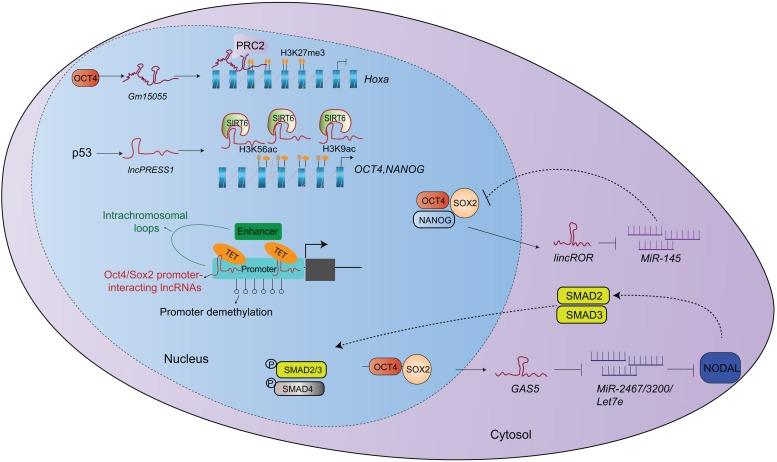
Pluripotent stem cells have broad applications in regenerative medicine and offer ideal models for understanding the biological process of embryonic development and specific diseases. Studies suggest that the self-renewal and multi-lineage differentiation of stem cells are regulated by a complex network consisting of transcription factors, chromatin regulators, signaling factors, and non-coding RNAs. It is of great interest to identify RNA regulatory factors that determine the fate of stem cells. Long non-coding RNA (lncRNA), a class of non-coding RNAs with more than 200 bp in length, has been shown to act as essential epigenetic regulators of stem cell pluripotency and specific lineage commitment. In this review, we focus on recent research progress related to the function and epigenetic mechanisms of lncRNA in determining the fate of stem cells, particularly pluripotency maintenance and lineage-specific differentiation. We discuss the role of the and promoter-interacting lncRNA as identified by Chromatin RNA reverse Transcription sequencing (CRIST-seq). Further understanding of their potential actions will provide a basis for the development of regenerative medicine for clinical application. This work offers comprehensive details and better understanding of the role of lncRNA in determining the fate of stem cells and paves the way for clinical stem cell applications.
多能干细胞在再生医学中具有广泛应用,并为理解胚胎发育和特定疾病的生物学过程提供了理想模型。研究表明,干细胞的自我更新和多谱系分化受一个由转录因子、染色质调节因子、信号因子和非编码RNA组成的复杂网络调控。识别决定干细胞命运的RNA调节因子具有重要意义。长链非编码RNA(lncRNA)是一类长度超过200 bp的非编码RNA,已被证明是干细胞多能性和特定谱系定向分化的重要表观遗传调节因子。在本综述中,我们重点关注lncRNA在决定干细胞命运,特别是多能性维持和谱系特异性分化方面的功能及表观遗传机制的最新研究进展。我们讨论了通过染色质RNA逆转录测序(CRIST-seq)鉴定的与启动子相互作用的lncRNA的作用。进一步了解它们的潜在作用将为临床应用的再生医学发展提供基础。这项工作提供了关于lncRNA在决定干细胞命运中作用的全面细节和更好理解,并为临床干细胞应用铺平了道路。


 Zotero 插件