
双功能抗 PD-L1/IL-15 超级激动剂的功能和机制优势。
Functional and mechanistic advantage of the use of a bifunctional anti-PD-L1/IL-15 superagonist.
机构信息
Laboratory of Tumor Immunology and Biology, Center for Cancer Research, National Cancer Institute, Bethesda, Maryland, USA.
Laboratory of Tumor Immunology and Biology, Center for Cancer Research, National Cancer Institute, Bethesda, Maryland, USA
出版信息
J Immunother Cancer. 2020 Apr;8(1). doi: 10.1136/jitc-2019-000493.
BACKGROUND
Anti(α)-programmed cell death-1 (PD-1)/programmed death-ligand 1 (PD-L1) monotherapy fails to provide durable clinical benefit for most patients with carcinoma. Recent studies suggested that strategies to reduce immunosuppressive cells, promote systemic T-cell responses and lymphocyte trafficking to the tumor microenvironment (TME) may improve efficacy. N-809 is a first-in-class bifunctional agent comprising the interleukin (IL)-15 superagonist N-803 fused to two αPD-L1 domains. Thus, N-809 can potentially stimulate effector immune cells through IL-15 and block immunosuppressive PD-L1. Here, we examined the antitumor efficacy and immunomodulatory effects of N-809 versus N-803+αPD-L1 combination.
METHODS
The ability of N-809 to block PD-L1 and induce IL-15-dependent immune effects was examined in vitro and in vivo. Antitumor efficacy of N-809 or N-803+αPD-L1 was evaluated in two murine carcinoma models and an extensive analysis of immune correlates was performed in the tumor and tumor-draining lymph node (dLN).
RESULTS
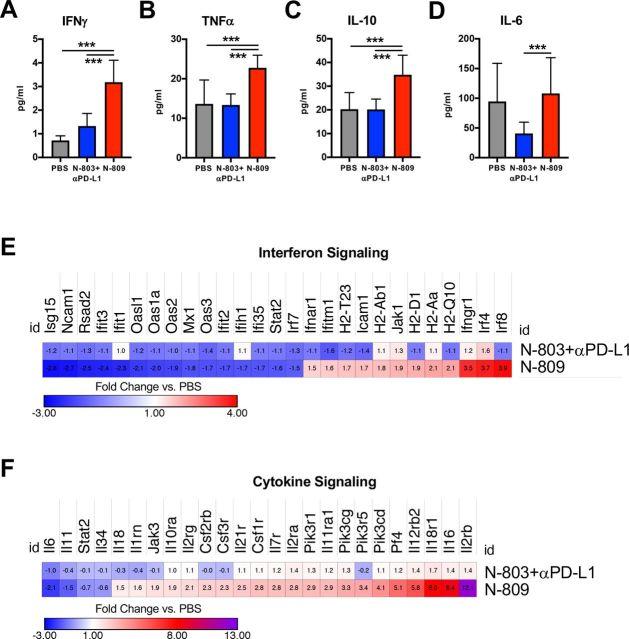
We demonstrate that N-809 blocks PD-L1 and induces IL-15-dependent immune effects. N-809 was well-tolerated and reduced 4T1 lung metastasis, decreased MC38 tumor burden and increased survival versus N-803+αPD-L1. Compared with N-803+αPD-L1, N-809 enhanced natural killer (NK) and CD8 T-cell activation and function in the dLN and TME, relating to increased gene expression associated with interferon and cytokine signaling, lymphoid compartment, costimulation and cytotoxicity. The higher number of TME CD8 T cells was attributed to enhanced infiltration, not in situ expansion. Increased TME NK and CD8 T-cell numbers correlated with augmented chemokine ligands and receptors. Moreover, in contrast to N-803+αPD-L1, N-809 reduced immunosuppressive regulatory T cells (T), monocytic myeloid-derived suppressor cells (M-MDSC) and M2-like macrophages in the TME.
CONCLUSIONS
Our results suggest that N-809 functions by a novel immune mechanism to promote antitumor efficacy. Foremost, N-809 enhances intratumoral lymphocyte numbers by increasing trafficking via altered chemokine levels in the TME and chemokine receptor expression on CD8 T cells and NK cells. In addition, N-809 reduces immunosuppressive and pro-tumorigenic immune cells in the TME, including T, M2-like macrophages and M-MDSC. Overall, these novel effects of N-809 promote an inflamed TME, leading to lower tumor burden and increased survival. These results provide mechanistic insight and rationale supporting the potential clinical study of N-809 in patients with carcinoma.
背景
抗(α)-程序性细胞死亡-1(PD-1)/程序性死亡配体 1(PD-L1)单药治疗未能为大多数癌患者提供持久的临床获益。最近的研究表明,减少免疫抑制细胞、促进全身 T 细胞反应和淋巴细胞向肿瘤微环境(TME)转移的策略可能会提高疗效。N-809 是一种首创的双功能药物,由白细胞介素(IL)-15 超激动剂 N-803 与两个 αPD-L1 结构域融合而成。因此,N-809 可以通过 IL-15 刺激效应免疫细胞,并阻断免疫抑制性 PD-L1。在这里,我们研究了 N-809 与 N-803+αPD-L1 联合治疗的抗肿瘤疗效和免疫调节作用。
方法
在体外和体内研究了 N-809 阻断 PD-L1 和诱导 IL-15 依赖性免疫效应的能力。在两种小鼠癌模型中评估了 N-809 或 N-803+αPD-L1 的抗肿瘤疗效,并在肿瘤和肿瘤引流淋巴结(dLN)中进行了广泛的免疫相关性分析。
结果
我们证明 N-809 阻断 PD-L1 并诱导 IL-15 依赖性免疫效应。N-809 耐受性良好,可降低 4T1 肺转移、减少 MC38 肿瘤负担并提高存活率,优于 N-803+αPD-L1。与 N-803+αPD-L1 相比,N-809 在 dLN 和 TME 中增强了自然杀伤(NK)和 CD8 T 细胞的激活和功能,与干扰素和细胞因子信号、淋巴细胞区室、共刺激和细胞毒性相关的基因表达增加有关。TME CD8 T 细胞数量的增加归因于浸润的增强,而不是原位扩增。TME NK 和 CD8 T 细胞数量的增加与趋化因子配体和受体的增加有关。此外,与 N-803+αPD-L1 相比,N-809 减少了 TME 中的免疫抑制性调节性 T 细胞(T)、单核细胞来源的髓样抑制细胞(M-MDSC)和 M2 样巨噬细胞。
结论
我们的结果表明,N-809 通过一种新的免疫机制发挥作用,以促进抗肿瘤疗效。最重要的是,N-809 通过改变 TME 中的趋化因子水平和 CD8 T 细胞和 NK 细胞上的趋化因子受体表达,增加了肿瘤内淋巴细胞的迁移,从而增加了肿瘤内淋巴细胞的数量。此外,N-809 减少了 TME 中的免疫抑制性和促肿瘤生成性免疫细胞,包括 T、M2 样巨噬细胞和 M-MDSC。总体而言,N-809 的这些新作用促进了炎症性 TME 的形成,从而降低了肿瘤负担并提高了生存率。这些结果提供了机制上的见解,并为 N-809 在癌患者中的潜在临床研究提供了依据。




 Zotero 插件