
肺瘤平膏治疗外泌体在Lewis异种移植小鼠模型肺癌中的抗血管生成作用
Antiangiogenesis Roles of Exosomes with Fei-Liu-Ping Ointment Treatment are Involved in the Lung Carcinoma with the Lewis Xenograft Mouse Model.
作者信息
Zheng Qi, Liu Haolong, Fan Huiting, Zhang Ying, Hou Wei
机构信息
Oncology Department, Guang'anmen Hospital, China Academy of Chinese Medical Sciences, Beijing 100053, China.
Beijing Institute for Drug Control, NMPA Key Laboratory for Quality Evaluation of Traditional Chinese Medicine (Traditional Chinese Patent Medicine), Beijing Key Laboratory of Analysis and Evaluation on Chinese Medicine, Beijing 102206, China.
出版信息
Evid Based Complement Alternat Med. 2020 Apr 5;2020:9418593. doi: 10.1155/2020/9418593. eCollection 2020.
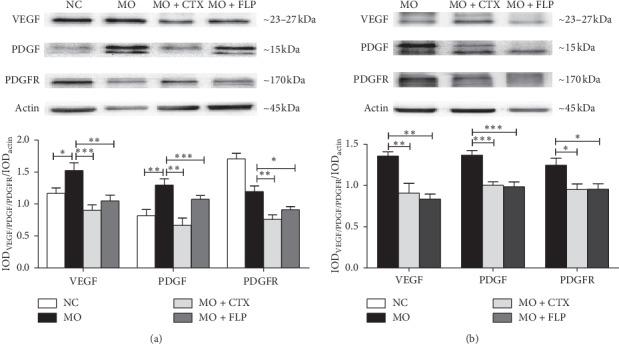
Exosomes display efficient biocompatibility and represent valuable vehicles for drug or effective material delivery in a tumour-therapeutic approach. Following treatment with Fei-Liu-Ping (FLP) ointment, a traditional Chinese herbal formula, which is used for treating lung cancer patients, could inhibit lung carcinoma growth in clinical and animal studies. In the present study, the values of VEGF and PDGF, which were closely related to angiogenesis, were estimated in serum and carcinoma tissue exosomes to unveil the FLP effects on angiogenesis. The common inflammatory factors of IL-6, IL-1, TNF-, and TGF- in serum exosomes were also detected with the Lewis xenograft model. . Male C57BL/6 mice were randomly divided into four groups, namely, normal, model, cyclophosphamide (CTX), and FLP treatment groups. Histological structures were observed and imaged by H&E. CD31 expressions in tumour tissues were detected by immunofluorescence (IF) and western blot (WB). VEGF, PDGF, and PDGFR levels in exosomes, serum, tumour, and lung tissues were detected by enzyme-linked immunosorbent assay (ELISA), immunohistochemistry (IHC), and WB, respectively. IL-6, IL-1, TNF-, and TGF- levels in exosomes were measured by multiplex immunoassay panels. . The results showed that FLP had tumour growth inhibition rate (39.31%). CD31 protein expression was obviously decreased in tumour tissues of CTX- and FLP-treated MO mice, compared to that of MO mice ( < 0.05 or < 0.001). VEGF, PDGF, and PDGFR expression levels with FLP treatment were downregulated in exosomes, serum, tumour, and lung tissues compared to model group ( < 0.05 or < 0.01). The expressions of IL-6, IL-1, and TNF- were downregulated in exosomes compared to the model group ( < 0.05 or < 0.01). . This study suggested that FLP had the ability of inhibiting tumourigenesis in a Lewis lung xenograft mouse model, whose therapeutic mechanisms might relate with the downregulation of angiogenesis factor and tumour inflammatory cytokines levels.
外泌体具有高效的生物相容性,是肿瘤治疗中药物或有效物质递送的重要载体。在临床和动物研究中,用于治疗肺癌患者的传统中药配方肺瘤平膏(FLP)治疗后可抑制肺癌生长。在本研究中,评估血清和癌组织外泌体中与血管生成密切相关的VEGF和PDGF值,以揭示FLP对血管生成的影响。还利用Lewis异种移植模型检测血清外泌体中常见的炎症因子IL-6、IL-1、TNF-α和TGF-β。雄性C57BL/6小鼠随机分为四组,即正常组、模型组、环磷酰胺(CTX)组和FLP治疗组。通过苏木精-伊红染色(H&E)观察组织学结构并成像。通过免疫荧光(IF)和蛋白质印迹法(WB)检测肿瘤组织中CD31的表达。分别通过酶联免疫吸附测定(ELISA)、免疫组织化学(IHC)和WB检测外泌体、血清、肿瘤和肺组织中VEGF、PDGF和PDGFR的水平。通过多重免疫测定板测量外泌体中IL-6、IL-1、TNF-α和TGF-β的水平。结果表明,FLP具有肿瘤生长抑制率(39.31%)。与模型组小鼠相比,CTX和FLP治疗的模型组小鼠肿瘤组织中CD31蛋白表达明显降低(P<0.05或P<0.001)。与模型组相比,FLP治疗后外泌体、血清、肿瘤和肺组织中VEGF、PDGF和PDGFR表达水平下调(P<0.05或P<0.01)。与模型组相比,外泌体中IL-6、IL-1和TNF-α的表达下调(P<0.05或P<0.01)。本研究表明,FLP在Lewis肺癌异种移植小鼠模型中具有抑制肿瘤发生的能力,其治疗机制可能与血管生成因子和肿瘤炎症细胞因子水平的下调有关。


 Zotero 插件