
使用临床级别的可溶性人血管紧张素转化酶 2 抑制工程化人类组织中的 SARS-CoV-2 感染。
Inhibition of SARS-CoV-2 Infections in Engineered Human Tissues Using Clinical-Grade Soluble Human ACE2.
机构信息
Karolinska Institute and Karolinska University Hospital, Department of Laboratory Medicine, Unit of Clinical Microbiology, 17177 Stockholm, Sweden.
National Veterinary Institute, 751 89 Uppsala, Sweden.
出版信息
Cell. 2020 May 14;181(4):905-913.e7. doi: 10.1016/j.cell.2020.04.004. Epub 2020 Apr 24.
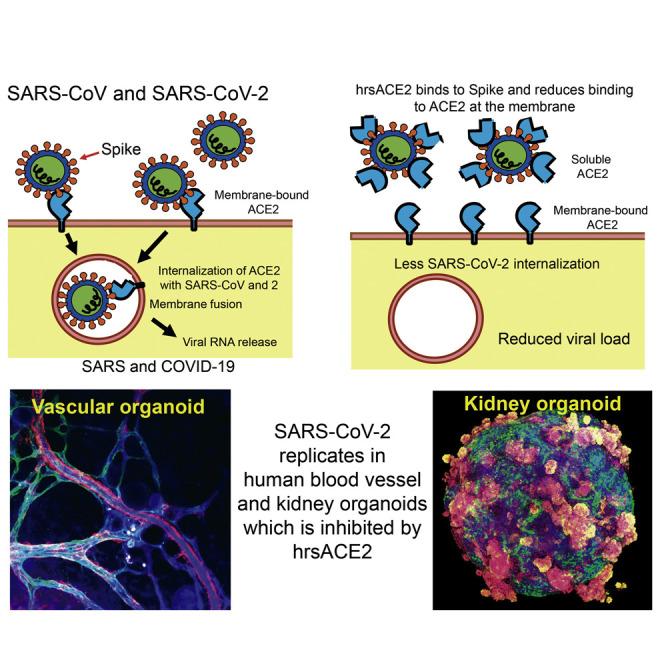
We have previously provided the first genetic evidence that angiotensin converting enzyme 2 (ACE2) is the critical receptor for severe acute respiratory syndrome coronavirus (SARS-CoV), and ACE2 protects the lung from injury, providing a molecular explanation for the severe lung failure and death due to SARS-CoV infections. ACE2 has now also been identified as a key receptor for SARS-CoV-2 infections, and it has been proposed that inhibiting this interaction might be used in treating patients with COVID-19. However, it is not known whether human recombinant soluble ACE2 (hrsACE2) blocks growth of SARS-CoV-2. Here, we show that clinical grade hrsACE2 reduced SARS-CoV-2 recovery from Vero cells by a factor of 1,000-5,000. An equivalent mouse rsACE2 had no effect. We also show that SARS-CoV-2 can directly infect engineered human blood vessel organoids and human kidney organoids, which can be inhibited by hrsACE2. These data demonstrate that hrsACE2 can significantly block early stages of SARS-CoV-2 infections.
我们之前提供了第一个遗传证据,证明血管紧张素转换酶 2(ACE2)是严重急性呼吸综合征冠状病毒(SARS-CoV)的关键受体,ACE2 可保护肺部免受损伤,为 SARS-CoV 感染导致的严重肺衰竭和死亡提供了分子解释。ACE2 现在也被确定为 SARS-CoV-2 感染的关键受体,有人提出抑制这种相互作用可能用于治疗 COVID-19 患者。然而,目前尚不清楚人重组可溶性 ACE2(hrsACE2)是否能阻止 SARS-CoV-2 的生长。在这里,我们发现临床级 hrsACE2 将 SARS-CoV-2 从 Vero 细胞中的恢复降低了 1000-5000 倍。等效的小鼠 rsACE2 没有影响。我们还表明,SARS-CoV-2 可以直接感染工程化的人血管类器官和人肾类器官,而 hrsACE2 可以抑制这种感染。这些数据表明,hrsACE2 可以显著阻断 SARS-CoV-2 感染的早期阶段。


 Zotero 插件