
空气过滤器对空气传播感染性病毒的抗病毒效率测定
Determination of Air Filter Anti-Viral Efficiency against an Airborne Infectious Virus.
作者信息
Park Dae Hoon, Joe Yun Haeng, Piri Amin, An Sanggwon, Hwang Jungho
机构信息
School of Mechanical Engineering, Yonsei University, Seoul 03722, Republic of Korea.
Climate Change Research Division, Korea Institute of Energy Research, Daejeon 34129, Republic of Korea.
出版信息
J Hazard Mater. 2020 Sep 5;396:122640. doi: 10.1016/j.jhazmat.2020.122640. Epub 2020 Apr 12.
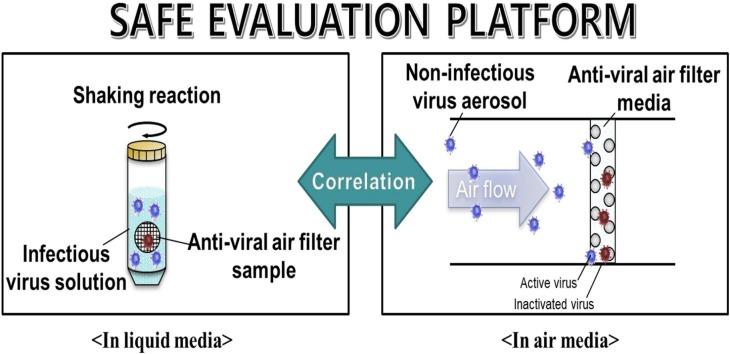
Recently, various studies have reported the prevention and treatment of respiratory infection outbreaks caused by lethal viruses. Consequently, a variety of air filters coated with antimicrobial agents have been developed to capture and inactivate virus particles in continuous airflow conditions. However, since aerosolized infectious viral-testing is inadvisable due to safety concerns, their anti-viral capability has only been tested by inserting the filters into liquid media, where infectious virus particles disperse. In this study a novel method of determining anti-viral performance of an air filter against airborne infectious viruses is presented. Initially, anti-viral air filter tests were conducted. Firstly, by an air-media test, in which the air filter was placed against an aerosolized non-infectious virus. Secondly, by a liquid-media test, in which the filter was inserted into a liquid medium containing a non-infectious virus. Subsequently, a correlation was established by comparing the susceptibility constants obtained between the two medium tests and an association was found for the air medium test with infectious virus. After ensuring the relationship did not depend on the virus species, the correlation was used to derive the results of the air-medium test from the results of the liquid-medium test.
最近,多项研究报告了对由致命病毒引起的呼吸道感染爆发的预防和治疗。因此,已开发出各种涂有抗菌剂的空气过滤器,以在连续气流条件下捕获并灭活病毒颗粒。然而,由于出于安全考虑,雾化传染性病毒检测不可取,其抗病毒能力仅通过将过滤器插入液体介质中进行测试,在液体介质中传染性病毒颗粒会分散。在本研究中,提出了一种测定空气过滤器对空气传播传染性病毒抗病毒性能的新方法。首先,进行了抗病毒空气过滤器测试。第一,通过空气介质测试,将空气过滤器置于雾化的非传染性病毒对面。第二,通过液体介质测试,将过滤器插入含有非传染性病毒的液体介质中。随后,通过比较两种介质测试获得的敏感性常数建立了相关性,并发现空气介质测试与传染性病毒之间存在关联。在确保该关系不依赖于病毒种类后,利用该相关性从液体介质测试结果推导出空气介质测试结果。





 Zotero 插件