
接触模式的改变塑造了中国 COVID-19 疫情的动态。
Changes in contact patterns shape the dynamics of the COVID-19 outbreak in China.
机构信息
School of Public Health, Fudan University, Key Laboratory of Public Health Safety, Ministry of Education, Shanghai, China.
ISI Foundation, Turin, Italy.
出版信息
Science. 2020 Jun 26;368(6498):1481-1486. doi: 10.1126/science.abb8001. Epub 2020 Apr 29.
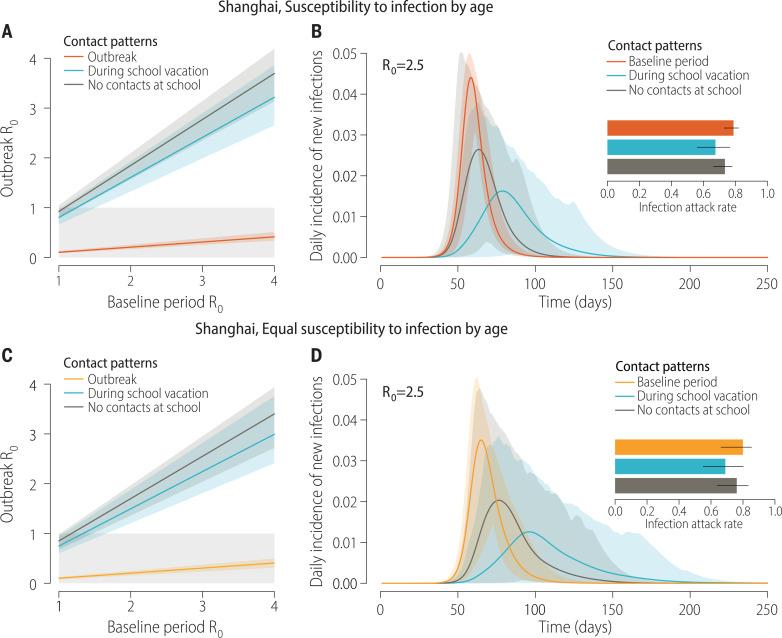
Intense nonpharmaceutical interventions were put in place in China to stop transmission of the novel coronavirus disease 2019 (COVID-19). As transmission intensifies in other countries, the interplay between age, contact patterns, social distancing, susceptibility to infection, and COVID-19 dynamics remains unclear. To answer these questions, we analyze contact survey data for Wuhan and Shanghai before and during the outbreak and contact-tracing information from Hunan province. Daily contacts were reduced seven- to eightfold during the COVID-19 social distancing period, with most interactions restricted to the household. We find that children 0 to 14 years of age are less susceptible to severe acute respiratory syndrome coronavirus 2 (SARS-CoV-2) infection than adults 15 to 64 years of age (odds ratio 0.34, 95% confidence interval 0.24 to 0.49), whereas individuals more than 65 years of age are more susceptible to infection (odds ratio 1.47, 95% confidence interval 1.12 to 1.92). Based on these data, we built a transmission model to study the impact of social distancing and school closure on transmission. We find that social distancing alone, as implemented in China during the outbreak, is sufficient to control COVID-19. Although proactive school closures cannot interrupt transmission on their own, they can reduce peak incidence by 40 to 60% and delay the epidemic.
中国采取了高强度的非药物干预措施来阻止 2019 年新型冠状病毒病(COVID-19)的传播。随着其他国家的传播加剧,年龄、接触模式、社交距离、易感性和 COVID-19 动力学之间的相互作用仍不清楚。为了回答这些问题,我们分析了武汉和上海在疫情爆发前后的接触调查数据,以及湖南省的接触追踪信息。在 COVID-19 社交距离期间,日常接触减少了七到八成,大多数互动都局限于家庭内部。我们发现,儿童(0 至 14 岁)比成年人(15 至 64 岁)更容易感染严重急性呼吸综合征冠状病毒 2(SARS-CoV-2)(比值比 0.34,95%置信区间 0.24 至 0.49),而 65 岁以上的人更容易感染(比值比 1.47,95%置信区间 1.12 至 1.92)。基于这些数据,我们建立了一个传播模型来研究社交距离和学校关闭对传播的影响。我们发现,仅实施中国在疫情期间实施的社交距离措施就足以控制 COVID-19。虽然主动关闭学校本身无法阻断传播,但可以将峰值发病率降低 40%至 60%,并延迟疫情。


 Zotero 插件