
细胞外囊泡在肾脏生理和病理生理过程调节中的新进展
Novel Aspects of Extracellular Vesicles in the Regulation of Renal Physiological and Pathophysiological Processes.
作者信息
Rigalli Juan Pablo, Barros Eric Raul, Sommers Vera, Bindels René J M, Hoenderop Joost G J
机构信息
Department of Physiology, Radboud Institute for Molecular Life Sciences, Radboud University Medical Center, Nijmegen, Netherlands.
Department of Endocrinology, School of Medicine, Pontificia Universidad Católica de Chile, Santiago, Chile.
出版信息
Front Cell Dev Biol. 2020 Apr 15;8:244. doi: 10.3389/fcell.2020.00244. eCollection 2020.
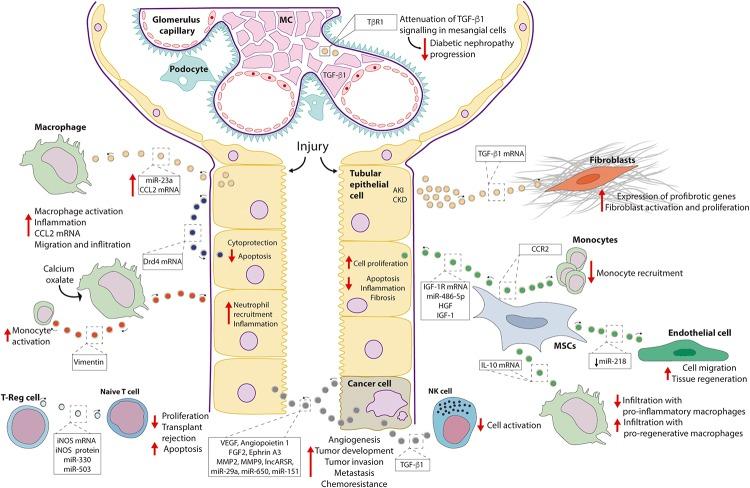
Extracellular vesicles (EV) are nanosized particles released by a large variety of cells. They carry molecules such as proteins, RNA and lipids. While urinary EVs have been longer studied as a source of biomarkers for renal and non-renal disorders, research on EVs as regulatory players of renal physiological and pathological processes has experienced an outbreak recently in the past decade. In general, the microenvironment and (patho)physiological state of the donor cells affect the cargo of the EVs released, which then determines the effect of these EVs once they reach a target cell. For instance, EVs released by renal epithelial cells modulate the expression and function of water and solute transporting proteins in other cells. Also, EVs have been demonstrated to regulate renal organogenesis and blood flow. Furthermore, a dual role of EVs promoting, but also counteracting, disease has also been reported. EVs released by renal tubular cells can reach fibroblasts, monocytes, macrophages, T cells and natural killer cells, thus influencing the pathogenesis and progression of renal disorders like acute kidney injury and fibrosis, nephrolithiasis, renal transplant rejection and renal cancer, among others. On the contrary, EVs may also exert a cytoprotective role upon renal damage and promote recovery of renal function. In the current review, a systematic summary of the key studies from the past 5 years addressing the role of EVs in the modulation of renal physiological and pathophysiological processes is provided, highlighting open questions and discussing the potential of future research.
细胞外囊泡(EV)是由多种细胞释放的纳米级颗粒。它们携带蛋白质、RNA和脂质等分子。虽然尿EV作为肾脏和非肾脏疾病生物标志物的来源已被研究了更长时间,但在过去十年中,关于EV作为肾脏生理和病理过程调节因子的研究最近出现了爆发式增长。一般来说,供体细胞的微环境和(病理)生理状态会影响所释放的EV的货物,这进而决定了这些EV一旦到达靶细胞后的作用。例如,肾上皮细胞释放的EV可调节其他细胞中水和溶质转运蛋白的表达及功能。此外,EV已被证明可调节肾脏器官发生和血流。此外,也有报道称EV在促进疾病的同时也具有对抗疾病的双重作用。肾小管细胞释放的EV可到达成纤维细胞、单核细胞、巨噬细胞、T细胞和自然杀伤细胞,从而影响急性肾损伤和纤维化、肾结石、肾移植排斥反应和肾癌等肾脏疾病的发病机制和进展。相反,EV在肾脏损伤时也可能发挥细胞保护作用并促进肾功能恢复。在本综述中,对过去5年中关于EV在调节肾脏生理和病理生理过程中作用的关键研究进行了系统总结,突出了未解决的问题并讨论了未来研究的潜力。

 Zotero 插件