
肾素-血管紧张素-醛固酮系统抑制剂与新冠病毒风险。
Renin-Angiotensin-Aldosterone System Inhibitors and Risk of Covid-19.
机构信息
From the New York University (NYU) Grossman School of Medicine, New York.
出版信息
N Engl J Med. 2020 Jun 18;382(25):2441-2448. doi: 10.1056/NEJMoa2008975. Epub 2020 May 1.
BACKGROUND
There is concern about the potential of an increased risk related to medications that act on the renin-angiotensin-aldosterone system in patients exposed to coronavirus disease 2019 (Covid-19), because the viral receptor is angiotensin-converting enzyme 2 (ACE2).
METHODS
We assessed the relation between previous treatment with ACE inhibitors, angiotensin-receptor blockers, beta-blockers, calcium-channel blockers, or thiazide diuretics and the likelihood of a positive or negative result on Covid-19 testing as well as the likelihood of severe illness (defined as intensive care, mechanical ventilation, or death) among patients who tested positive. Using Bayesian methods, we compared outcomes in patients who had been treated with these medications and in untreated patients, overall and in those with hypertension, after propensity-score matching for receipt of each medication class. A difference of at least 10 percentage points was prespecified as a substantial difference.
RESULTS
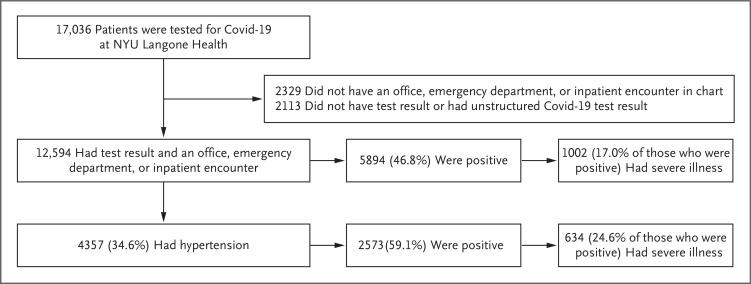
Among 12,594 patients who were tested for Covid-19, a total of 5894 (46.8%) were positive; 1002 of these patients (17.0%) had severe illness. A history of hypertension was present in 4357 patients (34.6%), among whom 2573 (59.1%) had a positive test; 634 of these patients (24.6%) had severe illness. There was no association between any single medication class and an increased likelihood of a positive test. None of the medications examined was associated with a substantial increase in the risk of severe illness among patients who tested positive.
CONCLUSIONS
We found no substantial increase in the likelihood of a positive test for Covid-19 or in the risk of severe Covid-19 among patients who tested positive in association with five common classes of antihypertensive medications.
背景
人们担心接触 2019 冠状病毒病(COVID-19)的患者使用作用于肾素-血管紧张素-醛固酮系统的药物可能会增加风险,因为病毒受体是血管紧张素转换酶 2(ACE2)。
方法
我们评估了 ACE 抑制剂、血管紧张素受体阻滞剂、β受体阻滞剂、钙通道阻滞剂或噻嗪类利尿剂之前的治疗与 COVID-19 检测阳性结果的可能性以及阳性患者发生重症(定义为重症监护、机械通气或死亡)的可能性之间的关系。使用贝叶斯方法,我们比较了在接受这些药物治疗的患者和未接受治疗的患者中的结局,总体以及在接受每种药物类别倾向性评分匹配的高血压患者中比较了结局。指定至少 10 个百分点的差异为实质性差异。
结果
在接受 COVID-19 检测的 12594 名患者中,共有 5894 名(46.8%)检测结果呈阳性;其中 1002 名(17.0%)患者病情严重。4357 名患者(34.6%)存在高血压病史,其中 2573 名(59.1%)检测结果呈阳性;这些患者中有 634 名(24.6%)病情严重。没有任何单一药物类别与检测结果呈阳性的可能性增加之间存在关联。在检测结果呈阳性的患者中,所检查的药物均未与重症 COVID-19 的风险增加有实质性关联。
结论
我们发现,在检测结果呈阳性的患者中,与五类常见降压药物相关的 COVID-19 检测阳性的可能性或重症 COVID-19 的风险没有实质性增加。
 Zotero 插件