
伊朗人群血液恶性肿瘤的遗传学:概述。
Genetics of blood malignancies among Iranian population: an overview.
机构信息
Metabolic Syndrome Research Center, School of Medicine, Mashhad University of Medical Sciences, Mashhad, Iran.
Student Research Committee, Faculty of Medicine, Mashhad University of Medical Sciences, Mashhad, Iran.
出版信息
Diagn Pathol. 2020 May 6;15(1):44. doi: 10.1186/s13000-020-00968-2.
BACKGROUND
Blood malignancies are among the leading causes of cancer related deaths in the world. Different environmental and genetic risk factors are involved in progression of blood malignancies. It has been shown that the lifestyle changes have affected the epidemiological patterns of these malignancies. Hematologic cancers are the 5th common cancer among Iranian population. It has been observed that there is a rising trend of blood malignancies incidences during the recent decades. Therefore, it is required to design novel diagnostic methods for the early detection of such malignancies in this population.
MAIN BODY
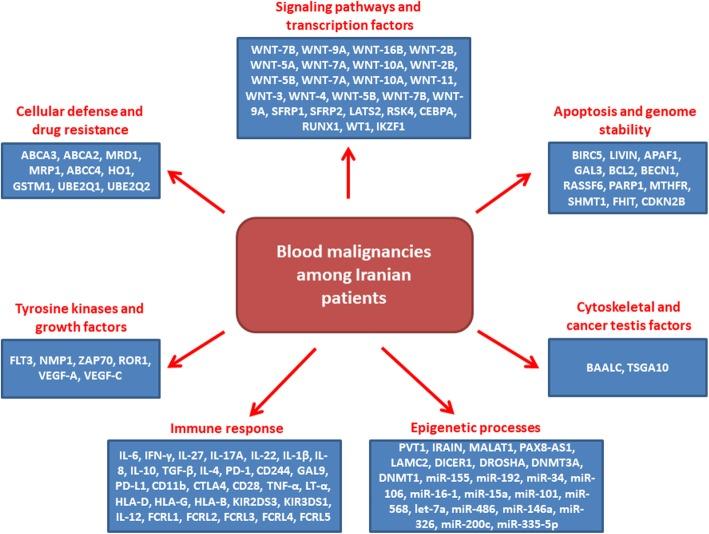
In present review we have summarized all of the significant genes which have been reported among Iranian patients with blood malignancies. The reported genes were categorized based on their cell and molecular functions to clarify the molecular biology and genetics of blood malignancies among Iranian patients.
CONCLUSION
It was observed that the epigenetic and immune response factors were the most frequent molecular processes associated with progression of blood malignancies among Iranian population. This review paves the way of introducing a population based panel of genetic markers for the early detection of blood malignancies in this population.
背景
血液恶性肿瘤是全球癌症相关死亡的主要原因之一。不同的环境和遗传风险因素与血液恶性肿瘤的进展有关。已经表明,生活方式的改变影响了这些恶性肿瘤的流行病学模式。血液癌是伊朗人群中第 5 常见的癌症。据观察,近几十年来血液恶性肿瘤的发病率呈上升趋势。因此,需要为该人群中此类恶性肿瘤的早期检测设计新的诊断方法。
正文
在本综述中,我们总结了所有在伊朗血液恶性肿瘤患者中报道的重要基因。根据其细胞和分子功能对报道的基因进行分类,以阐明伊朗患者血液恶性肿瘤的分子生物学和遗传学。
结论
观察到表观遗传和免疫反应因素是与伊朗人群中血液恶性肿瘤进展最相关的分子过程。本综述为在该人群中早期检测血液恶性肿瘤引入基于人群的遗传标记面板铺平了道路。
 Zotero 插件