
阿帕替尼联合卡瑞利珠单抗(抗 PD-1 治疗药物,SHR-1210)治疗化疗后进展的晚期骨肉瘤(APFAO):一项单臂、开放标签、2 期临床试验。
Apatinib plus camrelizumab (anti-PD1 therapy, SHR-1210) for advanced osteosarcoma (APFAO) progressing after chemotherapy: a single-arm, open-label, phase 2 trial.
机构信息
Musculoskeletal Tumor Center, Peking University People's Hospital, Beijing, China.
Musculoskeletal Tumor Center, Peking University People's Hospital, Beijing, China
出版信息
J Immunother Cancer. 2020 May;8(1). doi: 10.1136/jitc-2020-000798.
BACKGROUND
Results of our previous study showed high objective response but short-term activity of apatinib in advanced osteosarcoma. We aimed to investigate the activity of apatinib in combination with camrelizumab in patients with inoperable high-grade osteosarcoma progressing after chemotherapy.
METHODS
This open-label, phase 2 trial was conducted at Peking University People's Hospital. We enrolled patients with advanced osteosarcoma progressed after chemotherapy. Patients received 500 mg apatinib orally once daily plus 200 mg camrelizumab by intravenous infusion every 2 weeks until disease progression or unacceptable toxicity. The primary endpoint was progression-free survival (PFS) and clinical benefit rate at 6 months, which were based on RECIST V.1.1.
RESULTS
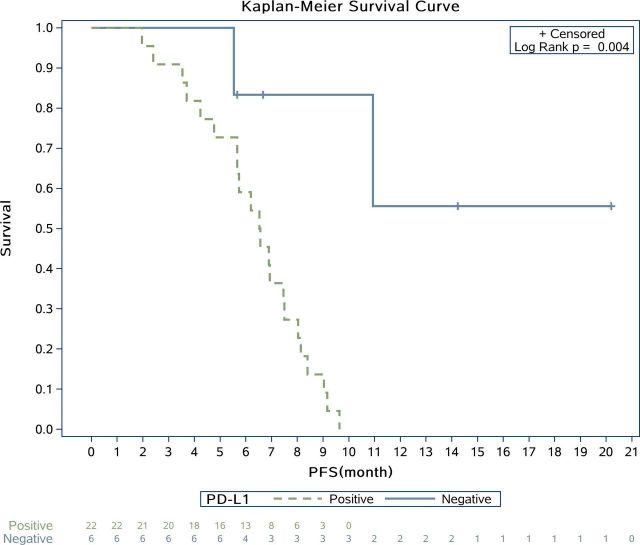
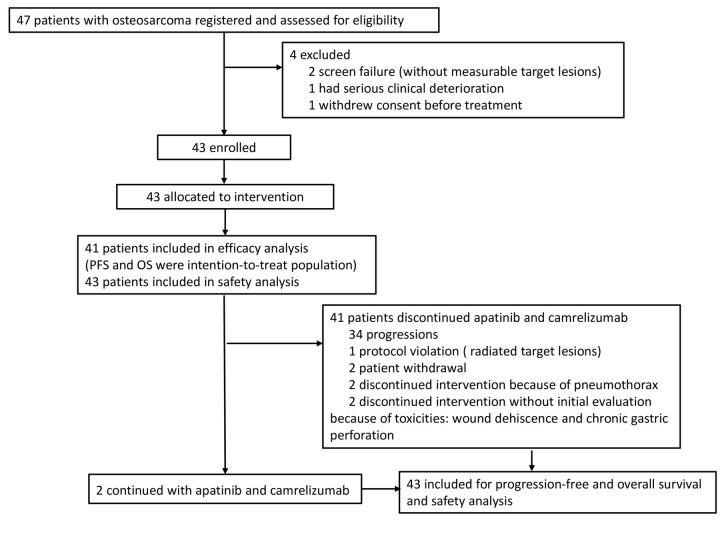
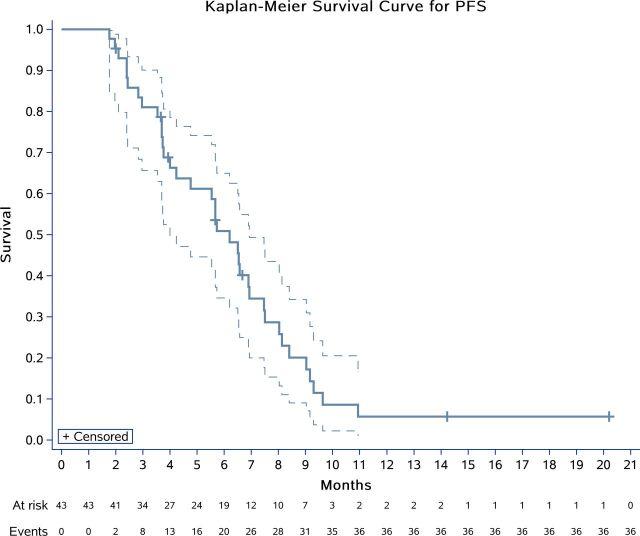
43 patients were enrolled between January 25 and September 4, 2018. With median follow-up time of 48.3 (Q1, Q3, 30.6, 66.6) weeks, 13 (30.23%, 95% CI 17.2%, 40.1%) of 43 patients were progression free at 6 months and the 6-month PFS rate was 50.9% (95% CI 34.6%, 65.0%). Until final follow-up, the objective response rate was 20.9% (9/43) and two patients with durable disease control were observed. Patients with programmed cell death 1 ligand-1 (PD-L1) tumor proportion score ≥5% and pulmonary metastases tended to have a longer PFS in comparison to the others (p=0.004 and 0.017, respectively). Toxic effects led to dose reductions, or interruptions, or both in 24 (55.8%) of 43 patients and permanent discontinuation in 4 (9.3%) patients. There were no treatment-related deaths.
CONCLUSIONS
Although the combination of apatinib and camrelizumab seemed to prolong PFS in comparison to single agent apatinib in treating advanced osteosarcoma, it did not reach the prespecified target of 6-month PFS of 60% or greater. Overexpression of PD-L1 and the presence of pulmonary metastases only were associated with longer PFS.
TRIAL REGISTRATION NUMBER
NCT03359018.
背景
我们之前的研究结果表明,阿帕替尼在晚期骨肉瘤中具有较高的客观缓解率,但短期疗效不佳。我们旨在研究阿帕替尼联合卡瑞利珠单抗治疗化疗后进展的不可切除的高级别骨肉瘤患者的疗效。
方法
这是一项在北京大学人民医院进行的开放标签、Ⅱ期临床试验。我们纳入了化疗后进展的晚期骨肉瘤患者。患者接受每日一次口服 500mg 阿帕替尼和每 2 周一次静脉输注 200mg 卡瑞利珠单抗,直至疾病进展或出现不可耐受的毒性。主要终点为无进展生存期(PFS)和 6 个月时的临床获益率,根据 RECIST V.1.1 评估。
结果
2018 年 1 月 25 日至 9 月 4 日期间共纳入 43 例患者。中位随访时间为 48.3(Q1,Q3,30.6,66.6)周,43 例患者中有 13 例(30.23%,95%CI 17.2%,40.1%)在 6 个月时无进展,6 个月时的 PFS 率为 50.9%(95%CI 34.6%,65.0%)。截至最终随访时,客观缓解率为 20.9%(9/43),有 2 例患者疾病得到持久控制。程序性死亡配体 1(PD-L1)肿瘤比例评分≥5%的患者和有肺转移的患者与其他患者相比,PFS 更长(分别为 p=0.004 和 0.017)。43 例患者中有 24 例(55.8%)因毒性作用而减少或中断剂量,4 例(9.3%)患者永久停药。无治疗相关死亡。
结论
尽管与单药阿帕替尼相比,阿帕替尼联合卡瑞利珠单抗治疗晚期骨肉瘤似乎延长了 PFS,但未达到 6 个月 PFS 大于或等于 60%的预设目标。PD-L1 过表达和存在肺转移与更长的 PFS 相关。
试验注册
NCT03359018。
 Zotero 插件