
索拉非尼治疗肝细胞癌后的二线治疗:过去 10 年中使用的治疗方法的特征以及卡博替尼、瑞戈非尼和雷莫芦单抗的真实世界适应证。
Second-line treatment of hepatocellular carcinoma after sorafenib: Characterizing treatments used over the past 10 years and real-world eligibility for cabozantinib, regorafenib, and ramucirumab.
机构信息
Tom Baker Cancer Centre, Calgary, AB, Canada.
Cumming School of Medicine, University of Calgary, Calgary, AB, Canada.
出版信息
Cancer Med. 2020 Jul;9(13):4640-4647. doi: 10.1002/cam4.3116. Epub 2020 May 7.
BACKGROUND
The CELESTIAL, RESORCE, and REACH-2 trials showed survival benefit of cabozantinib, regorafenib, and ramucirumab, respectively, in hepatocellular carcinoma (HCC) patients treated with sorafenib who had good performance status (ECOG 0-1) and liver function (Child-Pugh-A). This study characterizes subsequent treatments received by HCC patients after sorafenib, and determines the proportion of patients eligible for novel therapies if strict eligibility criteria (SEC) were utilized compared to more liberal modified eligibility criteria (MEC, including ECOG 2, Child-Pugh-B7).
METHODS
HCC patients who received sorafenib between 2008 and 2017 were included from the Canadian HCC CHORD Database. Patients were classified as eligible or ineligible based on available CELESTIAL, RESORCE, and REACH-2 trial SEC or MEC. Median overall survival (mOS) was assessed using the Kaplan-Meier method.
RESULTS
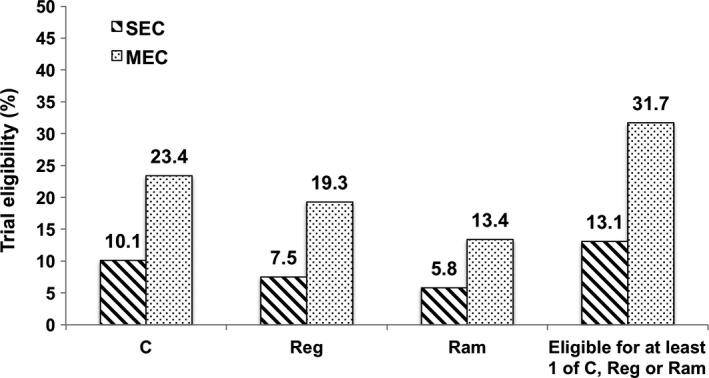
A total of 730 patients were identified; and 172 (23.6%) received subsequent treatment. Patients who received subsequent treatment had longer mOS than those who did not (12.1 vs 3.3 months; P < .001). Using SEC, only 13.1% of patients would be eligible for cabozantinib, regorafenib, or ramucirumab. Expanding eligibility to include patients who meet MEC increased the proportion of eligible patients to 31.7%. Higher ineligibility for regorafenib and ramucirumab was driven by trial-specific criteria, including sorafenib intolerance (28%) for RESORCE and AFP <400 (58.9%) for REACH-2.
CONCLUSIONS
A small proportion of real-world HCC patients would be eligible for cabozantinib, regorafenib, or ramucirumab if SEC in clinical trials were followed, while more than double would be eligible if MEC were applied. Patients who received subsequent treatment had improved mOS, regardless of whether they met SEC or MEC.
背景
CELESTIAL、RESORCE 和 REACH-2 试验分别显示卡博替尼、瑞戈非尼和雷莫芦单抗在索拉非尼治疗的具有良好表现状态(ECOG 0-1)和肝功能(Child-Pugh-A)的肝细胞癌(HCC)患者中的生存获益。本研究描述了 HCC 患者在接受索拉非尼治疗后的后续治疗,并确定了如果使用严格的入选标准(SEC)与更宽松的改良入选标准(MEC,包括 ECOG 2 和 Child-Pugh-B7)相比,符合新型治疗药物资格的患者比例。
方法
从加拿大 HCC CHORD 数据库中纳入了 2008 年至 2017 年期间接受索拉非尼治疗的 HCC 患者。根据可用的 CELESTIAL、RESORCE 和 REACH-2 试验 SEC 或 MEC,将患者分为符合入选标准或不符合入选标准。使用 Kaplan-Meier 方法评估中位总生存期(mOS)。
结果
共确定了 730 例患者,其中 172 例(23.6%)接受了后续治疗。接受后续治疗的患者 mOS 长于未接受后续治疗的患者(12.1 个月 vs 3.3 个月;P<0.001)。使用 SEC,只有 13.1%的患者有资格接受卡博替尼、瑞戈非尼或雷莫芦单抗治疗。将符合 MEC 的患者纳入其中,可将符合条件的患者比例提高到 31.7%。REGORAFENIB 和 RAMUCIRUMAB 较高的不适用性是由试验特定标准驱动的,包括 RESORCE 中的索拉非尼不耐受(28%)和 REACH-2 中的 AFP<400(58.9%)。
结论
如果遵循临床试验中的 SEC,那么只有一小部分真实世界的 HCC 患者有资格接受卡博替尼、瑞戈非尼或雷莫芦单抗治疗,而如果应用 MEC,则有超过两倍的患者有资格接受治疗。无论是否符合 SEC 或 MEC,接受后续治疗的患者 mOS 均有改善。

 Zotero 插件