
三甲基取代碳酸酯作为一种通用的自毁型连接物,用于酶反应的荧光检测。
Trimethyl-Substituted Carbamate as a Versatile Self-Immolative Linker for Fluorescence Detection of Enzyme Reactions.
机构信息
Graduate School of Pharmaceutical Sciences, Kyushu University, Fukuoka 812-8582, Japan.
出版信息
Molecules. 2020 May 5;25(9):2153. doi: 10.3390/molecules25092153.
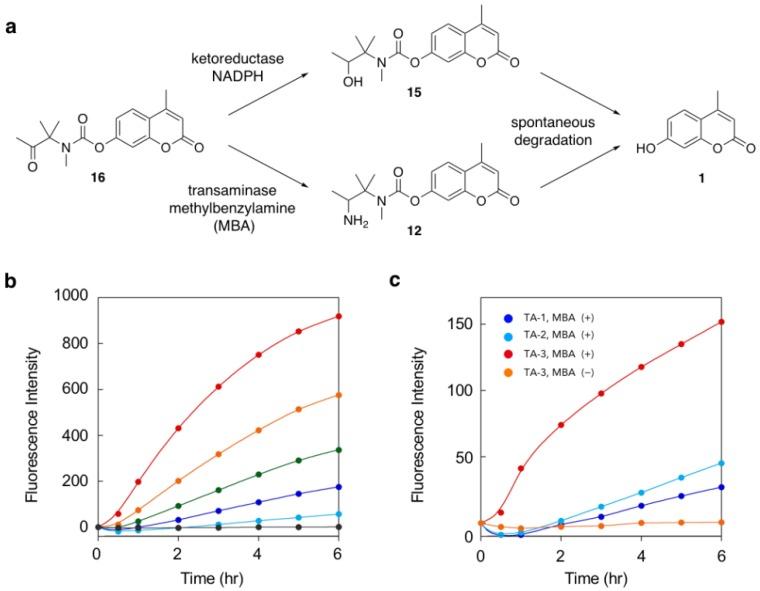
Self-immolative linker is a useful building block of molecular probes, with broad applications in the fields of enzyme activity analysis, stimuli-responsive material science, and drug delivery. This manuscript presents -methyl dimethyl methyl (i.e., trimethyl) carbamate as a new class of self-immolative linker for the fluorescence detection of enzyme reactions. The trimethyl carbamate was shown to spontaneously undergo intramolecular cyclization upon formation of a carboxylate group, to liberate a fluorophore with the second time rapid reaction kinetics. Interestingly, the auto-cleavage reaction of trimethyl carbamate was also induced by the formation of hydroxyl and amino groups. Fluorescent probes with a trimethyl carbamate could be applicable for fluorescence monitoring of the enzyme reactions catalyzed by esterase, ketoreductase, and aminotransferase, and for fluorescence imaging of intracellular esterase activity in living cells, hence demonstrating the utility of this new class of self-immolative linker.
自毁连接子是分子探针的有用构建模块,在酶活性分析、刺激响应材料科学和药物输送等领域有广泛的应用。本文提出了 -甲基二甲基甲基(即三甲)碳酸酯作为一种新的自毁连接子,用于荧光检测酶反应。研究表明,三甲碳酸酯在形成羧酸根后会自发地进行分子内环化,释放出具有二次快速反应动力学的荧光团。有趣的是,三甲碳酸酯的自动裂解反应也可以被羟基和氨基的形成所诱导。带有三甲碳酸酯的荧光探针可用于荧光监测酯酶、酮还原酶和转氨酶催化的酶反应,以及活细胞内酯酶活性的荧光成像,从而证明了这种新的自毁连接子的实用性。


 Zotero 插件