
参与患者减少低价值临床护理的去执行干预措施:系统评价和荟萃分析。
Engaging patients in de-implementation interventions to reduce low-value clinical care: a systematic review and meta-analysis.
机构信息
Department of Community Health Sciences, Cumming School of Medicine, University of Calgary, Calgary, Canada.
Department of Critical Care Medicine, Cumming School of Medicine, University of Calgary and Alberta Health Services, Calgary, Canada.
出版信息
BMC Med. 2020 May 8;18(1):116. doi: 10.1186/s12916-020-01567-0.
BACKGROUND
Many decisions regarding health resource utilization flow through the patient-clinician interaction. Thus, it represents a place where de-implementation interventions may have considerable effect on reducing the use of clinical interventions that lack efficacy, have risks that outweigh benefits, or are not cost-effective (i.e., low-value care). The objective of this systematic review with meta-analysis was to determine the effect of de-implementation interventions that engage patients within the patient-clinician interaction on use of low-value care.
METHODS
MEDLINE, EMBASE, and CINAHL were searched from inception to November 2019. Gray literature was searched using the CADTH tool. Studies were screened independently by two reviewers and were included if they (1) described an intervention that engaged patients in an initiative to reduce low-value care, (2) reported the use of low-value care with and without the intervention, and (3) were randomized clinical trials (RCTs) or quasi-experimental designs. Studies describing interventions solely focused on clinicians or published in a language other than English were excluded. Data was extracted independently in duplicate and pertained to the low-value clinical intervention of interest, components of the strategy for patient engagement, and study outcomes. Quality of included studies was assessed using the Cochrane Risk of Bias tool for RCTs and a modified Downs and Black checklist for quasi-experimental studies. Random effects meta-analysis (reported as risk ratio, RR) was used to examine the effect of de-implementation interventions on the use of low-value care.
RESULTS
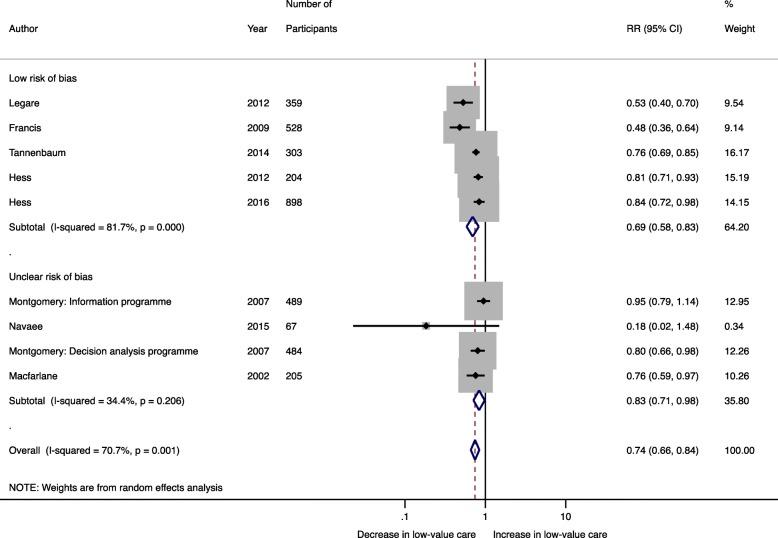
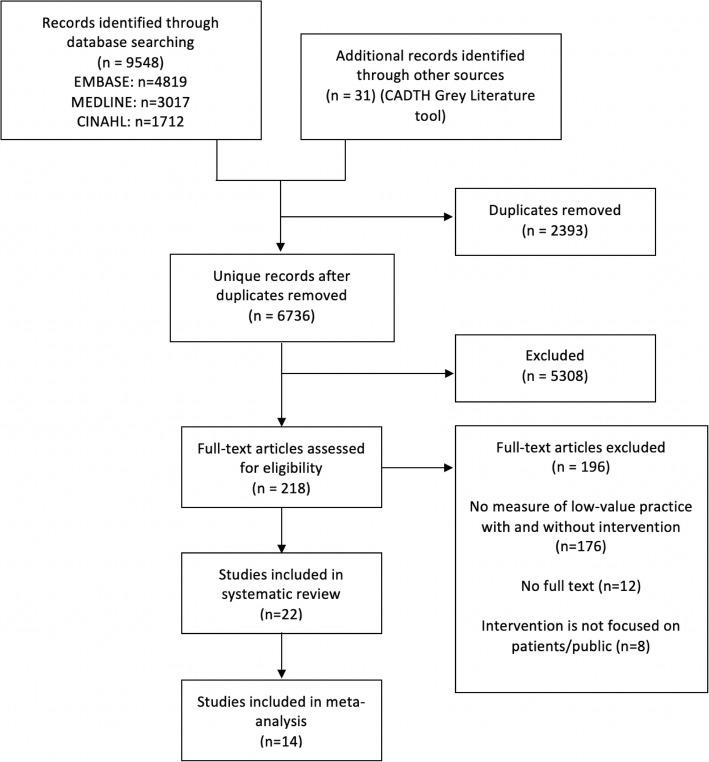
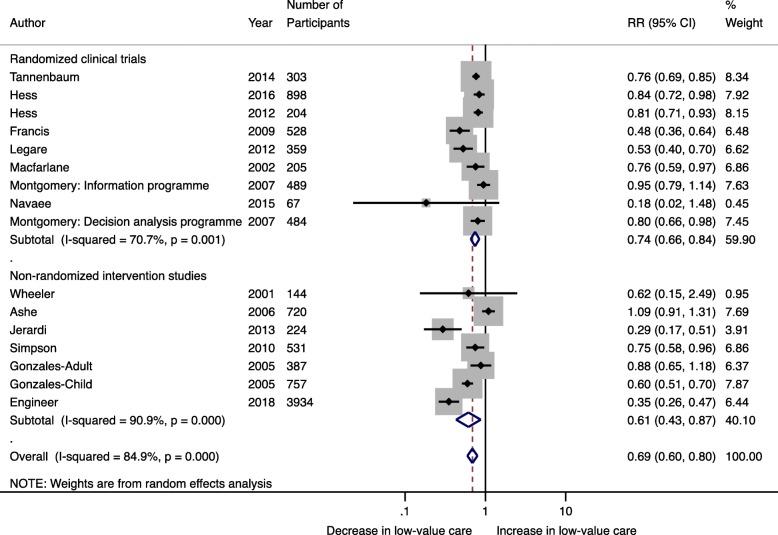
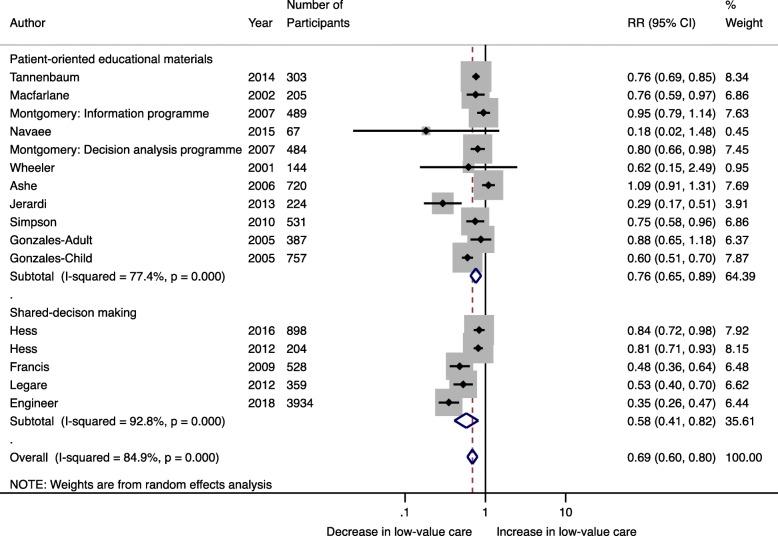
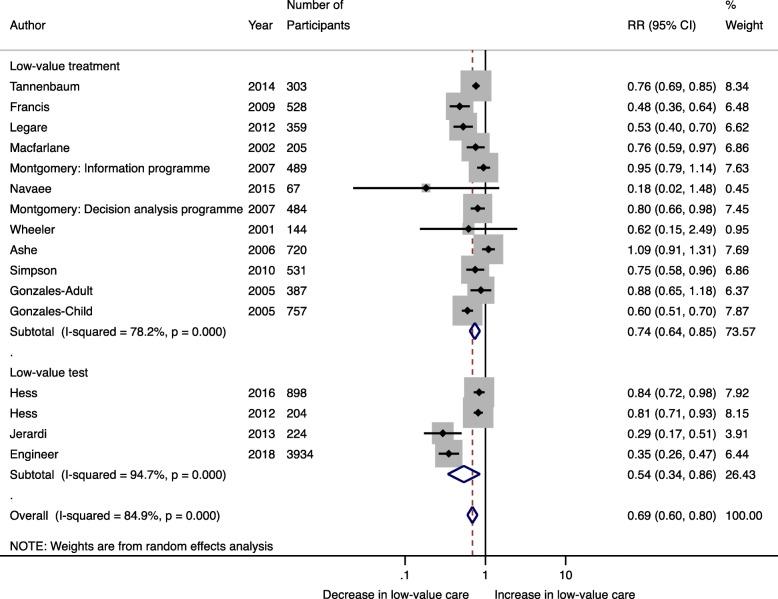
From 6736 unique citations, 9 RCTs and 13 quasi-experimental studies were included in the systematic review. Studies mostly originated from the USA (n = 13, 59%), targeted treatments (n = 17, 77%), and took place in primary care (n = 10, 45%). The most common intervention was patient-oriented educational material (n = 18, 82%), followed by tools for shared decision-making (n = 5, 23%). Random effects meta-analysis demonstrated that de-implementation interventions that engage patients within the patient-clinician interaction led to a significant reduction in low-value care in both RCTs (RR 0.74; 95% CI 0.66-0.84) and quasi-experimental studies (RR 0.61; 95% CI 0.43-0.87). There was significant inter-study heterogeneity; however, intervention effects were consistent across subgroups defined by low-value practice and patient-engagement strategy.
CONCLUSIONS
De-implementation interventions that engage patients within the patient-clinician interaction through patient-targeted educational materials or shared decision-making tools are effective in decreasing the use of low-value care. Clinicians and policymakers should consider engaging patients within initiatives that seek to reduce low-value care.
REGISTRATION
Open Science Framework (https://osf.io/6fsxm).
背景
许多关于卫生资源利用的决策都源于医患互动。因此,这是一个可以实施取消(de-implementation)干预的地方,这些干预可能会对减少缺乏疗效、风险大于收益或不具有成本效益(即低价值护理)的临床干预措施的使用产生重大影响。本系统评价和荟萃分析的目的是确定在医患互动中让患者参与的取消干预措施对减少低价值护理的使用的影响。
方法
从开始到 2019 年 11 月,我们在 MEDLINE、EMBASE 和 CINAHL 中进行了搜索。使用 CADTH 工具搜索灰色文献。如果研究(1)描述了一项干预措施,该措施使患者参与减少低价值护理的举措,(2)报告了有和没有干预措施时的低价值护理使用情况,(3)是随机临床试验(RCT)或准实验设计,则将其纳入研究。仅描述干预措施主要针对临床医生或发表语言不是英语的研究被排除在外。数据由两名独立的研究人员重复提取,涉及到感兴趣的低价值临床干预措施、患者参与策略的组成部分以及研究结果。使用 Cochrane 对 RCT 的偏倚风险工具和改良的 Downs 和 Black 清单对纳入研究的质量进行评估。使用随机效应荟萃分析(以风险比,RR 表示)来检验取消干预措施对低价值护理使用的影响。
结果
从 6736 条独特的引用中,9 项 RCT 和 13 项准实验研究被纳入系统评价。研究主要来自美国(n=13,59%),针对治疗(n=17,77%),并发生在初级保健机构(n=10,45%)。最常见的干预措施是面向患者的教育材料(n=18,82%),其次是用于共同决策的工具(n=5,23%)。随机效应荟萃分析表明,在医患互动中让患者参与的取消干预措施导致 RCT(RR 0.74;95%CI 0.66-0.84)和准实验研究(RR 0.61;95%CI 0.43-0.87)中低价值护理的使用显著减少。研究之间存在显著的异质性;然而,干预效果在低价值实践和患者参与策略定义的亚组之间是一致的。
结论
通过面向患者的教育材料或共同决策工具让患者参与医患互动的取消干预措施,可有效减少低价值护理的使用。临床医生和决策者应考虑在减少低价值护理的举措中让患者参与。
登记
开放科学框架(https://osf.io/6fsxm)。
 Zotero 插件