
家族性低钙尿性高钙血症 1 型和常染色体显性低钙血症 1 型:在大型医疗保健人群中的患病率。
Familial Hypocalciuric Hypercalcemia Type 1 and Autosomal-Dominant Hypocalcemia Type 1: Prevalence in a Large Healthcare Population.
机构信息
Molecular and Functional Genomics, Weis Center for Research, Geisinger, Danville, PA 17822, USA.
Academic Endocrine Unit, Radcliffe Department of Medicine, University of Oxford, Oxford OX3 9DU, UK.
出版信息
Am J Hum Genet. 2020 Jun 4;106(6):734-747. doi: 10.1016/j.ajhg.2020.04.006. Epub 2020 May 7.
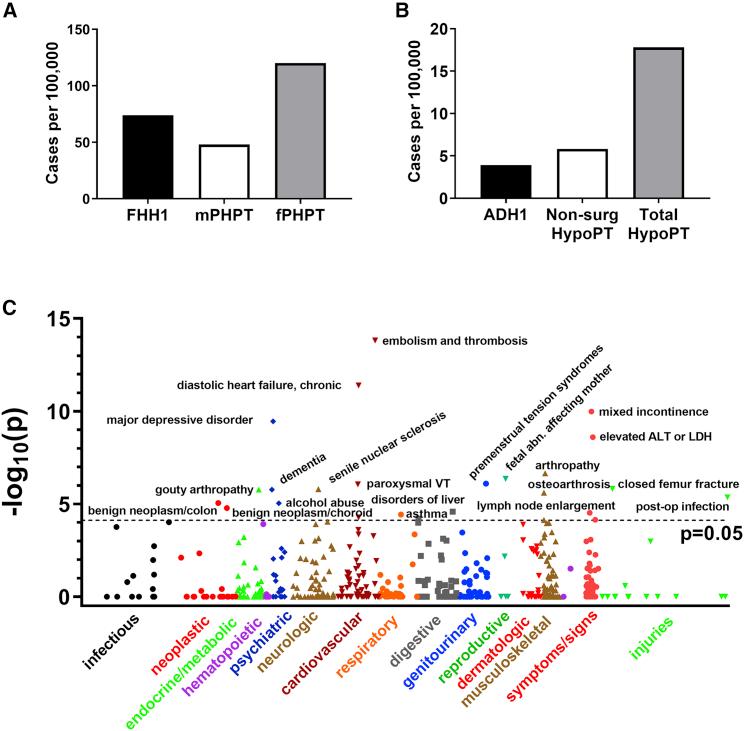
The calcium-sensing receptor (CaSR) regulates serum calcium concentrations. CASR loss- or gain-of-function mutations cause familial hypocalciuric hypercalcemia type 1 (FHH1) or autosomal-dominant hypocalcemia type 1 (ADH1), respectively, but the population prevalence of FHH1 or ADH1 is unknown. Rare CASR variants were identified in whole-exome sequences from 51,289 de-identified individuals in the DiscovEHR cohort derived from a single US healthcare system. We integrated bioinformatics pathogenicity triage, mean serum Ca concentrations, and mode of inheritance to identify potential FHH1 or ADH1 variants, and we used a Sequence Kernel Association Test (SKAT) to identify rare variant-associated diseases. We identified predicted heterozygous loss-of-function CASR variants (6 different nonsense/frameshift variants and 12 different missense variants) in 38 unrelated individuals, 21 of whom were hypercalcemic. Missense CASR variants were identified in two unrelated hypocalcemic individuals. Functional studies showed that all hypercalcemia-associated missense variants impaired heterologous expression, plasma membrane targeting, and/or signaling, whereas hypocalcemia-associated missense variants increased expression, plasma membrane targeting, and/or signaling. Thus, 38 individuals with a genetic diagnosis of FHH1 and two individuals with a genetic diagnosis of ADH1 were identified in the 51,289 cohort, giving a prevalence in this population of 74.1 per 100,000 for FHH1 and 3.9 per 100,000 for ADH1. SKAT combining all nonsense, frameshift, and missense loss-of-function variants revealed associations with cardiovascular, neurological, and other diseases. In conclusion, FHH1 is a common cause of hypercalcemia, with prevalence similar to that of primary hyperparathyroidism, and is associated with altered disease risks, whereas ADH1 is a major cause of non-surgical hypoparathyroidism.
钙敏感受体 (CaSR) 调节血清钙浓度。CASR 失活或功能获得性突变分别导致家族性低钙血症性高钙血症 1 型 (FHH1) 或常染色体显性低钙血症 1 型 (ADH1),但 FHH1 或 ADH1 的人群患病率尚不清楚。在源自单一美国医疗保健系统的 DiscovEHR 队列的 51289 名去识别个体的外显子组序列中,发现了罕见的 CASR 变体。我们整合了生物信息学致病性分诊、平均血清 Ca 浓度和遗传方式,以鉴定潜在的 FHH1 或 ADH1 变体,并使用序列核关联测试 (SKAT) 鉴定罕见变体相关疾病。我们在 38 名无亲缘关系的个体中发现了预测杂合性失活 CASR 变体(6 种不同的无义/移码变体和 12 种不同的错义变体),其中 21 名血钙升高。在两名无亲缘关系的低钙血症个体中发现了错义 CASR 变体。功能研究表明,所有与高钙血症相关的错义变体均损害了异源表达、质膜靶向和/或信号传导,而与低钙血症相关的错义变体则增加了表达、质膜靶向和/或信号传导。因此,在 51289 名队列中,38 名个体被诊断为 FHH1,2 名个体被诊断为 ADH1,FHH1 在该人群中的患病率为每 10 万人 74.1 例,ADH1 为每 10 万人 3.9 例。结合所有无义、移码和错义失活变体的 SKAT 显示与心血管、神经和其他疾病存在关联。总之,FHH1 是高钙血症的常见原因,其患病率与原发性甲状旁腺功能亢进症相似,与改变的疾病风险相关,而 ADH1 是手术性甲状旁腺功能减退症的主要原因。


 Zotero 插件