
骨骼肌再生过程中肌纤维成熟度的准确评估方法
Methods for Accurate Assessment of Myofiber Maturity During Skeletal Muscle Regeneration.
作者信息
Yoshimoto Yuki, Ikemoto-Uezumi Madoka, Hitachi Keisuke, Fukada So-Ichiro, Uezumi Akiyoshi
机构信息
Muscle Aging and Regenerative Medicine, Tokyo Metropolitan Institute of Gerontology, Tokyo, Japan.
Division for Therapies against Intractable Diseases, Institute for Comprehensive Medical Science, Fujita Health University, Toyoake, Japan.
出版信息
Front Cell Dev Biol. 2020 Apr 22;8:267. doi: 10.3389/fcell.2020.00267. eCollection 2020.
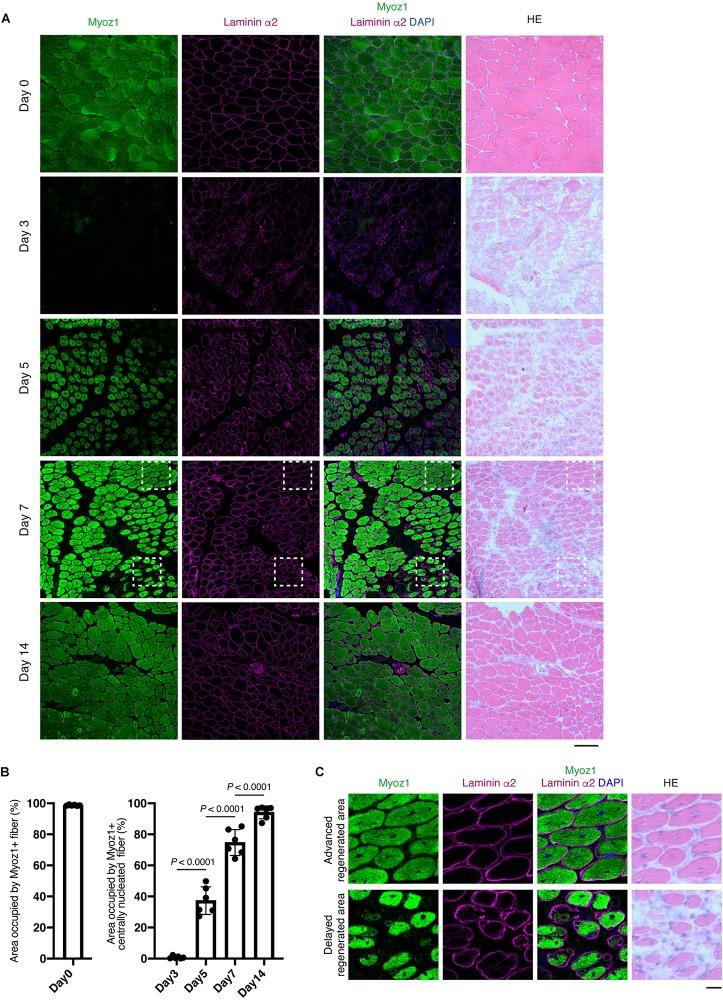
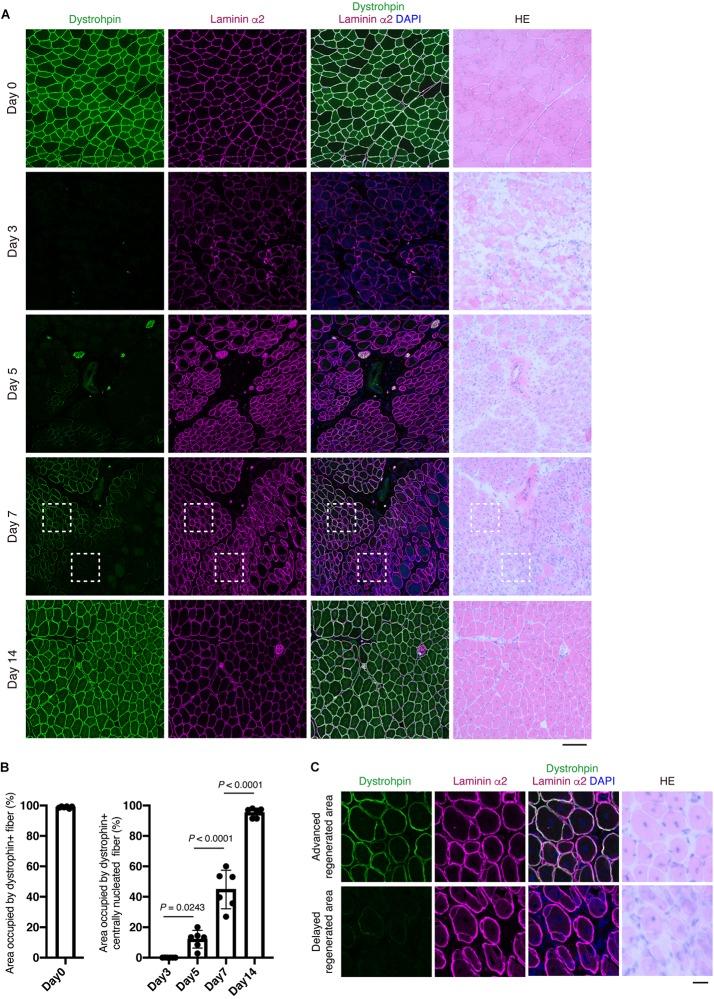
Adult skeletal muscle has a remarkable ability to regenerate. Regeneration of mature muscle fibers is dependent on muscle stem cells called satellite cells. Although they are normally in a quiescent state, satellite cells are rapidly activated after injury, and subsequently proliferate and differentiate to make new muscle fibers. Myogenesis is a highly orchestrated biological process and has been extensively studied, and therefore many parameters that can precisely evaluate regenerating events have been established. However, in some cases, it is necessary to evaluate the completion of regeneration rather than ongoing regeneration. In this study, we establish methods for assessing the myofiber maturation during muscle regeneration. By carefully comparing expression patterns of several muscle regeneration-related genes, we found that expression of ( and ), (), and () is gradually increased as muscle regeneration proceeds. In contrast, commonly used regeneration markers such as and are transiently upregulated after muscle injury but their expression decreases as regeneration progresses. Intriguingly, upregulation of , and cannot be achieved in cultured myotubes, indicating that these markers are excellent indicators to assess myofiber maturity. We also show that analyzing re-expression of Myoz1 and dystrophin in individual fiber during regeneration enables accurate assessment of myofiber maturity at the single-myofiber level. Together, our study provides valuable methods that are useful in evaluating muscle regeneration and the efficacy of therapeutic strategies for muscle diseases.
成体骨骼肌具有显著的再生能力。成熟肌纤维的再生依赖于称为卫星细胞的肌肉干细胞。尽管卫星细胞通常处于静止状态,但在损伤后会迅速被激活,随后增殖并分化以形成新的肌纤维。肌生成是一个高度协调的生物学过程,已经得到了广泛研究,因此已经建立了许多能够精确评估再生事件的参数。然而,在某些情况下,有必要评估再生的完成情况而非正在进行的再生过程。在本研究中,我们建立了评估肌肉再生过程中肌纤维成熟度的方法。通过仔细比较几个与肌肉再生相关基因的表达模式,我们发现随着肌肉再生的进行,(和)、()以及()的表达逐渐增加。相比之下,常用的再生标志物如和在肌肉损伤后会短暂上调,但其表达会随着再生的进展而降低。有趣的是,在培养的肌管中无法实现、和的上调,这表明这些标志物是评估肌纤维成熟度的优秀指标。我们还表明,分析再生过程中单个纤维中Myoz1和肌营养不良蛋白的重新表达能够在单肌纤维水平上准确评估肌纤维的成熟度。总之,我们的研究提供了有价值的方法,有助于评估肌肉再生以及肌肉疾病治疗策略的疗效。


 Zotero 插件