
ESHRE指南:体外受精/卵胞浆内单精子注射的卵巢刺激
ESHRE guideline: ovarian stimulation for IVF/ICSI.
作者信息
Ovarian Stimulation The Eshre Guideline Group On, Bosch Ernesto, Broer Simone, Griesinger Georg, Grynberg Michael, Humaidan Peter, Kolibianakis Estratios, Kunicki Michal, La Marca Antonio, Lainas George, Le Clef Nathalie, Massin Nathalie, Mastenbroek Sebastiaan, Polyzos Nikolaos, Sunkara Sesh Kamal, Timeva Tanya, Töyli Mira, Urbancsek Janos, Vermeulen Nathalie, Broekmans Frank
机构信息
IVI-RMS Valencia, Valencia, Spain.
Department of Reproductive Medicine and Gynecology, University Medical Center Utrecht, Utrecht, The Netherlands.
出版信息
Hum Reprod Open. 2020 May 1;2020(2):hoaa009. doi: 10.1093/hropen/hoaa009. eCollection 2020.
STUDY QUESTION
What is the recommended management of ovarian stimulation, based on the best available evidence in the literature?
SUMMARY ANSWER
The guideline development group formulated 84 recommendations answering 18 key questions on ovarian stimulation.
WHAT IS KNOWN ALREADY
Ovarian stimulation for IVF/ICSI has been discussed briefly in the National Institute for Health and Care Excellence guideline on fertility problems, and the Royal Australian and New Zealand College of Obstetricians and Gynaecologist has published a statement on ovarian stimulation in assisted reproduction. There are, to our knowledge, no evidence-based guidelines dedicated to the process of ovarian stimulation.
STUDY DESIGN SIZE DURATION
The guideline was developed according to the structured methodology for development of ESHRE guidelines. After formulation of key questions by a group of experts, literature searches and assessments were performed. Papers published up to 8 November 2018 and written in English were included. The critical outcomes for this guideline were efficacy in terms of cumulative live birth rate per started cycle or live birth rate per started cycle, as well as safety in terms of the rate of occurrence of moderate and/or severe ovarian hyperstimulation syndrome (OHSS).
PARTICIPANTS/MATERIALS SETTING METHODS: Based on the collected evidence, recommendations were formulated and discussed until consensus was reached within the guideline group. A stakeholder review was organized after finalization of the draft. The final version was approved by the guideline group and the ESHRE Executive Committee.
MAIN RESULTS AND THE ROLE OF CHANCE
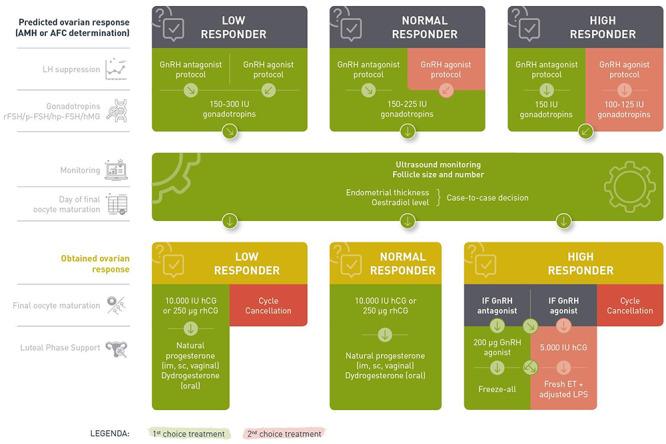
The guideline provides 84 recommendations: 7 recommendations on pre-stimulation management, 40 recommendations on LH suppression and gonadotrophin stimulation, 11 recommendations on monitoring during ovarian stimulation, 18 recommendations on triggering of final oocyte maturation and luteal support and 8 recommendations on the prevention of OHSS. These include 61 evidence-based recommendations-of which only 21 were formulated as strong recommendations-and 19 good practice points and 4 research-only recommendations. The guideline includes a strong recommendation for the use of either antral follicle count or anti-Müllerian hormone (instead of other ovarian reserve tests) to predict high and poor response to ovarian stimulation. The guideline also includes a strong recommendation for the use of the GnRH antagonist protocol over the GnRH agonist protocols in the general IVF/ICSI population, based on the comparable efficacy and higher safety. For predicted poor responders, GnRH antagonists and GnRH agonists are equally recommended. With regards to hormone pre-treatment and other adjuvant treatments (metformin, growth hormone (GH), testosterone, dehydroepiandrosterone, aspirin and sildenafil), the guideline group concluded that none are recommended for increasing efficacy or safety.
LIMITATIONS REASON FOR CAUTION
Several newer interventions are not well studied yet. For most of these interventions, a recommendation against the intervention or a research-only recommendation was formulated based on insufficient evidence. Future studies may require these recommendations to be revised.
WIDER IMPLICATIONS OF THE FINDINGS
The guideline provides clinicians with clear advice on best practice in ovarian stimulation, based on the best evidence available. In addition, a list of research recommendations is provided to promote further studies in ovarian stimulation.
STUDY FUNDING/COMPETING INTERESTS: The guideline was developed and funded by ESHRE, covering expenses associated with the guideline meetings, with the literature searches and with the dissemination of the guideline. The guideline group members did not receive payment. F.B. reports research grant from Ferring and consulting fees from Merck, Ferring, Gedeon Richter and speaker's fees from Merck. N.P. reports research grants from Ferring, MSD, Roche Diagnositics, Theramex and Besins Healthcare; consulting fees from MSD, Ferring and IBSA; and speaker's fees from Ferring, MSD, Merck Serono, IBSA, Theramex, Besins Healthcare, Gedeon Richter and Roche Diagnostics. A.L.M reports research grants from Ferring, MSD, IBSA, Merck Serono, Gedeon Richter and TEVA and consulting fees from Roche, Beckman-Coulter. G.G. reports consulting fees from MSD, Ferring, Merck Serono, IBSA, Finox, Theramex, Gedeon-Richter, Glycotope, Abbott, Vitrolife, Biosilu, ReprodWissen, Obseva and PregLem and speaker's fees from MSD, Ferring, Merck Serono, IBSA, Finox, TEVA, Gedeon Richter, Glycotope, Abbott, Vitrolife and Biosilu. E.B. reports research grants from Gedeon Richter; consulting and speaker's fees from MSD, Ferring, Abbot, Gedeon Richter, Merck Serono, Roche Diagnostics and IBSA; and ownership interest from IVI-RMS Valencia. P.H. reports research grants from Gedeon Richter, Merck, IBSA and Ferring and speaker's fees from MSD, IBSA, Merck and Gedeon Richter. J.U. reports speaker's fees from IBSA and Ferring. N.M. reports research grants from MSD, Merck and IBSA; consulting fees from MSD, Merck, IBSA and Ferring and speaker's fees from MSD, Merck, IBSA, Gedeon Richter and Theramex. M.G. reports speaker's fees from Merck Serono, Ferring, Gedeon Richter and MSD. S.K.S. reports speaker's fees from Merck, MSD, Ferring and Pharmasure. E.K. reports speaker's fees from Merck Serono, Angellini Pharma and MSD. M.K. reports speaker's fees from Ferring. T.T. reports speaker's fees from Merck, MSD and MLD. The other authors report no conflicts of interest.
DISCLAIMER
. . www.eshre.eu/guidelines. ESHRE Pages content is not externally peer reviewed. The manuscript has been approved by the Executive Committee of ESHRE.
研究问题
根据文献中现有最佳证据,卵巢刺激的推荐管理方案是什么?
总结答案
指南制定小组制定了84条建议,回答了关于卵巢刺激的18个关键问题。
已知信息
英国国家卫生与临床优化研究所(National Institute for Health and Care Excellence)关于生育问题的指南中简要讨论了用于体外受精/卵胞浆内单精子注射(IVF/ICSI)的卵巢刺激,澳大利亚和新西兰皇家妇产科医师学院也发表了关于辅助生殖中卵巢刺激的声明。据我们所知,尚无专门针对卵巢刺激过程的循证指南。
研究设计、规模、持续时间:该指南是根据欧洲人类生殖与胚胎学会(ESHRE)指南制定的结构化方法制定的。在一组专家提出关键问题后,进行了文献检索和评估。纳入了截至2018年11月8日发表且为英文撰写的论文。本指南的关键结局是起始周期累积活产率或起始周期活产率方面的疗效,以及中度和/或重度卵巢过度刺激综合征(OHSS)发生率方面的安全性。
参与者/材料、环境、方法:基于收集到的证据制定并讨论建议,直至在指南小组内达成共识。在草案定稿后组织了利益相关者审查。最终版本由指南小组和ESHRE执行委员会批准。
主要结果及机遇的作用
该指南提供了84条建议:关于刺激前管理的7条建议,关于促黄体生成素(LH)抑制和促性腺激素刺激的40条建议,关于卵巢刺激期间监测的11条建议,关于最终卵母细胞成熟触发和黄体支持的18条建议,以及关于预防OHSS的8条建议。其中包括61条循证建议——其中只有21条被制定为强烈建议——19条良好实践要点和4条仅用于研究的建议。该指南强烈建议使用窦卵泡计数或抗苗勒管激素(而不是其他卵巢储备测试)来预测对卵巢刺激的高反应和低反应。该指南还基于可比的疗效和更高的安全性,强烈建议在一般IVF/ICSI人群中使用促性腺激素释放激素(GnRH)拮抗剂方案而非GnRH激动剂方案。对于预测的低反应者,GnRH拮抗剂和GnRH激动剂同样被推荐。关于激素预处理和其他辅助治疗(二甲双胍、生长激素(GH)、睾酮、脱氢表雄酮、阿司匹林和西地那非),指南小组得出结论,不推荐用于提高疗效或安全性。
局限性、谨慎理由:几种较新的干预措施尚未得到充分研究。对于这些干预措施中的大多数,基于证据不足制定了反对该干预措施的建议或仅用于研究的建议。未来的研究可能需要修订这些建议。
研究结果的更广泛影响
该指南基于现有最佳证据,为临床医生提供了关于卵巢刺激最佳实践的明确建议。此外,提供了一份研究建议清单,以促进卵巢刺激方面的进一步研究。
研究资金/利益冲突:该指南由ESHRE制定并资助,涵盖与指南会议、文献检索以及指南传播相关的费用。指南小组成员未获得报酬。F.B.报告了来自辉凌(Ferring)的研究资助以及来自默克(Merck)、辉凌、吉德昂·里奇特(Gedeon Richter)的咨询费和来自默克的演讲费。N.P.报告了来自辉凌、默克雪兰诺(MSD)、罗氏诊断(Roche Diagnositics)、赛美克(Theramex)和贝西尼斯医疗保健公司(Besins Healthcare)的研究资助;来自默克雪兰诺、辉凌和IBSA的咨询费;以及来自辉凌、默克雪兰诺、默克赛诺(Merck Serono)、IBSA、赛美克、贝西尼斯医疗保健公司、吉德昂·里奇特和罗氏诊断的演讲费。A.L.M报告了来自辉凌、默克雪兰诺、IBSA、默克赛诺、吉德昂·里奇特和梯瓦(TEVA)的研究资助以及来自罗氏、贝克曼库尔特(Beckman-Coulter)的咨询费。G.G.报告了来自默克雪兰诺、辉凌、默克赛诺、IBSA、芬诺克斯(Finox)、赛美克、吉德昂 - 里奇特、糖肽(Glycotope)、雅培(Abbott)、维特罗生命(Vitrolife)、生物西卢(Biosilu)、生殖知识(ReprodWissen)、奥贝莎(Obseva)和孕乐美(PregLem)的咨询费以及来自默克雪兰诺、辉凌、默克赛诺、IBSA、芬诺克斯、TEVA、吉德昂·里奇特、糖肽、雅培、维特罗生命和生物西卢的演讲费。E.B.报告了来自吉德昂·里奇特的研究资助;来自默克雪兰诺、辉凌、雅培、吉德昂·里奇特、默克赛诺、罗氏诊断和IBSA的咨询和演讲费;以及在IVI-RMS瓦伦西亚的股权。P.H.报告了来自吉德昂·里奇特、默克、IBSA和辉凌的研究资助以及来自默克雪兰诺、IBSA、默克和吉德昂·里奇特的演讲费。J.U.报告了来自IBSA和辉凌的演讲费。N.M.报告了来自默克雪兰诺、默克和IBSA的研究资助;来自默克雪兰诺、默克、IBSA和辉凌的咨询费以及来自默克雪兰诺、默克、IBSA、吉德昂·里奇特和赛美克的演讲费。M.G.报告了来自默克赛诺、辉凌、吉德昂·里奇特和默克雪兰诺的演讲费。S.K.S.报告了来自默克、默克雪兰诺、辉凌和Pharmasure的演讲费。E.K.报告了来自默克赛诺、安吉利尼制药(Angellini Pharma)和默克雪兰诺的演讲费。M.K.报告了来自辉凌的演讲费。T.T.报告了来自默克、默克雪兰诺和MLD的演讲费。其他作者报告无利益冲突。
免责声明
......www.eshre.eu/guidelines。ESHRE页面内容未经过外部同行评审。该手稿已由ESHRE执行委员会批准。

 Zotero 插件