
中国浙江省 465 例新冠肺炎(COVID-19)住院病例的流行病学、临床和病毒学特征。
Epidemiological, clinical, and virological characteristics of 465 hospitalized cases of coronavirus disease 2019 (COVID-19) from Zhejiang province in China.
机构信息
Department of Infectious Diseases, State Key Laboratory for Diagnosis and Treatment of Infectious Diseases, National Clinical Research Center for Infectious Diseases, Collaborative Innovation Center for Diagnosis and Treatment of Infectious Diseases, The First Affiliated Hospital, College of Medicine, Zhejiang University, Hangzhou, China.
Department of Gastroenterology, the First Affiliated Hospital, College of Medicine, Zhejiang University, Hangzhou, China.
出版信息
Influenza Other Respir Viruses. 2020 Sep;14(5):564-574. doi: 10.1111/irv.12758. Epub 2020 May 19.
BACKGROUND
The severe acute respiratory syndrome coronavirus 2 (SARS-CoV-2) and the associated coronavirus disease (COVID-19) have spread throughout China. Previous studies predominantly focused on its place of origin, Wuhan, causing over estimation of the disease severity due to selection bias. We analyzed 465 confirmed cases in Zhejiang province to determine the epidemiological, clinical, and virological characteristics of COVID-19.
METHODS
Epidemiological, demographic, clinical, laboratory, and management data from qRT-PCR confirmed COVID-19 patients from January 17, 2020, to January 31, 2020, were collected, followed by multivariate logistic regression analysis for independent predictors of severe/critical-type COVID-19 and bioinformatic analysis for features of SARS-CoV-2 from Zhejiang province.
RESULTS
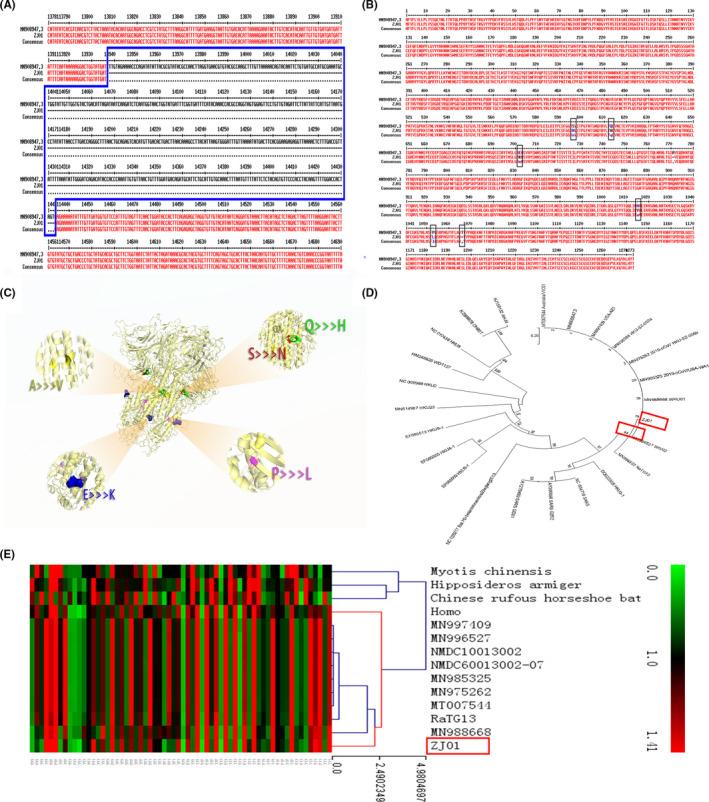
Among 465 COVID-19 patients, median age was 45 years, while hypertension, diabetes, and chronic liver disease were the most common comorbidities. History of exposure to the epidemic area was present in 170 (36.56%) and 185 (39.78%) patients were clustered in 77 families. Severe/critical-type of COVID-19 developed in 49 (10.54%) patients. Fever and cough were the most common symptoms, while diarrhea/vomiting was reported in 58 (12.47%) patients. Multivariate analysis revealed eight risk factors for severe/critical COVID-19. Glucocorticoids and antibiotics were administered to 60 (12.90%) and 218(46.88%) patients, respectively. Bioinformatics showed four single amino acid mutations and one amino acid position loss in SARS-CoV-2 from Zhejiang province, with more similarity to humans than to viruses.
CONCLUSIONS
SARS-CoV-2 showed virological mutations and more human transmission in Zhejiang province, indicating considerable epidemiological and clinical changes. Caution in glucocorticoid and antibiotics use is advisable.
背景
严重急性呼吸综合征冠状病毒 2(SARS-CoV-2)和相关的冠状病毒病(COVID-19)已在中国各地传播。以前的研究主要集中在其发源地武汉,由于选择偏倚,导致对疾病严重程度的高估。我们分析了浙江省的 465 例确诊病例,以确定 COVID-19 的流行病学、临床和病毒学特征。
方法
收集 2020 年 1 月 17 日至 2020 年 1 月 31 日 qRT-PCR 确诊 COVID-19 患者的流行病学、人口统计学、临床、实验室和管理数据,然后进行多变量逻辑回归分析,以确定严重/危重型 COVID-19 的独立预测因素,并对来自浙江省的 SARS-CoV-2 进行生物信息学分析。
结果
在 465 例 COVID-19 患者中,中位年龄为 45 岁,而高血压、糖尿病和慢性肝病是最常见的合并症。170 例(36.56%)有疫区暴露史,185 例(39.78%)患者聚集在 77 个家庭中。49 例(10.54%)患者发展为严重/危重型 COVID-19。发热和咳嗽是最常见的症状,而腹泻/呕吐见于 58 例(12.47%)患者。多变量分析显示,严重/危重型 COVID-19 有 8 个危险因素。60 例(12.90%)和 218 例(46.88%)患者分别接受了糖皮质激素和抗生素治疗。生物信息学显示,来自浙江省的 SARS-CoV-2 有 4 个单一氨基酸突变和 1 个氨基酸位置缺失,与人类的相似度高于与病毒的相似度。
结论
SARS-CoV-2 在浙江省显示出病毒学突变和更多的人际传播,表明其流行病学和临床特征发生了重大变化。使用糖皮质激素和抗生素时应谨慎。

 Zotero 插件