
实验进化:确定肺炎球菌定植过程中的选择压力
Experimental Evolution To Identify Selective Pressures during Pneumococcal Colonization.
作者信息
Cooper Vaughn S, Honsa Erin, Rowe Hannah, Deitrick Christopher, Iverson Amy R, Whittall Jonathan J, Neville Stephanie L, McDevitt Christopher A, Kietzman Colin, Rosch Jason W
机构信息
Department of Microbiology and Molecular Genetics, University of Pittsburgh School of Medicine, Pittsburgh, Pennsylvania, USA.
Center for Evolutionary Biology and Medicine, University of Pittsburgh School of Medicine, Pittsburgh, Pennsylvania, USA.
出版信息
mSystems. 2020 May 12;5(3):e00352-20. doi: 10.1128/mSystems.00352-20.
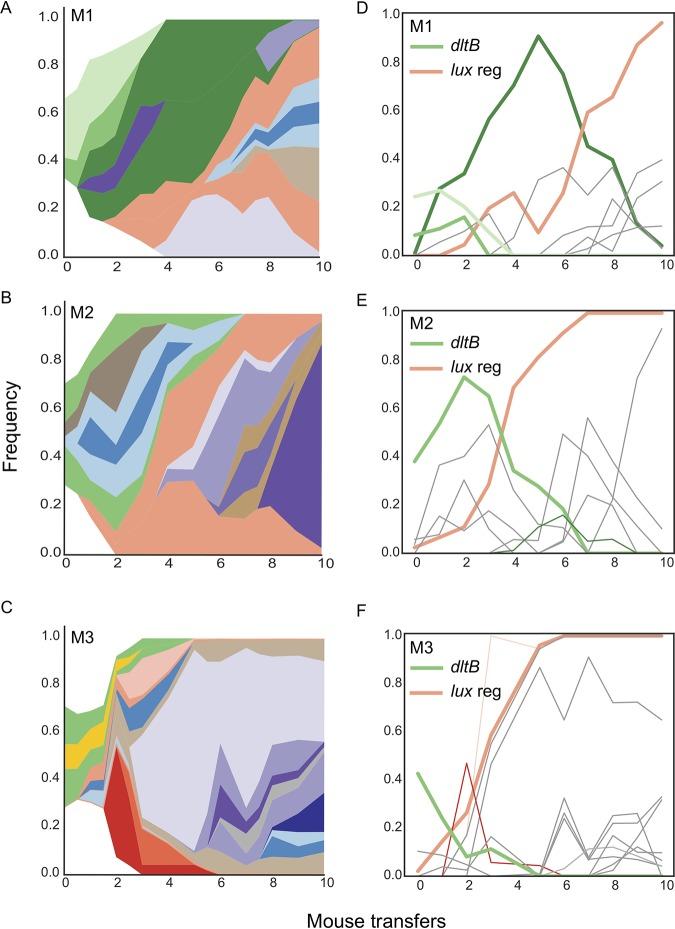
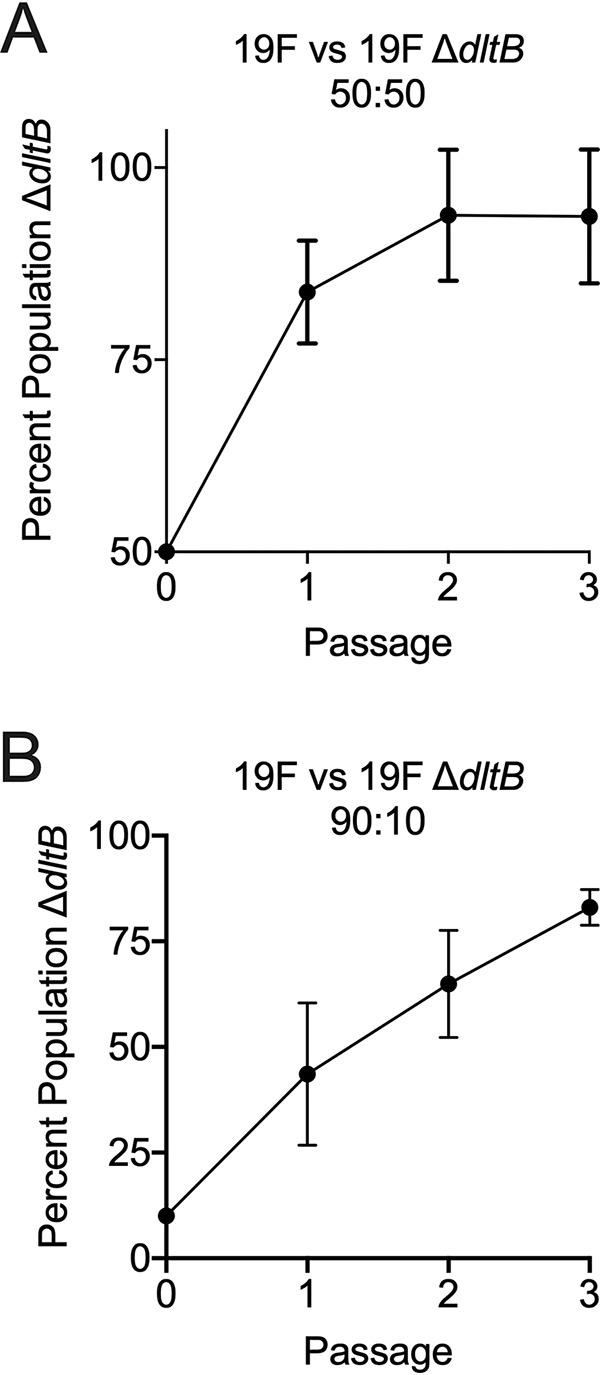
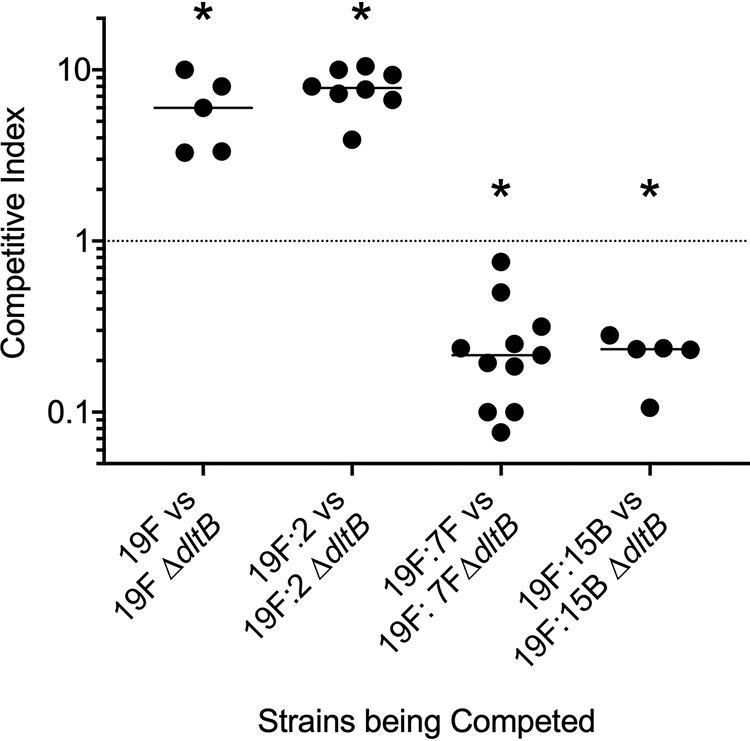
Experimental evolution is a powerful technique to understand how populations evolve from selective pressures imparted by the surrounding environment. With the advancement of whole-population genomic sequencing, it is possible to identify and track multiple contending genotypes associated with adaptations to specific selective pressures. This approach has been used repeatedly with model species , but only rarely Herein we report results of replicate experimentally evolved populations of propagated by repeated murine nasal colonization with the aim of identifying gene products under strong selection as well as the population genetic dynamics of infection cycles. Frameshift mutations in one gene, , responsible for incorporation of d-alanine into teichoic acids on the bacterial surface, evolved repeatedly and swept to high frequency. Targeted deletions of produced a fitness advantage during initial nasal colonization coupled with a corresponding fitness disadvantage in the lungs during pulmonary infection. The underlying mechanism behind the fitness trade-off between these two niches was found to be enhanced adherence to respiratory cells balanced by increased sensitivity to host-derived antimicrobial peptides, a finding recapitulated in the murine model. Additional mutations that are predicted to affect trace metal transport, central metabolism, and regulation of biofilm production and competence were also selected. These data indicate that experimental evolution can be applied to murine models of pathogenesis to gain insight into organism-specific tissue tropisms. Evolution is a powerful force that can be experimentally harnessed to gain insight into how populations evolve in response to selective pressures. Herein we tested the applicability of experimental evolutionary approaches to gain insight into how the major human pathogen responds to repeated colonization events using a murine model. These studies revealed the population dynamics of repeated colonization events and demonstrated that experimental evolution resulted in highly reproducible trajectories that reflect the environmental niche encountered during nasal colonization. Mutations impacting the surface charge of the bacteria were repeatedly selected during colonization and provided a fitness benefit in this niche that was counterbalanced by a corresponding fitness defect during lung infection. These data indicate that experimental evolution can be applied to models of pathogenesis to gain insight into organism-specific tissue tropisms.
实验进化是一种强大的技术,可用于了解种群如何在周围环境施加的选择压力下进化。随着全种群基因组测序技术的进步,识别和追踪与特定选择压力适应相关的多种竞争基因型成为可能。这种方法已在模式物种中反复使用,但很少用于[此处缺失相关内容]。在此,我们报告了通过重复小鼠鼻腔定植繁殖的实验进化种群的复制结果,目的是识别受到强烈选择的基因产物以及感染周期的种群遗传动态。一个负责将D - 丙氨酸掺入细菌表面磷壁酸的基因发生了移码突变,该突变反复出现并席卷至高频。对[此处缺失相关内容]的靶向缺失在初始鼻腔定植期间产生了适应性优势,而在肺部感染期间在肺部则产生了相应的适应性劣势。发现这两个生态位之间适应性权衡背后的潜在机制是对呼吸道细胞的粘附增强,同时对宿主来源的抗菌肽敏感性增加,这一发现也在小鼠模型中得到了印证。还选择了其他预计会影响微量金属运输、中心代谢以及生物膜产生和感受态调节的突变。这些数据表明,实验进化可应用于发病机制的小鼠模型,以深入了解特定生物体的组织嗜性。进化是一种强大的力量,可以通过实验来利用它,以深入了解种群如何响应选择压力而进化。在此,我们测试了实验进化方法的适用性,以利用小鼠模型深入了解主要人类病原体[此处缺失相关内容]如何应对反复的定植事件。这些研究揭示了反复定植事件的种群动态,并表明实验进化导致了高度可重复的轨迹,反映了鼻腔定植期间遇到的环境生态位。在定植过程中反复选择影响细菌表面电荷的突变,这些突变在该生态位中提供了适应性益处,但在肺部感染期间被相应的适应性缺陷所抵消。这些数据表明,实验进化可应用于发病机制模型,以深入了解特定生物体的组织嗜性。



 Zotero 插件