
国际免疫肿瘤生物标志物工作组关于肿瘤浸润淋巴细胞的计算评估报告。
Report on computational assessment of Tumor Infiltrating Lymphocytes from the International Immuno-Oncology Biomarker Working Group.
作者信息
Amgad Mohamed, Stovgaard Elisabeth Specht, Balslev Eva, Thagaard Jeppe, Chen Weijie, Dudgeon Sarah, Sharma Ashish, Kerner Jennifer K, Denkert Carsten, Yuan Yinyin, AbdulJabbar Khalid, Wienert Stephan, Savas Peter, Voorwerk Leonie, Beck Andrew H, Madabhushi Anant, Hartman Johan, Sebastian Manu M, Horlings Hugo M, Hudeček Jan, Ciompi Francesco, Moore David A, Singh Rajendra, Roblin Elvire, Balancin Marcelo Luiz, Mathieu Marie-Christine, Lennerz Jochen K, Kirtani Pawan, Chen I-Chun, Braybrooke Jeremy P, Pruneri Giancarlo, Demaria Sandra, Adams Sylvia, Schnitt Stuart J, Lakhani Sunil R, Rojo Federico, Comerma Laura, Badve Sunil S, Khojasteh Mehrnoush, Symmans W Fraser, Sotiriou Christos, Gonzalez-Ericsson Paula, Pogue-Geile Katherine L, Kim Rim S, Rimm David L, Viale Giuseppe, Hewitt Stephen M, Bartlett John M S, Penault-Llorca Frédérique, Goel Shom, Lien Huang-Chun, Loibl Sibylle, Kos Zuzana, Loi Sherene, Hanna Matthew G, Michiels Stefan, Kok Marleen, Nielsen Torsten O, Lazar Alexander J, Bago-Horvath Zsuzsanna, Kooreman Loes F S, van der Laak Jeroen A W M, Saltz Joel, Gallas Brandon D, Kurkure Uday, Barnes Michael, Salgado Roberto, Cooper Lee A D
机构信息
1Department of Biomedical Informatics, Emory University School of Medicine, Atlanta, GA USA.
2Department of Pathology, Herlev and Gentofte Hospital, University of Copenhagen, Herlev, Denmark.
出版信息
NPJ Breast Cancer. 2020 May 12;6:16. doi: 10.1038/s41523-020-0154-2. eCollection 2020.
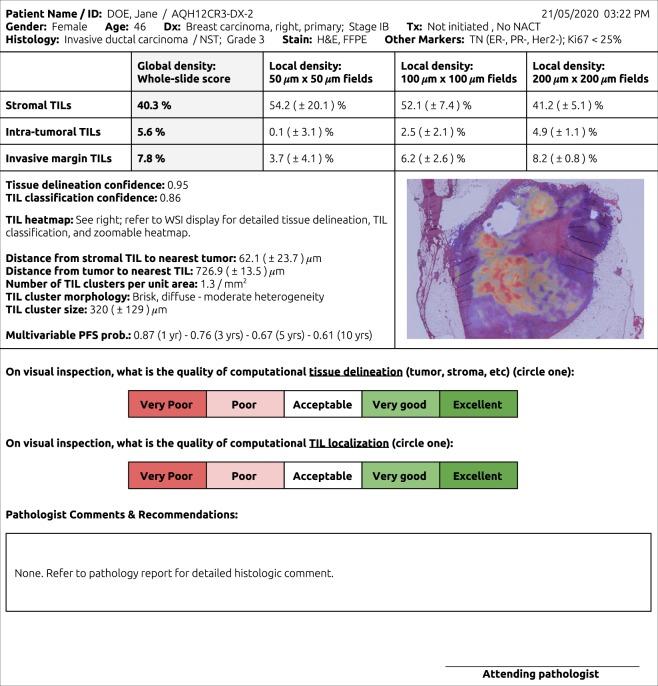
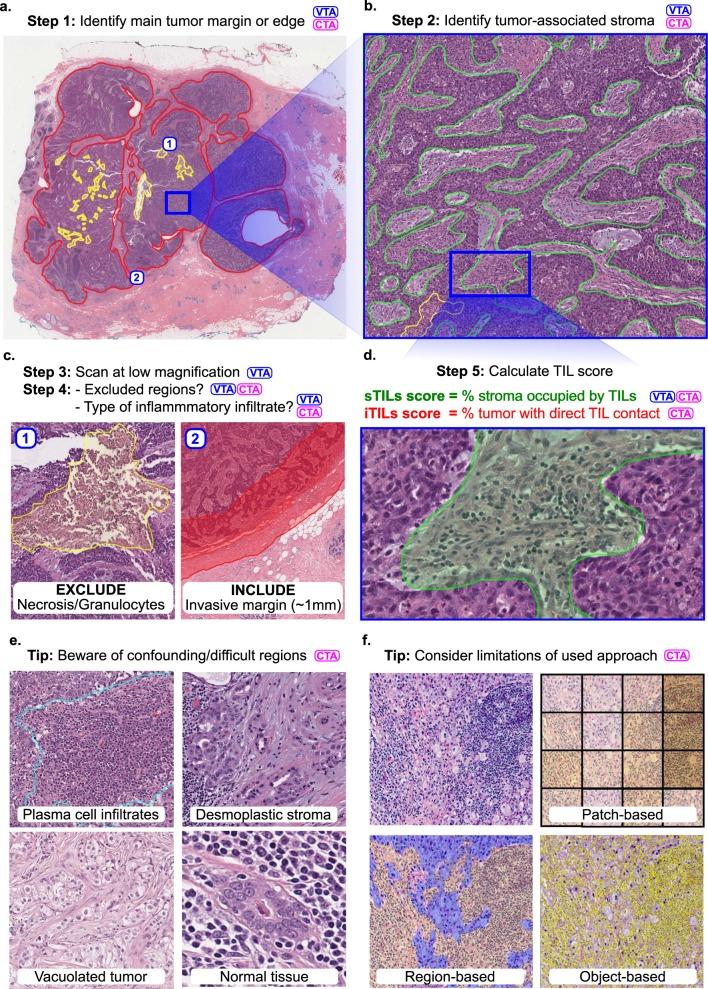
Assessment of tumor-infiltrating lymphocytes (TILs) is increasingly recognized as an integral part of the prognostic workflow in triple-negative (TNBC) and HER2-positive breast cancer, as well as many other solid tumors. This recognition has come about thanks to standardized visual reporting guidelines, which helped to reduce inter-reader variability. Now, there are ripe opportunities to employ computational methods that extract spatio-morphologic predictive features, enabling computer-aided diagnostics. We detail the benefits of computational TILs assessment, the readiness of TILs scoring for computational assessment, and outline considerations for overcoming key barriers to clinical translation in this arena. Specifically, we discuss: 1. ensuring computational workflows closely capture visual guidelines and standards; 2. challenges and thoughts standards for assessment of algorithms including training, preanalytical, analytical, and clinical validation; 3. perspectives on how to realize the potential of machine learning models and to overcome the perceptual and practical limits of visual scoring.
肿瘤浸润淋巴细胞(TILs)评估日益被视为三阴性乳腺癌(TNBC)和HER2阳性乳腺癌以及许多其他实体瘤预后工作流程的一个组成部分。这种认可得益于标准化的视觉报告指南,该指南有助于减少阅片者之间的差异。现在,利用计算方法提取空间形态学预测特征以实现计算机辅助诊断的时机已经成熟。我们详细阐述了计算TILs评估的益处、TILs评分用于计算评估的准备情况,并概述了克服该领域临床转化关键障碍的注意事项。具体而言,我们讨论:1. 确保计算工作流程紧密遵循视觉指南和标准;2. 算法评估标准面临的挑战及思考,包括训练、分析前、分析和临床验证;3. 关于如何实现机器学习模型的潜力以及克服视觉评分的感知和实际限制的观点。
 Zotero 插件