
人群药代动力学和氯喹在间日疟原虫志愿者感染研究中的药效动力学。
Population Pharmacokinetics and Pharmacodynamics of Chloroquine in a Plasmodium vivax Volunteer Infection Study.
机构信息
QIMR Berghofer Medical Research Institute, Brisbane, Australia.
Medicines for Malaria Venture, Geneva, Switzerland.
出版信息
Clin Pharmacol Ther. 2020 Nov;108(5):1055-1066. doi: 10.1002/cpt.1893. Epub 2020 Jul 2.
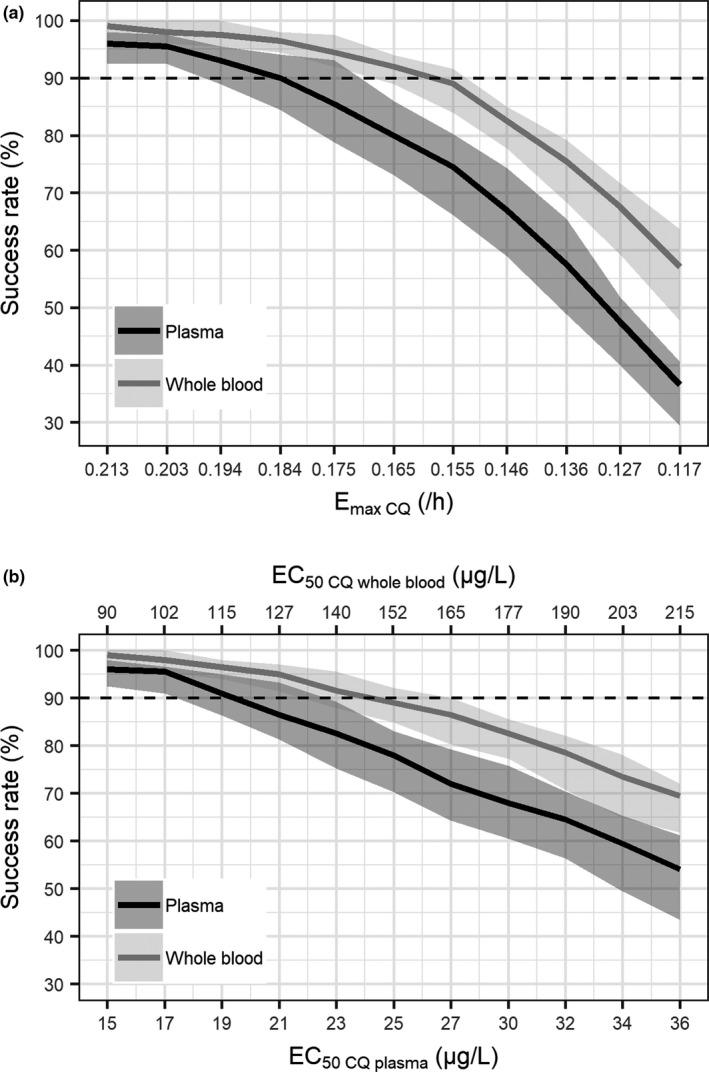
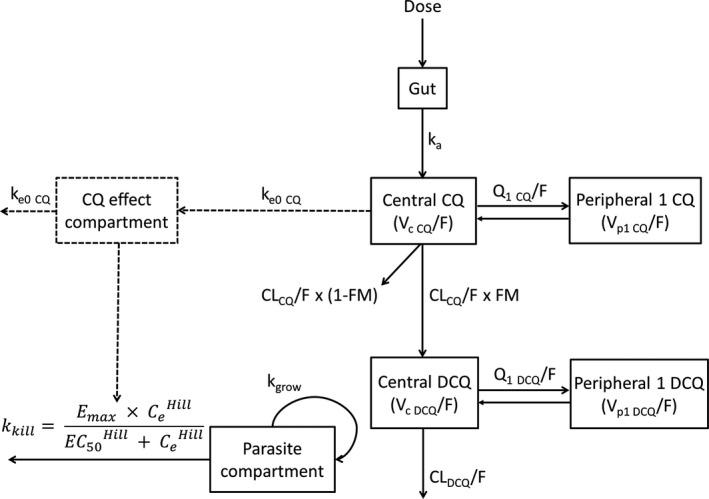
Chloroquine has been used for the treatment of malaria for > 70 years; however, chloroquine pharmacokinetic (PK) and pharmacodynamic (PD) profile in Plasmodium vivax malaria is poorly understood. The objective of this study was to describe the PK/PD relationship of chloroquine and its major metabolite, desethylchloroquine, in a P. vivax volunteer infection study. We analyzed data from 24 healthy subjects who were inoculated with blood-stage P. vivax malaria and administered a standard treatment course of chloroquine. The PK of chloroquine and desethylchloroquine was described by a two-compartment model with first-order absorption and elimination. The relationship between plasma and whole blood concentrations of chloroquine and P. vivax parasitemia was characterized by a PK/PD delayed response model, where the equilibration half-lives were 32.7 hours (95% confidence interval (CI) 27.4-40.5) for plasma data and 24.1 hours (95% CI 19.0-32.7) for whole blood data. The estimated parasite multiplication rate was 17 folds per 48 hours (95% CI 14-20) and maximum parasite killing rate by chloroquine was 0.213 hour (95% CI 0.196-0.230), translating to a parasite clearance half-life of 4.5 hours (95% CI 4.1-5.0) and a parasite reduction ratio of 400 every 48 hours (95% CI 320-500). This is the first study that characterized the PK/PD relationship between chloroquine plasma and whole blood concentrations and P. vivax clearance using a semimechanistic population PK/PD modeling. This PK/PD model can be used to optimize dosing scenarios and to identify optimal dosing regimens for chloroquine where resistance to chloroquine is increasing.
氯喹已用于治疗疟疾超过 70 年;然而,人们对间日疟原虫感染中氯喹的药代动力学(PK)和药效动力学(PD)特征了解甚少。本研究的目的是描述间日疟原虫志愿者感染研究中氯喹及其主要代谢物去乙基氯喹的 PK/PD 关系。我们分析了 24 名健康受试者的数据,这些受试者接种了间日疟原虫血期疟原虫并接受了标准的氯喹治疗疗程。氯喹和去乙基氯喹的 PK 采用具有一级吸收和消除的两室模型进行描述。血浆和全血中氯喹浓度与间日疟原虫寄生虫血症之间的关系由 PK/PD 延迟反应模型描述,其中平衡半衰期分别为 32.7 小时(95%置信区间(CI)27.4-40.5)和 24.1 小时(95%CI 19.0-32.7)。估计的寄生虫倍增率为每 48 小时 17 倍(95%CI 14-20),氯喹的最大寄生虫杀伤率为 0.213 小时(95%CI 0.196-0.230),这转化为寄生虫清除半衰期为 4.5 小时(95%CI 4.1-5.0)和寄生虫减少率为每 48 小时 400(95%CI 320-500)。这是第一项使用半机械 PK/PD 模型描述氯喹血浆和全血浓度与间日疟原虫清除之间 PK/PD 关系的研究。该 PK/PD 模型可用于优化给药方案,并确定氯喹的最佳给药方案,因为氯喹的耐药性正在增加。


 Zotero 插件