
晚期非小细胞肺癌患者中抗 PD-1 和抗 PD-L1 抗体免疫检查点抑制剂再挑战时的给药切换:病例系列和文献复习。
Switching administration of anti-PD-1 and anti-PD-L1 antibodies as immune checkpoint inhibitor rechallenge in individuals with advanced non-small cell lung cancer: Case series and literature review.
机构信息
Department of Thoracic Oncology and Respiratory Medicine, Tokyo Metropolitan Cancer and Infectious Diseases Center Komagome Hospital, Tokyo, Japan.
出版信息
Thorac Cancer. 2020 Jul;11(7):1927-1933. doi: 10.1111/1759-7714.13483. Epub 2020 May 18.
BACKGROUND
Based on several phase III studies, immune checkpoint inhibitors (ICIs) are essential and promising drugs for the treatment of non-small cell lung cancer (NSCLC). However, in patients previously treated with ICI, the efficacy and safety of rechallenging the same or another type of ICI inhibitor remain unclear. Moreover, clinical data about the efficacy of switching the administration of anti-programmed death-1 (PD-1) antibodies (e.g. nivolumab, pembrolizumab) and anti-programmed death-ligand 1 (PD-L1) antibodies (e.g. atezolizumab) as ICI rechallenge are limited. Thus, the current study aimed to evaluate the efficacy and safety of such treatment strategy in NSCLC patients.
METHODS
We retrospectively reviewed the medical records of 17 patients with advanced or recurrent NSCLC who received both anti-PD-1 and anti-PD-L1 antibodies during their clinical courses.
RESULTS
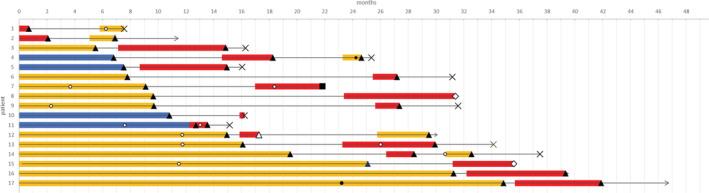
Among the 17 patients, one (5.9%) and nine (52.9%) achieved partial response and stable disease, respectively, after ICI rechallenge. The median progression-free survival of ICI rechallenge in these patients was 4.0 (range: 0.4-8.0) months, and the median overall survival from the start of the initial ICI was 31.0 (range: 7.6-46.8) months. Of the 10 patients who developed immune-related adverse events (irAEs) during the first ICI treatment, five presented with these events after the readministration of ICI. Among them, four experienced relapsed irAEs and two patients had pneumonitis, which is a grade 3 or higher irAE. Almost all irAEs during the rechallenge treatment were manageable.
CONCLUSIONS
Switching the administration of anti-PD-1 and anti-PD-L1 antibodies as ICI rechallenge could be a treatment option for some NSCLC patients.
KEY POINTS
• Significant findings of the study In this study, switching the administration of anti-PD-1 and anti-PD-L1 antibodies as ICI rechallenge could be an effective and safe treatment option for some patients with advanced or recurrent NSCLC. • What this study adds Switching the administration of ICI may increase the efficacy of readministration. However, the mechanism is unknown. Thus, further accumulation of cases is required, and extensive investigations must be conducted to elucidate the mechanism and benefits of such treatment.
背景
基于几项 III 期研究结果,免疫检查点抑制剂(ICI)是治疗非小细胞肺癌(NSCLC)的重要且有前景的药物。然而,对于先前接受过 ICI 治疗的患者,再次使用相同或另一种类型的 ICI 抑制剂的疗效和安全性尚不清楚。此外,关于切换使用抗程序性死亡-1(PD-1)抗体(如 nivolumab、pembrolizumab)和抗程序性死亡配体 1(PD-L1)抗体(如 atezolizumab)作为 ICI 再挑战的临床数据也很有限。因此,本研究旨在评估 NSCLC 患者接受这种治疗策略的疗效和安全性。
方法
我们回顾性分析了 17 例在其临床过程中接受过抗 PD-1 和抗 PD-L1 抗体治疗的晚期或复发性 NSCLC 患者的病历。
结果
在这 17 例患者中,1 例(5.9%)和 9 例(52.9%)在 ICI 再挑战后分别获得部分缓解和疾病稳定。这些患者的 ICI 再挑战的中位无进展生存期为 4.0(范围:0.4-8.0)个月,从初始 ICI 开始的中位总生存期为 31.0(范围:7.6-46.8)个月。在 10 例首次 ICI 治疗中发生免疫相关不良事件(irAE)的患者中,有 5 例在 ICI 再给药后出现这些事件。其中,4 例出现复发 irAE,2 例患者发生肺炎,这是一种 3 级或更高级别的 irAE。几乎所有再挑战治疗中的 irAE 都可管理。
结论
切换使用抗 PD-1 和抗 PD-L1 抗体作为 ICI 再挑战可能是一些 NSCLC 患者的一种治疗选择。
关键要点
研究的显著发现:在这项研究中,切换使用抗 PD-1 和抗 PD-L1 抗体作为 ICI 再挑战可能是治疗晚期或复发性 NSCLC 患者的一种有效且安全的治疗选择。
本研究增加的内容:ICI 的给药切换可能会提高再给药的疗效。然而,其机制尚不清楚。因此,需要进一步积累病例,并进行广泛的研究以阐明这种治疗的机制和益处。
 Zotero 插件