
衰老过程中的卫星细胞:用进废退。
Satellite cells in ageing: use it or lose it.
机构信息
Sprott Centre for Stem Cell Research, Regenerative Medicine Program, Ottawa Hospital Research Institute, Ottawa, Ontario, Canada K1H 8L6.
Department of Cellular and Molecular Medicine, Faculty of Medicine, University of Ottawa, Ottawa, Ontario, Canada K1H 8M5.
出版信息
Open Biol. 2020 May;10(5):200048. doi: 10.1098/rsob.200048. Epub 2020 May 20.
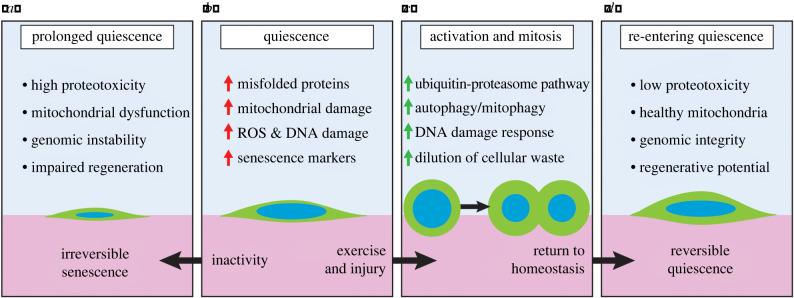
Individuals that maintain healthy skeletal tissue tend to live healthier, happier lives as proper muscle function enables maintenance of independence and actuation of autonomy. The onset of skeletal muscle decline begins around the age of 30, and muscle atrophy is associated with a number of serious morbidities and mortalities. Satellite cells are responsible for regeneration of skeletal muscle and enter a reversible non-dividing state of quiescence under homeostatic conditions. In response to injury, satellite cells are able to activate and re-enter the cell cycle, creating new cells to repair and create nascent muscle fibres while preserving a small population that can return to quiescence for future regenerative demands. However, in aged muscle, satellite cells that experience prolonged quiescence will undergo programmed cellular senescence, an irreversible non-dividing state that handicaps the regenerative capabilities of muscle. This review examines how periodic activation and cycling of satellite cells through exercise can mitigate senescence acquisition and myogenic decline.
维持健康骨骼组织的个体往往生活更健康、更快乐,因为适当的肌肉功能可以维持独立性并实现自主性。骨骼肌衰退始于 30 岁左右,肌肉萎缩与许多严重的疾病和死亡率有关。卫星细胞负责骨骼肌肉的再生,在体内平衡条件下进入可逆的非分裂静止状态。在受到损伤时,卫星细胞能够激活并重新进入细胞周期,产生新的细胞来修复和形成新生的肌肉纤维,同时保留一小部分细胞可以返回静止状态以备未来的再生需求。然而,在衰老的肌肉中,经历长期静止的卫星细胞会经历程序性细胞衰老,这是一种不可逆的非分裂状态,会削弱肌肉的再生能力。本综述探讨了通过运动周期性地激活和循环卫星细胞如何减轻衰老的发生和肌肉减少。

 Zotero 插件