
吡非尼酮通过调节 Wnt/GSK-3β/β-catenin 和 TGF-β1/Smad2/3 信号通路缓解肺纤维化的发生发展。
Pirfenidone alleviates pulmonary fibrosis in vitro and in vivo through regulating Wnt/GSK-3β/β-catenin and TGF-β1/Smad2/3 signaling pathways.
机构信息
Department of Pneumology, The Affiliated Hospital of Hangzhou Normal University, No. 126, Wenzhou Road, Hangzhou, 31000, Zhejiang, China.
出版信息
Mol Med. 2020 May 24;26(1):49. doi: 10.1186/s10020-020-00173-3.
BACKGROUND
Pirfenidone (PFD) is effective for pulmonary fibrosis (PF), but its action mechanism has not been fully explained. This study explored the signaling pathways involved in anti-fibrosis role of PFD, thus laying a foundation for clinical application.
METHODS
Pulmonary fibrosis mice models were constructed by bleomycin (BLM), and TGF-β1 was used to treat human fetal lung fibroblasts (HLFs). Then, PFD was added into treated mice and cells alone or in combination with β-catenin vector. The pathological changes, inflammatory factors levels, and Collagen I levels in mice lung tissues were assessed, as well as the activity of HLFs was measured. Levels of indices related to extracellular matrix, epithelial-mesenchymal transition (EMT), Wnt/GSK-3β/β-catenin and TGF-β1/Smad2/3 signaling pathways were determined in tissues or cells.
RESULTS
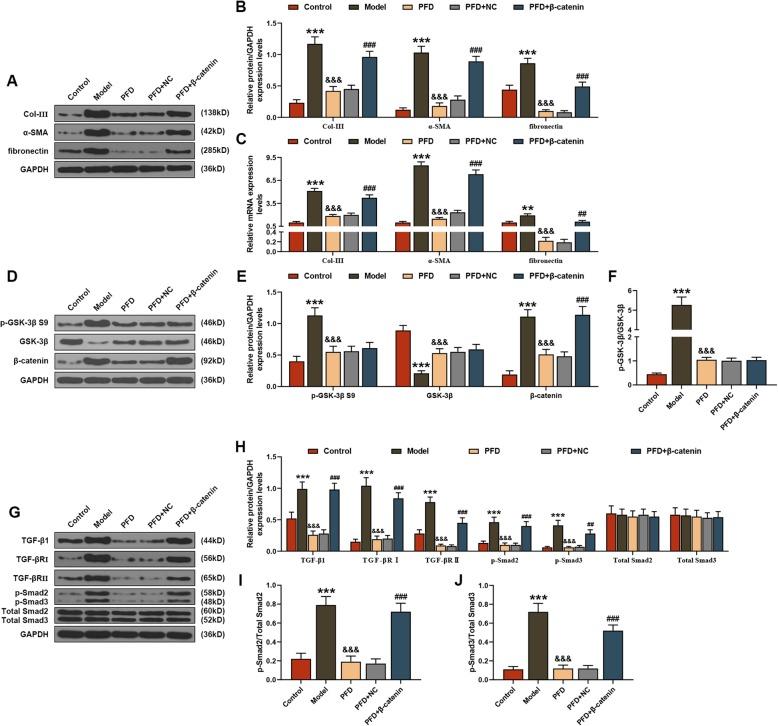
After treatment with BLM, the inflammatory reaction and extracellular matrix deposition in mice lung tissues were serious, which were alleviated by PFD and aggravated by the addition of β-catenin. In HLFs, PFD reduced the activity of HLFs induced by TGF-β1, inhibited levels of vimentin and N-cadherin and promoted levels of E-cadherin, whereas β-catenin produced the opposite effects to PFD. In both tissues and cells, Wnt/GSK-3β/β-catenin and TGF-β1/Smad2/3 signaling pathways were activated, which could be suppressed by PFD.
CONCLUSIONS
PFD alleviated pulmonary fibrosis in vitro and in vivo through regulating Wnt/GSK-3β/β-catenin and TGF-β1/Smad2/3 signaling pathways, which might further improve the action mechanism of anti-fibrosis effect of PFD.
背景
吡非尼酮(PFD)对肺纤维化(PF)有效,但作用机制尚未完全阐明。本研究探讨了 PFD 抗纤维化作用涉及的信号通路,为临床应用奠定了基础。
方法
通过博来霉素(BLM)构建肺纤维化小鼠模型,并用人胎儿肺成纤维细胞(HLFs)用 TGF-β1 处理。然后,单独或联合β-catenin 载体将 PFD 加入到处理的小鼠和细胞中。评估小鼠肺组织的病理变化、炎症因子水平和胶原 I 水平,以及 HLFs 的活性。测定组织或细胞中与细胞外基质、上皮间质转化(EMT)、Wnt/GSK-3β/β-catenin 和 TGF-β1/Smad2/3 信号通路相关的指标水平。
结果
用 BLM 处理后,小鼠肺组织中的炎症反应和细胞外基质沉积严重,PFD 缓解,β-catenin 加重。在 HLFs 中,PFD 降低了 TGF-β1 诱导的 HLFs 活性,抑制了波形蛋白和 N-钙粘蛋白的水平,促进了 E-钙粘蛋白的水平,而β-catenin 则产生了与 PFD 相反的作用。在组织和细胞中,Wnt/GSK-3β/β-catenin 和 TGF-β1/Smad2/3 信号通路被激活,可被 PFD 抑制。
结论
PFD 通过调节 Wnt/GSK-3β/β-catenin 和 TGF-β1/Smad2/3 信号通路,减轻了体外和体内的肺纤维化,可能进一步改善了 PFD 的抗纤维化作用机制。



 Zotero 插件