
异二聚体 IL-15 通过涉及 XCL1、IFN-γ、CXCL9 和 CXCL10 的细胞因子网络延迟肿瘤生长并促进肿瘤内 CTL 和树突状细胞积累。
Heterodimeric IL-15 delays tumor growth and promotes intratumoral CTL and dendritic cell accumulation by a cytokine network involving XCL1, IFN-γ, CXCL9 and CXCL10.
机构信息
Human Retrovirus Pathogenesis Section, Vaccine Branch, Center for Cancer Research, National Cancer Institute at Frederick, Frederick, Maryland, USA.
Human Retrovirus Section, Vaccine Branch, Center for Cancer Research, National Cancer Institute at Frederick, Frederick, Maryland, USA.
出版信息
J Immunother Cancer. 2020 May;8(1). doi: 10.1136/jitc-2020-000599.
BACKGROUND
Interleukin-15 (IL-15) promotes growth and activation of cytotoxic CD8 T and natural killer (NK) cells. Bioactive IL-15 is produced in the body as a heterodimeric cytokine, comprising the IL-15 and IL-15 receptor alpha chains (hetIL-15). Several preclinical models support the antitumor activity of hetIL-15 promoting its application in clinical trials.
METHODS
The antitumor activity of hetIL-15 produced from mammalian cells was tested in mouse tumor models (MC38 colon carcinoma and TC-1 epithelial carcinoma). The functional diversity of the immune infiltrate and the cytokine/chemokine network within the tumor was evaluated by flow cytometry, multicolor immunohistochemistry (IHC), gene expression profiling by Nanostring Technologies, and protein analysis by electrochemiluminescence and ELISA assays.
RESULTS
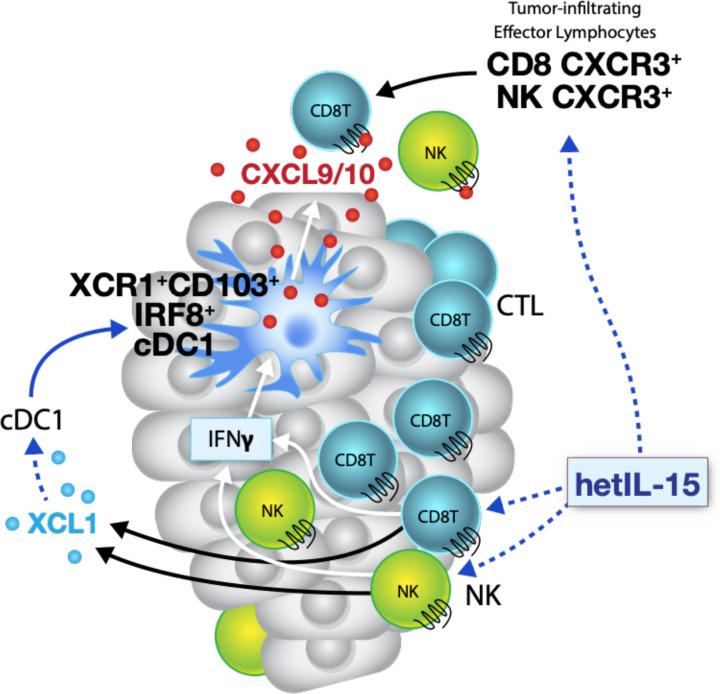
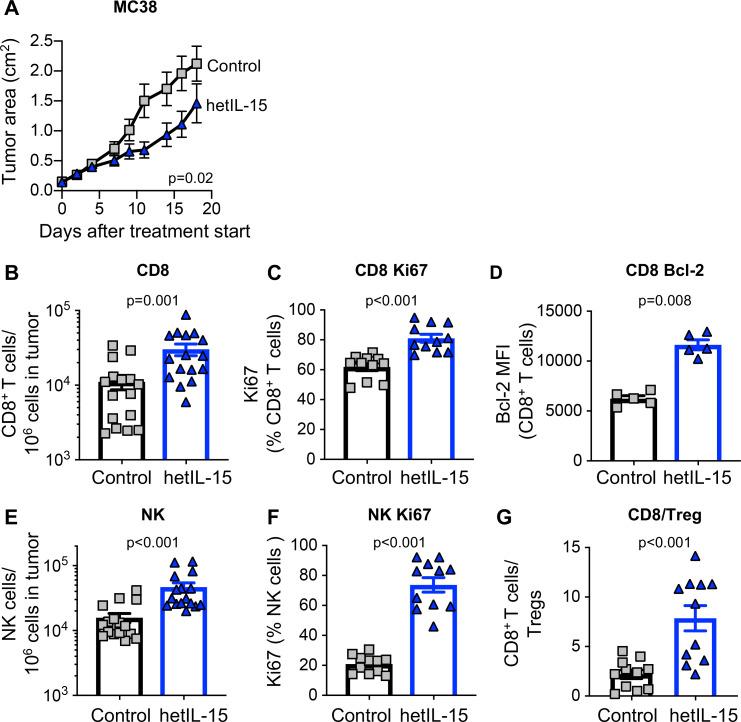
hetIL-15 treatment resulted in delayed primary tumor growth. Increased NK and CD8 T cell tumoral infiltration with an increased CD8/Treg ratio were found by flow cytometry and IHC in hetIL-15 treated animals. Intratumoral NK and CD8 T cells showed activation features with enhanced interferon-γ (IFN-γ) production, proliferation (Ki67), cytotoxic potential (Granzyme B) and expression of the survival factor Bcl-2. Transcriptomics and proteomics analyses revealed complex effects on the tumor microenvironment triggered by hetIL-15 therapy, including increased levels of IFN-γ and XCL1 with intratumoral accumulation of XCR1IRF8CD103 conventional type 1 dendritic cells (cDC1). Concomitantly, the production of the chemokines CXCL9 and CXCL10 by tumor-localized myeloid cells, including cDC1, was boosted by hetIL-15 in an IFN-γ-dependent manner. An increased frequency of circulating CXCR3 NK and CD8 T cells was found, suggesting their ability to migrate toward the tumors following the CXCL9 and CXCL10 chemokine gradient.
CONCLUSIONS
Our results show that hetIL-15 administration enhances T cell entry into tumors, increasing the success rate of immunotherapy interventions. Our study further supports the incorporation of hetIL-15 in tumor immunotherapy approaches to promote the development of antitumor responses by favoring effector over regulatory cells and by promoting lymphocyte and DC localization into tumors through the modification of the tumor chemokine and cytokine milieu.
背景
白细胞介素-15(IL-15)促进细胞毒性 CD8 T 细胞和自然杀伤(NK)细胞的生长和激活。生物活性的 IL-15 作为一种异二聚体细胞因子在体内产生,由 IL-15 和 IL-15 受体α链(hetIL-15)组成。几种临床前模型支持 hetIL-15 的抗肿瘤活性,促进了其在临床试验中的应用。
方法
在小鼠肿瘤模型(MC38 结肠癌细胞和 TC-1 上皮癌细胞)中测试了哺乳动物细胞产生的 hetIL-15 的抗肿瘤活性。通过流式细胞术、多色免疫组织化学(IHC)、Nanostring 技术的基因表达谱分析以及电化学发光和 ELISA 测定法对肿瘤内免疫浸润的功能多样性和细胞因子/趋化因子网络进行了评估。
结果
hetIL-15 治疗导致原发性肿瘤生长延迟。通过流式细胞术和 IHC 在 hetIL-15 治疗动物中发现 NK 和 CD8 T 细胞肿瘤浸润增加,CD8/Treg 比值增加。肿瘤内 NK 和 CD8 T 细胞表现出激活特征,IFN-γ(IFN-γ)产生、增殖(Ki67)、细胞毒性潜力(Granzyme B)和生存因子 Bcl-2 表达增强。转录组学和蛋白质组学分析显示,hetIL-15 治疗引发了肿瘤微环境的复杂影响,包括 IFN-γ和 XCL1 水平升高,肿瘤内 XCR1IRF8CD103 常规 1 型树突状细胞(cDC1)积累。同时,hetIL-15 以 IFN-γ依赖性方式增强了肿瘤定位的髓样细胞(包括 cDC1)产生趋化因子 CXCL9 和 CXCL10。发现循环 CXCR3 NK 和 CD8 T 细胞的频率增加,表明它们能够在 CXCL9 和 CXCL10 趋化因子梯度的作用下迁移到肿瘤中。
结论
我们的结果表明,hetIL-15 的给药增强了 T 细胞进入肿瘤,提高了免疫治疗干预的成功率。我们的研究进一步支持将 hetIL-15 纳入肿瘤免疫治疗方法,通过促进效应细胞而不是调节细胞,并通过改变肿瘤趋化因子和细胞因子环境促进淋巴细胞和 DC 定位于肿瘤,从而促进抗肿瘤反应的发展。


 Zotero 插件