The Smidt Heart Institute, Cedars-Sinai Health System Los Angeles CA.
Enterprise Information Systems Data Intelligence Team Cedars-Sinai Health System Los Angeles CA.
J Am Heart Assoc. 2020 Jun 16;9(12):e017144. doi: 10.1161/JAHA.120.017144. Epub 2020 May 28.
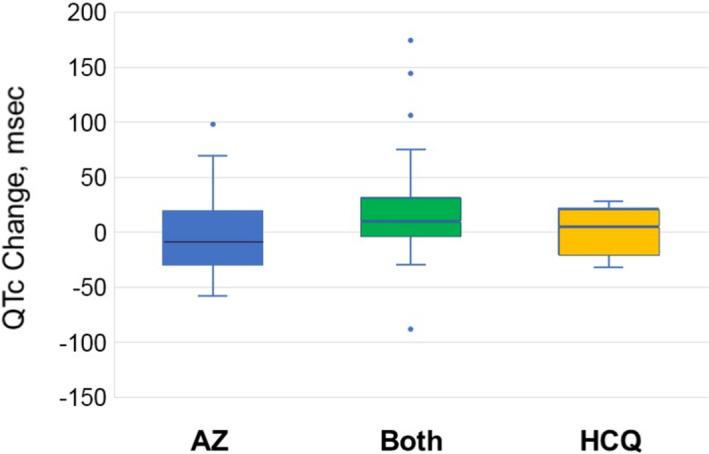
Background Despite a lack of clinical evidence, hydroxychloroquine and azithromycin are being administered widely to patients with verified or suspected coronavirus disease 2019 (COVID-19). Both drugs may increase risk of lethal arrhythmias associated with QT interval prolongation. Methods and Results We analyzed a case series of COVID-19-positive/suspected patients admitted between February 1, 2020, and April 4, 2020, who were treated with azithromycin, hydroxychloroquine, or a combination of both drugs. We evaluated baseline and postmedication QT interval (corrected QT interval [QTc]; Bazett) using 12-lead ECGs. Critical QTc prolongation was defined as follows: (1) maximum QTc ≥500 ms (if QRS <120 ms) or QTc ≥550 ms (if QRS ≥120 ms) and (2) QTc increase of ≥60 ms. Tisdale score and Elixhauser comorbidity index were calculated. Of 490 COVID-19-positive/suspected patients, 314 (64%) received either/both drugs and 98 (73 COVID-19 positive and 25 suspected) met study criteria (age, 62±17 years; 61% men). Azithromycin was prescribed in 28%, hydroxychloroquine in 10%, and both in 62%. Baseline mean QTc was 448±29 ms and increased to 459±36 ms (=0.005) with medications. Significant prolongation was observed only in men (18±43 ms versus -0.2±28 ms in women; =0.02). A total of 12% of patients reached critical QTc prolongation. Changes in QTc were highest with the combination compared with either drug, with much greater prolongation with combination versus azithromycin (17±39 ms versus 0.5±40 ms; =0.07). No patients manifested torsades de pointes. Conclusions Overall, 12% of patients manifested critical QTc prolongation, and the combination caused greater prolongation than either drug alone. The balance between uncertain benefit and potential risk when treating COVID-19 patients should be carefully assessed.
尽管缺乏临床证据,但羟氯喹和阿奇霉素仍被广泛用于确诊或疑似 2019 年冠状病毒病(COVID-19)患者。这两种药物均可能增加与 QT 间期延长相关的致命性心律失常风险。
我们分析了 2020 年 2 月 1 日至 4 月 4 日期间收治的 COVID-19 阳性/疑似患者的病例系列,这些患者接受了阿奇霉素、羟氯喹或两者联合治疗。我们使用 12 导联心电图评估了基线和用药后的 QT 间期(校正 QT 间期[QTc];Bazett)。临界 QTc 延长定义如下:(1)最大 QTc≥500 ms(如果 QRS<120 ms)或 QTc≥550 ms(如果 QRS≥120 ms)和(2)QTc 增加≥60 ms。计算了 Tisdale 评分和 Elixhauser 合并症指数。在 490 例 COVID-19 阳性/疑似患者中,314 例(64%)接受了一种或两种药物治疗,98 例(73 例 COVID-19 阳性和 25 例疑似)符合研究标准(年龄 62±17 岁;61%为男性)。阿奇霉素的处方率为 28%,羟氯喹为 10%,两者联合应用为 62%。基线平均 QTc 为 448±29 ms,用药后增加至 459±36 ms(=0.005)。仅在男性中观察到显著延长(18±43 ms 与女性的-0.2±28 ms;=0.02)。共有 12%的患者达到临界 QTc 延长。与单一药物相比,联合用药时 QTc 的变化最大,与阿奇霉素相比,联合用药时的延长更为显著(17±39 ms 与 0.5±40 ms;=0.07)。没有患者出现尖端扭转型室性心动过速。
总体而言,有 12%的患者出现临界 QTc 延长,联合用药比单独用药引起的延长更明显。在治疗 COVID-19 患者时,应谨慎评估不确定的获益与潜在风险之间的平衡。


 Zotero 插件